


BIS Standards: BIS Certificate Full Form & BIS Mark Guide
Introduction
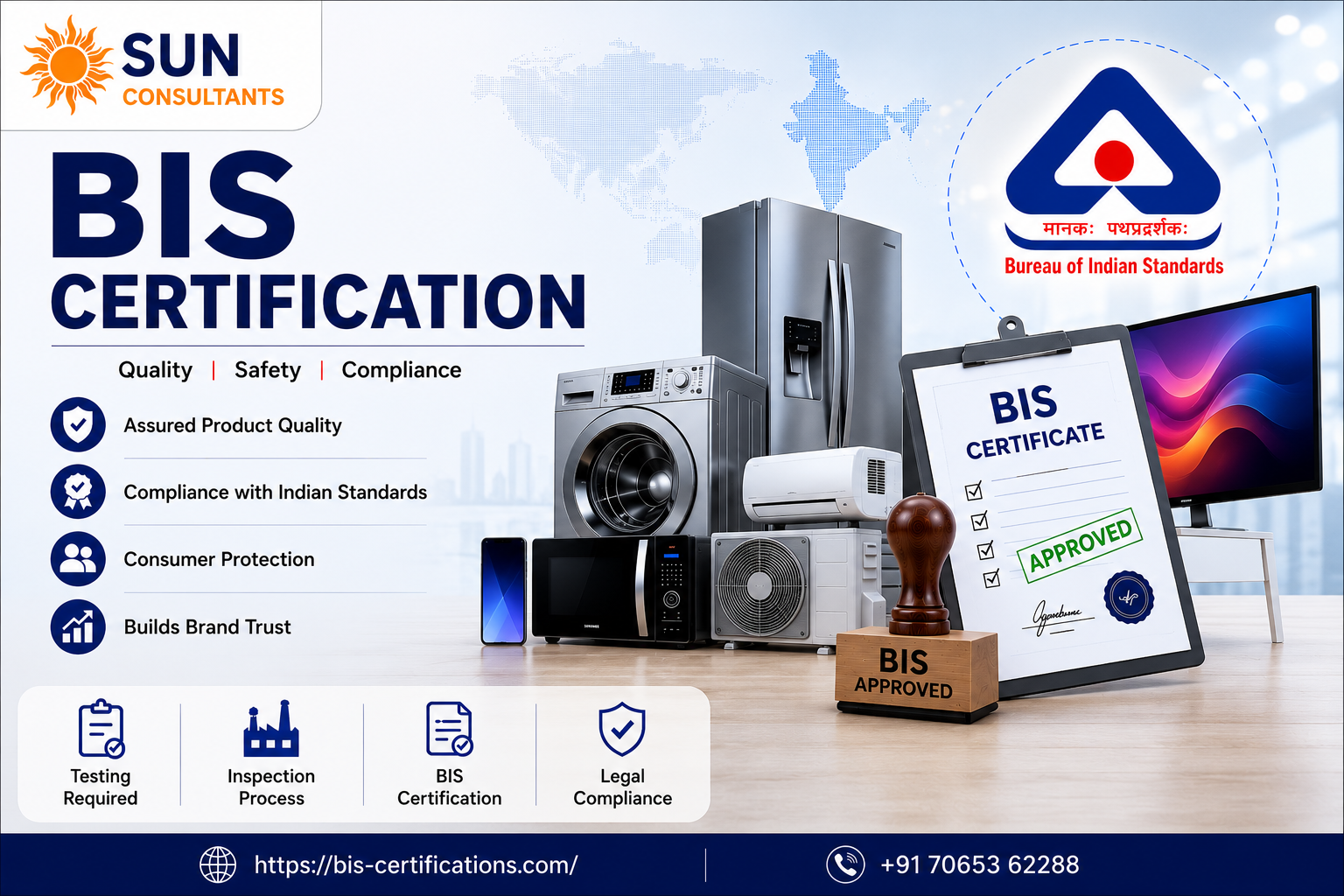
Ensuring product quality and safety is essential for manufacturers, importers, and consumers alike. In India, the BIS Standards established by the Bureau of Indian Standards provide a framework to ensure that products meet specific quality, safety, and performance requirements. Whether you manufacture electrical equipment, construction materials, household appliances, or consumer goods, understanding the role of BIS certification is crucial. In this guide, we'll explain the BIS Certificate Full Form, What is BIS Certificate, the significance of the BIS Mark, and why complying with BIS Standards is important for doing business in India.
What is BIS Certificate?
The first question many businesses ask is, What is BIS Certificate? A BIS Certificate is an official certification issued by the Bureau of Indian Standards (BIS) that confirms a product complies with the applicable Indian Standards. It assures consumers that the product has been tested and verified for quality, safety, and reliability. Several products in India require mandatory BIS certification before they can be manufactured, imported, or sold. These requirements are notified through various Quality Control Orders (QCOs) issued by the Government of India. Obtaining a BIS Certificate is not just about meeting legal requirements—it also strengthens consumer trust and improves the reputation of a business.
BIS Certificate Full Form
The BIS Certificate Full Form refers to the certification granted by the Bureau of Indian Standards, India's national standards authority. BIS was established under the Bureau of Indian Standards Act, 2016 and functions under the Ministry of Consumer Affairs, Food and Public Distribution.
Its primary objectives include:
-
Developing Indian Standards
-
Certifying products
-
Ensuring consumer safety
-
Promoting product quality
-
Supporting industrial growth
-
Encouraging standardization across industries
The BIS certification system helps maintain uniform quality standards throughout the country.
What are BIS Standards?
BIS Standards are officially recognized technical specifications developed by the Bureau of Indian Standards. These standards define the requirements related to:
-
Product quality
-
Safety
-
Performance
-
Design
-
Manufacturing process
-
Testing methods
-
Packaging
-
Labelling
Each standard is assigned an IS (Indian Standard) number. For example:
-
IS 302 – Electrical Appliances
-
IS 1786 – Steel Bars
-
IS 15644 – Toys
-
IS 1470 – Cement Products
Manufacturers must ensure their products comply with the applicable BIS Standards before applying for certification.
Importance of BIS Standards
Following BIS Standards offers several advantages for businesses and consumers.
Ensures Product Safety
Products manufactured according to BIS Standards undergo testing to verify that they are safe for use.
Maintains Consistent Quality
Standardized manufacturing practices help deliver consistent product performance.
Supports Regulatory Compliance
Many products are legally required to comply with BIS Standards before entering the Indian market.
Improves Consumer Confidence
Certified products are generally viewed as more reliable and trustworthy.
Enhances Business Reputation
Companies that follow BIS Standards demonstrate a commitment to quality and compliance.
What is the BIS Mark?
The BIS Mark is the official certification mark displayed on products that have successfully obtained BIS certification. It serves as evidence that the product complies with applicable Indian Standards and has passed the required testing and evaluation procedures. Consumers often look for the BIS Mark when purchasing products because it indicates quality assurance and regulatory compliance. Manufacturers are permitted to use the BIS Mark only after receiving a valid BIS license or registration.
Benefits of the BIS Mark
Displaying the BIS Mark provides several advantages:
-
Builds customer trust
-
Demonstrates product quality
-
Confirms compliance with Indian regulations
-
Enhances brand credibility
-
Reduces consumer concerns regarding safety
-
Improves acceptance in the Indian market
Unauthorized use of the BIS Mark is prohibited and may attract legal penalties.
Who Needs a BIS Certificate?
A BIS Certificate is generally required for:
-
Indian manufacturers
-
Foreign manufacturers exporting to India
-
Importers
-
Brand owners
-
OEM manufacturers
-
Electronics manufacturers
-
Construction material manufacturers
-
Consumer product manufacturers
The requirement depends on whether the product falls under mandatory BIS certification schemes or Quality Control Orders.
Documents Required for BIS Certification
Although documentation varies by product and certification scheme, common requirements include:
-
Business registration certificate
-
Manufacturing license
-
Factory address proof
-
Product specifications
-
Technical drawings
-
Product test reports
-
Quality management documents
-
Factory layout
-
Trademark documents (if applicable)
-
Authorized Indian Representative details (for foreign manufacturers)
Providing complete and accurate documentation helps speed up the certification process.
How to Obtain a BIS Certificate
The certification process generally involves the following steps:
1. Identify the Applicable BIS Standard
Determine the correct Indian Standard (IS Code) for your product.
2. Prepare Documentation
Collect all legal and technical documents required for certification.
3. Submit the Application
Apply through the BIS online portal under the appropriate certification scheme.
4. Product Testing
Products are tested in BIS-recognized laboratories to verify compliance with BIS Standards.
5. Factory Inspection
Depending on the certification scheme, BIS officials may inspect the manufacturing facility.
6. Evaluation
BIS reviews all documents, test reports, and inspection findings.
7. Grant of Certification
Upon successful verification, BIS issues the certificate, allowing the manufacturer to use the BIS Mark.
Products Covered Under BIS Standards
Thousands of products are covered under BIS Standards, including:
-
Electrical appliances
-
Electronic products
-
Steel and metal products
-
Cement
-
Household goods
-
Construction materials
-
Medical devices
-
Toys
-
Batteries
-
Chemicals
-
Footwear
-
Pressure cookers
Manufacturers should always verify whether their product requires mandatory BIS certification before entering the market.
Common Challenges in BIS Certification
Some common issues businesses face during certification include:
-
Incorrect standard selection
-
Missing documents
-
Delays in product testing
-
Non-compliance with BIS Standards
-
Factory inspection observations
-
Technical documentation errors
-
Delayed responses to BIS queries
Proper planning and expert guidance can significantly reduce these challenges.
Conclusion
Understanding BIS Standards, the BIS Certificate Full Form, the significance of the BIS Mark, and What is BIS Certificate is essential for manufacturers, importers, and businesses operating in India. BIS certification not only ensures compliance with Indian regulations but also enhances product quality, builds consumer trust, and strengthens market credibility. Whether you manufacture products in India or export goods to the Indian market, complying with BIS Standards is an important step toward long-term business success and customer confidence.

 English
 Arabic
 French
 Spanish
 Portuguese
 Turkish
 Dutch
Dutch
 Italiano
 Russian
 Romaian
 Portuguese (Brazil)
 Greek
Greek