


Quick Commerce vs. Traditional E-commerce: Which Is Better for Jaipur Businesses?
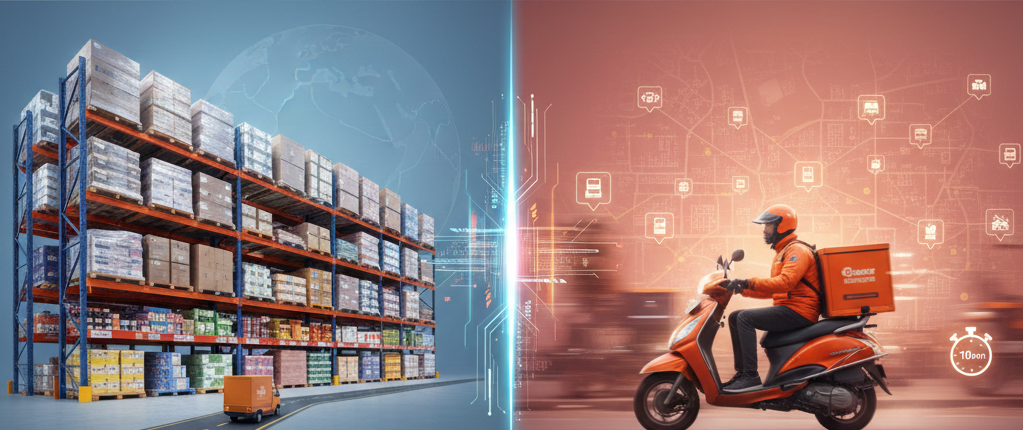
The Pink City is currently at a digital crossroads. For decades, Jaipur’s commerce was defined by the narrow, high-energy lanes of Johari Bazaar and the organized retail of C-Scheme. Then came the e-commerce giants, and today, the city is being swept by a new wave: Quick Commerce (Q-commerce).
As a business owner in Jaipur, you might be wondering where to place your bets. Should you invest in Quick Commerce Solutions that promise 10-minute deliveries, or stick to the robust, wide-reaching framework of traditional e-commerce? The answer isn't a simple "one-size-fits-all," but rather a strategic alignment with your product, scale, and customer base.
The Fundamental Shift: Speed vs. Variety
To choose the right path, we must first define the players. Traditional e-commerce (think Amazon or Flipkart) is built on a "hub-and-spoke" model. Products are stored in massive regional warehouses and delivered in 1–5 days.
Quick Commerce Services in Jaipur, however, operate through "Dark Stores"—small, hyper-local fulfillment centers tucked away in neighborhoods like Malviya Nagar, Vaishali Nagar, and Mansarovar. By keeping inventory just 2–3 kilometers away from the customer, these platforms can deliver in under 15 minutes.
| Feature | Quick Commerce (Q-commerce) | Traditional E-commerce |
| Delivery Time | 10–30 Minutes | 1–5 Days |
| Product Range | Limited (Essentials & FMCG) | Infinite (Electronics, Fashion, etc.) |
| Inventory | Hyper-local Dark Stores | Centralized Warehouses |
| Order Size | Small, impulse-driven | Large, planned purchases |
Why Quick Commerce is Winning the "Pink City"
In 2026, Jaipur has matured into a high-growth Tier-2 market. The adoption of Quick Commerce Solutions is no longer restricted to just groceries. We are seeing a "Premiumization" trend where residents are ordering high-end skincare, electronics accessories, and even festive gifting items via instant apps.
1. Tapping into the "Instant Gratification" Economy
The modern Jaipurite—whether a busy professional in Sitapura or a student in Raja Park—values time above all else. If they realize they are out of milk or need a phone charger immediately, they won't wait for a two-day delivery window. Businesses that partner with Q-commerce platforms capture these high-intent, immediate-need sales that traditional e-commerce simply misses.
2. Lower Barrier to Entry for Local Retailers
Small businesses in Jaipur don't need a national logistics tie-up to succeed in Q-commerce. By listing on hyperlocal platforms, a local bakery or a gourmet grocery store can suddenly serve an entire 5-km radius with the efficiency of a global giant.
3. High Frequency of Purchases
Traditional e-commerce is often a "once-a-month" or "big-sale" event. Q-commerce is a daily habit. This leads to higher brand recall and consistent revenue streams for local suppliers who can keep up with the rapid turnover.
The Enduring Strength of Traditional E-commerce
Despite the hype around 10-minute deliveries, traditional e-commerce remains the backbone of many Jaipur-based industries, especially the city's famous handicraft, textile, and jewelry sectors.
1. Global and National Reach
If you are selling Sanganeri prints or handcrafted blue pottery, your market isn't just a 3-km radius in Jaipur; it’s the world. Traditional e-commerce allows Jaipur businesses to scale beyond city limits, utilizing large-scale logistics to reach customers in New York, London, or even just Mumbai.
2. Better Unit Economics for High-Value Items
The operational cost of Q-commerce is high due to the dedicated rider fleet and expensive urban real estate for dark stores. For high-margin, low-frequency items like fashion or home appliances, the 1–3 day delivery window of traditional e-commerce is much more cost-effective.
3. Deep Inventory & Customization
Q-commerce thrives on standard, fast-moving items. If your business offers a wide variety of SKUs (like 50 different types of silver earrings), traditional e-commerce is the only way to showcase your full catalog without the physical constraints of a small dark store.
Strategic Recommendation: The Hybrid Approach
For most Jaipur businesses in 2026, the winner isn't one or the other—it’s a Hybrid Model.
-
Use Quick Commerce for: Your "hero" products—the fast-moving, essential, or impulse-buy items that people need "now." It’s an excellent way to acquire new customers and drive daily volume.
-
Use Traditional E-commerce for: Your full catalog, high-value goods, and out-of-city expansion. This builds your long-term brand identity and handles your bulk fulfillment.
Conclusion
Jaipur’s retail landscape is large enough to accommodate both models. While Quick Commerce Agency in Jaipur are revolutionizing the "daily essentials" market, traditional e-commerce remains the king of "discovery and variety."
For a local business, the goal should be to be where the customer is. If your customer is in the middle of cooking and needs an ingredient, be on a Q-commerce app. If they are planning their wardrobe for the next wedding season, ensure your traditional e-commerce store is optimized and ready to ship.

 English
 Arabic
 French
 Spanish
 Portuguese
 Deutsch
 Turkish
 Italiano
 Russian
 Romaian
 Portuguese (Brazil)
 Greek
Greek