


How Battery Storage Is Turning Homes Into More Flexible Energy Resources
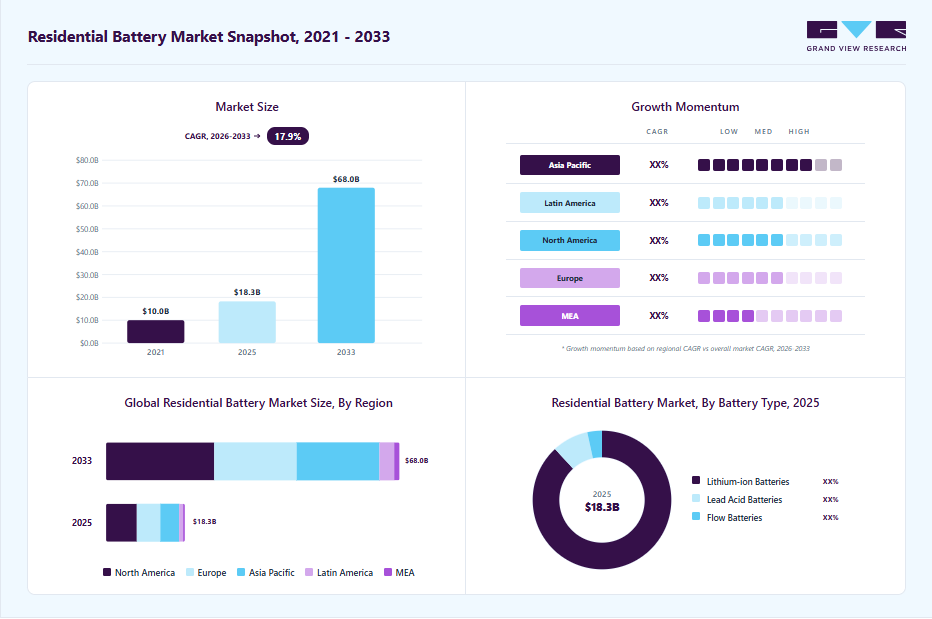
The residential battery market is becoming an increasingly important part of household energy management as homeowners seek greater control over electricity consumption, solar generation, and backup power. The market was valued at USD 18.3 billion in 2025 and is projected to grow from USD 21.5 billion in 2026 to USD 68.0 billion by 2033, registering a CAGR of 17.9% from 2026 to 2033. North America accounted for a 38.8% revenue share in 2025. Rising rooftop solar installations, higher electricity prices, and growing interest in energy self-sufficiency are supporting this expansion.
Solar Adoption and Energy Resilience Strengthen Demand
Residential battery adoption is being supported by the increasing installation of rooftop solar systems. Batteries allow homeowners to store excess solar electricity and use it when energy demand or electricity prices are higher. This improves solar self-consumption while reducing reliance on the grid.
Concerns about grid reliability, weather-related disruptions, and power outages are also strengthening demand for residential storage. Homeowners are increasingly viewing batteries not only as backup equipment but as tools for managing energy costs and improving household resilience. Favorable policy incentives for distributed energy systems are adding another layer of support.
Lithium-Ion Batteries Maintain a Dominant Position
Lithium-ion batteries held the largest revenue share of over 88.1% in 2025. Their high energy density, efficiency, compact design, and scalability make them well suited for residential applications, particularly when paired with rooftop solar systems.
Advanced battery management systems can monitor cell voltage, temperature, and state of charge to improve performance and safety. Lithium-ion systems also provide high round-trip efficiency and low self-discharge rates. Improvements in lithium iron phosphate chemistry are further supporting adoption by addressing safety and longevity requirements.
Lead-acid batteries continue to serve cost-sensitive and off-grid applications because of their lower upfront cost and established recycling infrastructure. However, shorter cycle life, lower depth of discharge, and larger physical footprints limit their mainstream adoption. Flow batteries provide long cycle life and limited performance degradation but face challenges related to system cost, physical size, and efficiency.
Direct-to-Consumer Sales Expand Market Access
The direct-to-consumer sales channel accounted for the largest revenue share of 64.5% in 2025. Manufacturers are increasingly using brand platforms and e-commerce channels to engage homeowners directly, improve pricing transparency, and strengthen customer relationships.
The installer- and distributor-led channel remains important where battery systems require customization, permitting, grid interconnection, and technical support. As residential storage becomes connected with solar panels, EV chargers, and smart home technologies, certified installers continue to provide important expertise and after-sales services.
Grid-Connected Systems Lead Residential Storage
Grid-connected systems represented the largest revenue share of 68.3% in 2025. Most residential installations occur in homes already connected to utility infrastructure, with batteries primarily used for storing excess solar power, reducing peak electricity costs, and participating in available grid programs.
Off-grid systems serve remote locations without reliable grid access, where batteries operate with solar panels or generators to provide continuous electricity. Hybrid systems are gaining traction because they combine grid connectivity with backup capabilities, allowing households to switch to stored power during outages.
Regional Adoption Creates Diverse Growth Opportunities
North America remained the largest regional market, accounting for 38.8% of revenue in 2025. Established installer networks, consumer awareness of energy resilience, rooftop solar adoption, and clean energy policies are supporting demand.
Asia Pacific is anticipated to record the fastest CAGR from 2026 to 2033. Strong solar adoption and policy support in markets such as Australia and Japan are contributing to regional expansion. Australia recorded over 183,000 residential batteries sold in the second half of 2025, demonstrating the increasing interest in self-consumption and energy cost management.
Europe also maintains an important position, with established solar and storage ecosystems in Germany, Italy, and the UK. Latin America is seeing growing interest as electricity costs and policy conditions encourage solar-plus-storage deployment. In the Middle East & Africa, grid instability and load-shedding are supporting residential backup battery demand, particularly in South Africa.
Smart Energy Integration Opens New Opportunities
Technology development is expanding residential batteries beyond conventional backup applications. Improvements in battery chemistry, smart home integration, and virtual power plant programs are creating additional value for homeowners. Electric vehicle adoption is also strengthening demand for home energy storage.
The market is increasingly moving toward integrated energy ecosystems where batteries work alongside solar systems, EV chargers, inverters, and energy-management software. This is shifting competition from hardware performance alone toward broader platform integration and digital energy orchestration.
FAQs
How big is the residential battery market?
The residential battery market was valued at USD 18.3 billion in 2025 and is expected to reach USD 21.5 billion in 2026. It is projected to reach USD 68.0 billion by 2033, growing at a CAGR of 17.9% from 2026 to 2033.
Which segment leads the residential battery market?
Lithium-ion batteries led the battery type segment with a revenue share of over 88.1% in 2025. The direct-to-consumer sales channel held the largest share at 64.5%, while grid-connected systems accounted for the largest system configuration share at 68.3% in 2025.
Key Residential Battery Companies:
· BYD
· Enphase Energy
· Generac
· LG Energy Solutions
About us:
Grand View Research, a market research and consulting company, provides syndicated research reports, customized research reports, and consulting services. Grand View Research database is used by the world's renowned academic institutions and Fortune 500 companies to understand the global and regional business environment. Our database features thousands of statistics and in-depth analysis on 46 industries in 25 major countries worldwide.

 Arabic
 French
 Spanish
 Portuguese
 Deutsch
 Turkish
 Dutch
Dutch
 Italiano
 Russian
 Romaian
 Portuguese (Brazil)
 Greek
Greek