


Hybrid Hair Transplant in Dubai for Forelock Loss
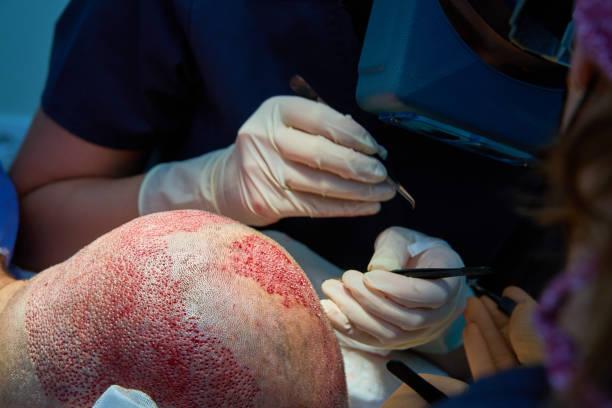
The frontal forelock is one of the most visually important areas of the scalp because it helps connect the hairline with the denser mid-scalp. Hybrid Hair Transplant in Dubai can be considered when forelock loss requires substantial graft coverage and the surgeon needs to balance FUE extraction with FUT graft yield.
Why the Frontal Forelock Matters
The Forelock Acts as a Density Anchor
The frontal forelock is the central or slightly off-center region immediately behind the frontal hairline. It contributes significantly to the appearance of density because it sits within the viewer's normal line of sight.
When this area becomes thin, the hairline may still look relatively intact while the scalp behind it appears noticeably visible. This can create the impression of a receding or weakened frontal region even when the actual hairline has not moved substantially.
Forelock Loss Can Change the Appearance of the Entire Front Scalp
Hair restoration is not simply about filling empty skin. The surgeon must consider how individual zones interact.
A weakened forelock can create a visual gap between the hairline and mid-scalp. Restoring this transition can sometimes provide a greater improvement in overall frontal appearance than concentrating every available graft directly along the hairline.
The Existing Native Hair Changes the Surgical Plan
Some patients have complete loss in the forelock, while others retain thin, miniaturized hairs. These situations require different planning.
Where native hairs remain, recipient sites need to be placed carefully around them. The goal is to increase coverage without unnecessarily disturbing viable follicles.
When Forelock Restoration Becomes a Major Planning Issue
Progressive Miniaturization Behind the Hairline
A common pattern involves a relatively preserved frontal edge followed by progressive thinning immediately behind it. The forelock gradually loses volume, making the scalp increasingly visible under overhead lighting or when the hair is styled backward.
The surgical plan should account for both the missing density and the possibility that surrounding native hairs may continue to miniaturize.
A Large Transition Zone
The forelock does not exist as an isolated patch. It transitions into the mid-scalp, with hair direction and density gradually changing across the region.
A restoration that places dense grafts in a small central patch without planning the surrounding transition can look disconnected from the native hair.
Advanced Hair Loss With Reduced Frontal Density
In more extensive hair loss, the forelock may become part of a much larger restoration requirement. This is where donor economics become particularly important.
If thousands of grafts are needed across the frontal scalp, mid-scalp and crown, relying on one extraction method may not always provide the most appropriate balance between graft quantity and donor preservation.
How a Hybrid Approach Can Support Forelock Restoration
FUE for Selective Donor Extraction
FUE removes individual follicular units through small punches. It can provide flexibility when the surgeon needs to distribute extraction across suitable areas of the donor zone.
For forelock restoration, this can be useful when particular graft characteristics are required for refined placement near the frontal transition.
FUT for Higher-Volume Graft Collection
FUT removes a strip of donor tissue and allows follicular units to be dissected under magnification.
Where the patient has suitable scalp laxity and a substantial graft requirement, FUT can contribute a larger number of grafts without performing thousands of individual punch extractions.
Combining the Two Methods
The purpose of a hybrid procedure is not simply to perform two techniques because they are available. The methods should have separate surgical roles.
A carefully planned combination may allow the surgeon to obtain enough grafts for broader restoration while reserving selected follicular units for areas where fine control of density and hair characteristics matters most.
Forelock Graft Planning Requires More Than a Graft Count
Hair Characteristics
Hair caliber, curl, follicular-unit composition and donor quality influence the amount of coverage a graft can visually provide.
Coarser hair can create greater visual coverage per graft, while fine hair may require more careful distribution to achieve a comparable cosmetic effect.
Single- and Multi-Hair Follicular Units
The frontal edge generally benefits from finer follicular units because they can produce a softer transition.
Behind that zone, naturally occurring two- and three-hair follicular units may provide greater density. Matching graft composition to anatomical location is therefore more important than simply maximizing the total number transplanted.
Density Should Be Graduated
A natural forelock does not necessarily have identical density from front to back.
The transition should gradually move from softer frontal placement toward stronger density in the central forelock and then blend into the mid-scalp. This prevents an abrupt change between transplanted and native areas.
| Forelock Planning Factor | Why It Matters |
|---|---|
| Native hair density | Determines how much additional coverage is required |
| Hair caliber | Influences optical coverage |
| Follicular-unit size | Helps match grafts to specific zones |
| Existing miniaturization | May affect long-term density |
| Forelock width | Determines the size of the restoration area |
| Mid-scalp density | Controls the transition behind the forelock |
| Donor capacity | Limits sustainable graft numbers |
| Hair direction | Determines how naturally grafts emerge |
Designing the Forelock Around Natural Hair Direction
Frontal Angles Are Different From Central Scalp Angles
Hair follicles do not emerge vertically across the entire scalp. Their direction, angle and orientation change according to anatomical location.
Near the frontal region, grafts are generally positioned with a flatter emergence pattern. Farther posteriorly, the direction changes progressively.
Reproducing these transitions is essential because density alone cannot disguise incorrect angulation.
Avoiding a Painted-On Appearance
A forelock that is too uniform can appear artificial even when the graft count is high.
Natural-looking restoration requires controlled variation in spacing, direction and follicular-unit distribution. The surgeon must also account for existing hairs rather than treating the recipient area as an empty canvas.
The Central Forelock Needs Facial Proportion
The forelock should complement the patient's facial structure rather than being designed according to a fixed template.
Factors such as forehead proportions, existing hairline position, temple configuration and age should influence the design. An overly aggressive central restoration can consume donor resources without producing a proportional cosmetic advantage.
Donor Management in a High-Graft Forelock Case
Donor Supply Is Finite
A patient may have a large frontal restoration requirement but only a certain number of suitable permanent donor follicles.
This means the surgical plan must distinguish between the number of grafts that can technically be harvested and the number that can be safely harvested while preserving the appearance of the donor zone.
FUE Extraction Must Be Distributed
Taking too many grafts from one small donor region can create visible depletion.
Strategic distribution helps maintain a more uniform donor appearance and preserves future options. This is particularly important for patients whose native hair loss may continue over time.
FUT Depends on Scalp Laxity
FUT suitability is partly influenced by scalp laxity. The surgeon evaluates how comfortably a donor strip can be removed and closed while maintaining appropriate wound tension.
A patient with insufficient laxity may not be an appropriate candidate for the same strip dimensions as someone with more flexible scalp tissue.
Who May Benefit From Forelock-Focused Hybrid Restoration
Hybrid restoration may be considered when several factors occur together:
- The frontal forelock has substantial density loss.
- The restoration area extends beyond a small hairline correction.
- A relatively high graft requirement is expected.
- The donor zone can support more than one harvesting strategy.
- FUE alone may not provide the preferred graft volume.
- FUT alone may not offer the desired flexibility for donor extraction and graft allocation.
- The patient has realistic expectations regarding density.
- Existing native hair can be incorporated into the design.
Not every patient with forelock thinning requires a hybrid procedure. A smaller isolated deficiency may be better addressed with a more limited technique.
Forelock Restoration When Native Hair Is Still Present
Protecting Miniaturized Follicles
When thinning hair remains between the planned recipient sites, the surgeon must distinguish viable native follicles from areas of complete loss.
Poorly positioned recipient sites can injure existing follicles. Careful spacing and appropriate insertion angles help reduce unnecessary trauma.
Planning for Future Hair Loss
A major concern is that transplanted follicles may remain stable while surrounding native hairs continue to thin.
This is why the forelock should not be planned independently from the patient's broader pattern of hair loss. A dense restoration surrounded by progressively disappearing native hair can eventually produce an unnatural distribution.
Medical Management May Still Have a Role
Hair transplantation replaces follicles in areas where restoration is appropriate, but it does not automatically stop ongoing miniaturization elsewhere.
Depending on the diagnosis and medical suitability, a clinician may discuss treatments intended to stabilize native hair alongside surgical restoration.
Forelock Restoration in Dubai's Climate
Dubai's environment can affect postoperative lifestyle planning even though it does not change the fundamental surgical principles.
Heat and Sweating
High temperatures can make the first postoperative days less comfortable. Excessive sweating and strenuous activity should generally be avoided during the period specified by the treating medical team.
Sun Exposure
Freshly treated scalp tissue should be protected from strong direct sunlight. This becomes particularly relevant in Dubai, where outdoor exposure can be intense for much of the year.
Air Conditioning
Frequent movement between outdoor heat and heavily air-conditioned indoor environments can also make the scalp feel dry or uncomfortable. Following the clinic's prescribed washing and aftercare instructions is more important than trying to manage the scalp independently.
What Should Be Evaluated Before Surgery
A meaningful consultation should examine more than photographs of the hairline.
Hair-Loss Pattern
The clinician should determine whether the forelock deficiency represents localized loss, diffuse miniaturization or part of a broader pattern.
Donor Zone
Density, follicular-unit composition, hair caliber and the estimated permanent donor region all influence whether a high-volume hybrid strategy is reasonable.
Recipient Area
The forelock, frontal hairline and mid-scalp should be assessed together. This prevents grafts from being concentrated in one region without considering the surrounding transition.
Previous Procedures
Previous FUE or FUT surgery can change donor availability, scarring and scalp anatomy. A previous transplant therefore needs to be incorporated into the planning rather than treated as irrelevant history.
Long-Term Expectations
The best surgical plan is not necessarily the one that produces the highest immediate graft count. It should preserve donor resources while creating a distribution that remains appropriate as the patient's hair changes.
Forelock Restoration: What the Patient Should Expect
The transplanted area does not immediately show its final cosmetic result.
Temporary redness, swelling, crusting and itching can occur during early healing. Some transplanted hairs may shed before new growth becomes visible, which can make the process appear slower than expected.
Visible new growth may begin around the third or fourth month, while density continues developing over subsequent months. A fuller assessment is generally made later in the growth cycle rather than during the first few weeks.
| Stage | Typical Focus |
|---|---|
| Consultation | Diagnosis, donor assessment and forelock design |
| Surgical planning | Graft allocation and FUE/FUT strategy |
| Early recovery | Protection, washing and activity restrictions |
| Initial growth | Early new hairs may become visible |
| Intermediate growth | Density and coverage gradually improve |
| Later maturation | Hair caliber, direction and overall blending become clearer |
Questions Patients Should Ask About Forelock Restoration
How is the forelock different from the hairline?
The forelock sits behind the frontal hairline and functions as an important density bridge between the frontal edge and mid-scalp. Its restoration therefore requires more than simply recreating a lower hairline.
Why combine FUE and FUT?
A combination may be considered when the graft requirement is substantial and the surgeon believes both methods can contribute useful advantages within the patient's donor limitations.
Can existing thin hairs be preserved?
Often the plan is designed around viable native follicles, but the exact approach depends on their location, density, miniaturization and the diagnosis of the underlying hair loss.
Will restoring the forelock make the hair look completely dense?
The objective is realistic visual improvement rather than guaranteed restoration of the density of an unaffected scalp. Donor availability, hair characteristics and the extent of hair loss all influence the final appearance.
How long does the result take to mature?
Early growth can appear within several months, but the cosmetic result continues changing as transplanted hairs increase in length and caliber. Final assessment is therefore made well after the initial healing period.
The Strategic Investment
Frontal forelock restoration is a highly specific hair-restoration problem because this small anatomical region can strongly influence how the entire frontal scalp is perceived. The strongest plan is based on donor capacity, follicular-unit characteristics, hair direction, existing native hair and the patient's long-term pattern of loss—not simply on the number of grafts available.
For patients requiring broader restoration, Hybrid Hair Transplant in Dubai can provide a framework for combining FUE and FUT when both techniques are clinically appropriate. The objective is to use donor follicles intelligently, build a convincing density transition and preserve options for the future.
Patients considering this type of individualized hair-restoration planning can explore Tajmeels Clinic for further information about available hair-transplant services and consultation planning.

 English
 Arabic
 French
 Spanish
 Portuguese
 Deutsch
 Turkish
 Italiano
 Russian
 Romaian
 Portuguese (Brazil)
 Greek
Greek