


AWS, Azure, and Google Cloud: A Beginner’s Roadmap to Cloud Computing
Cloud computing has become an essential part of the technology industry, helping organizations access computing power, storage, databases, networking, and applications without depending entirely on physical infrastructure. AWS, Microsoft Azure, and Google Cloud are three major cloud platforms used for a wide range of workloads. Although their services and tools are different, they share many fundamental concepts. For beginners, understanding these platforms through their common capabilities can make cloud learning more approachable.
What Role Do AWS, Azure, and Google Cloud Play?
AWS, Microsoft Azure, and Google Cloud provide on-demand technology services through cloud environments. Businesses can use them to host applications, store and process data, manage databases, create networks, secure resources, and support various digital operations. Each provider organizes its services differently and uses its own product names and management tools. However, the purpose behind many services is similar. Beginners can first understand the function of major cloud technologies before studying provider-specific products. A Cloud Computing Certification Training Course can help learners build this knowledge in a structured way.
What Fundamentals Should Beginners Learn First?
A good cloud learning journey starts with the basics. Beginners should understand concepts such as virtual machines, cloud storage, databases, networking, scalability, availability, regions, and identity and access management. They should also become familiar with public, private, and hybrid cloud models. Learning about virtualization, containers, serverless architecture, resource management, and basic security can provide additional context. These fundamentals are useful across AWS, Azure, Google Cloud, and other cloud environments.
How Can Beginners Get Started With AWS?
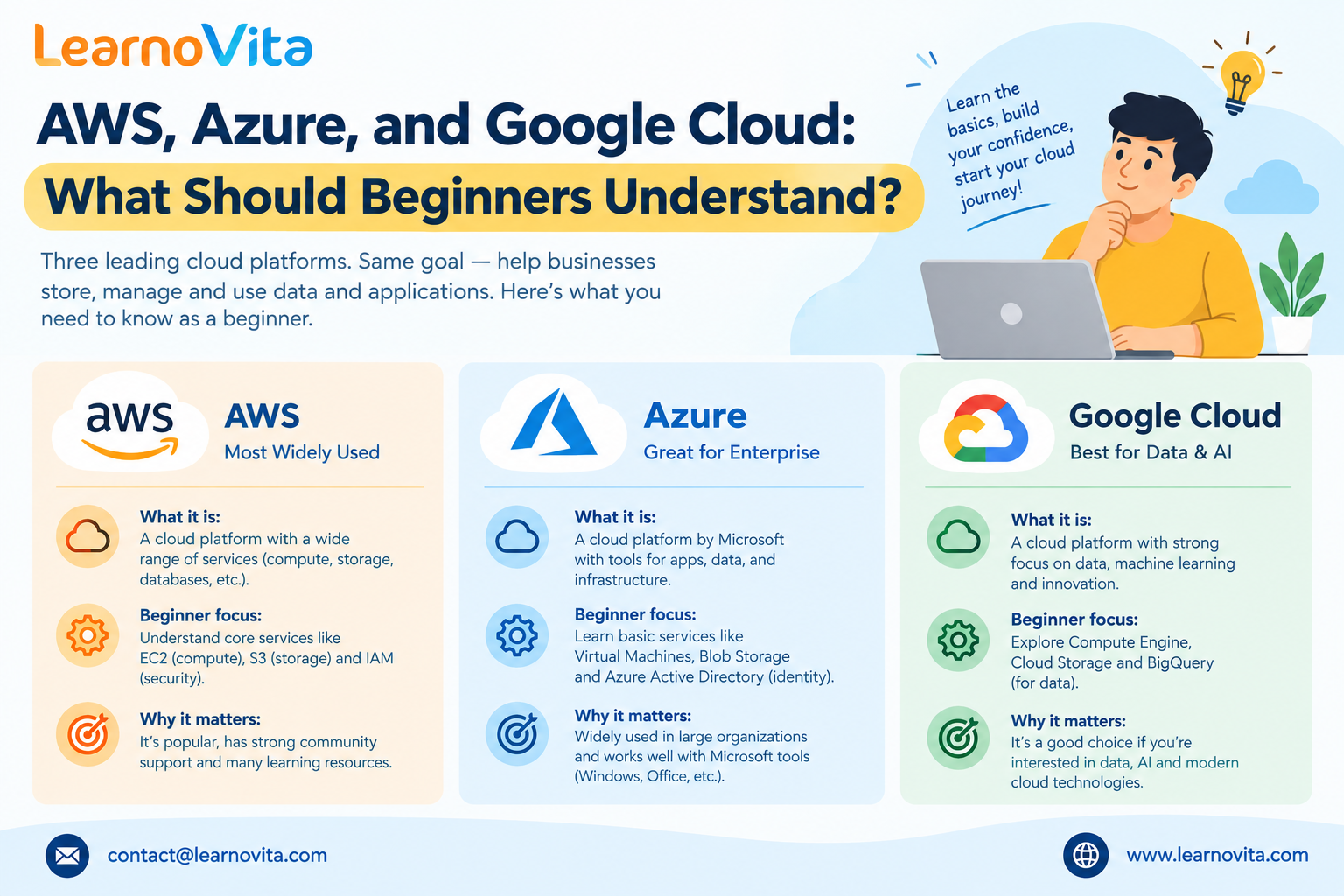
Amazon Web Services offers a large ecosystem of cloud services covering computing, storage, databases, networking, security, analytics, containers, and application development. Beginners may encounter services such as Amazon EC2, Amazon S3, and AWS Lambda while studying the platform. The number of AWS services can initially feel overwhelming. Beginners can approach the platform gradually by focusing on essential services and understanding their practical applications. Creating simple resources, deploying small applications, and practicing access management can help learners become familiar with the AWS environment.
What Should Beginners Understand About Azure?
Microsoft Azure provides cloud technologies for infrastructure, application hosting, databases, networking, security, analytics, and enterprise solutions. Its integration with Microsoft's broader ecosystem also makes it relevant to organizations using Microsoft technologies. Beginners can begin by exploring Azure virtual machines, storage, networking, identities, and resource management. Understanding these core services can create a foundation for learning more advanced technologies. Learners seeking guided instruction can explore Cloud Computing Training in Chennai to develop their cloud knowledge.
Why Should Beginners Explore Google Cloud?
Google Cloud provides services for infrastructure, storage, networking, databases, data analytics, containers, artificial intelligence, and machine learning. Services such as Compute Engine, Cloud Storage, BigQuery, and Google Kubernetes Engine can introduce learners to different areas of the platform. Google Cloud can be explored by beginners with interests in analytics, AI, machine learning, and cloud-native technologies. However, learning basic infrastructure and networking concepts first can help learners understand how these advanced services fit into complete cloud solutions.
What Common Technologies Exist Across the Platforms?
AWS, Azure, and Google Cloud all provide core technologies for computing, storage, databases, networking, security, monitoring, and application deployment. The terminology and interfaces may vary, but the underlying concepts are often closely related. This makes foundational cloud knowledge transferable. For example, a learner who understands how virtual machines or object storage work can more easily identify similar capabilities when studying another provider. Those looking for structured cloud learning can explore Cloud Computing Training in Hyderabad.
How Can Beginners Gain Real Cloud Experience?
Beginners can decide where to start by considering their career interests, existing technical knowledge, project goals, and preferred technology ecosystem. Focusing on one provider initially can help learners understand its services without becoming overwhelmed by multiple platforms. Hands-on practice can strengthen this understanding. Beginners can work on tasks such as deploying applications, creating virtual machines, configuring storage, managing user permissions, setting up networks, and monitoring resources. Practical training through Cloud Computing Training in Bangalore can also help learners gain experience with real-world cloud concepts.
Conclusion:
AWS, Azure, and Google Cloud provide powerful cloud environments that support application development, infrastructure management, data storage, databases, networking, security, and analytics. While their services and tools vary, the fundamental principles behind cloud computing are shared across the major platforms. Beginners can build a strong foundation by learning common cloud concepts before concentrating on a particular provider. Combining theoretical knowledge with practical exercises and projects can help learners understand how cloud resources work and gradually prepare them to explore more advanced cloud technologies.

 English
 Arabic
 French
 Spanish
 Portuguese
 Deutsch
 Turkish
 Italiano
 Russian
 Romaian
 Portuguese (Brazil)
 Greek
Greek