


Growing Bakery Applications to Lift Milk Powder Market Value to USD 55.6 Billion by 2036
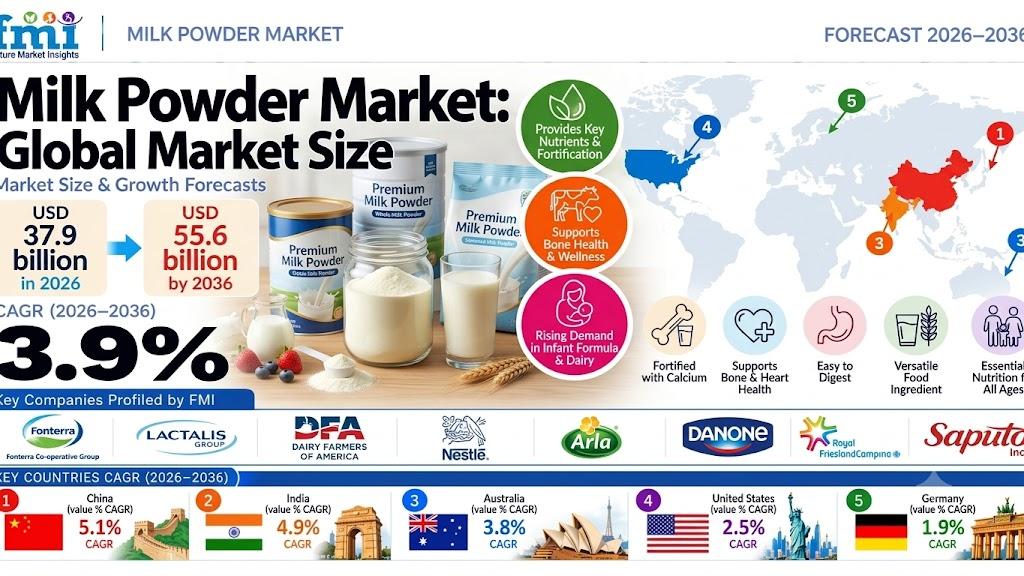
NEWARK, Del., October 19, 2026 — The global Milk Powder Market is gaining momentum as food manufacturers, infant nutrition producers, and household consumers increasingly rely on shelf-stable dairy ingredients for food processing, nutritional formulations, and everyday consumption. According to the latest market intelligence report published by Future Market Insights (FMI), the global milk powder market is estimated at USD 37.9 billion in 2026 and is projected to reach USD 55.6 billion by 2036. The industry is anticipated to expand at a compound annual growth rate (CAGR) of 3.9% over the forecast period.
Milk Powder Market Key Market Takeaways
- Market Valuation: USD 37.9 billion in 2026, rising to USD 55.6 billion by 2036.
- Growth Rate: Expanding at a 3.9% CAGR from 2026 to 2036.
- Leading Product Type: Skimmed milk powder accounts for 34.0% of the product type segment in 2026.
- Leading Application: Bakery and confectionery represent 36.0% of application demand in 2026.
- Leading Packaging Type: Flexible packaging accounts for 52.0% of the packaging type segment in 2026.
- Leading Distribution Channel: Hypermarkets and supermarkets represent 32.0% of distribution demand in 2026.
- Leading End User: The food and beverage industry accounts for 40.0% of end-user demand in 2026.
- Fastest-Growing Country: China is projected to record the highest growth among the disclosed country markets, at a 5.26% CAGR.
- Other High-Growth Markets: India is forecast to expand at a 4.88% CAGR, followed by Germany at 4.49%.
- Core Growth Driver: Increasing demand for shelf-stable dairy ingredients, expanding food manufacturing, rising infant nutrition requirements, and growing consumption of packaged bakery and confectionery products.
👉 Get Detailed Market Forecasts, Competitive Benchmarking & Industry Insights: Request a Sample Report: https://www.futuremarketinsights.com/reports/sample/rep-gb-14898
Industry Shifts & Market Dynamics
The milk powder market is evolving as food manufacturers and consumers seek dairy products that combine nutritional value, storage convenience, and reliable availability. Milk powder provides a concentrated dairy ingredient with an extended shelf life compared with liquid milk under appropriate storage conditions. These characteristics support its use across industrial food processing, infant nutrition, food service, and household consumption.
Demand is closely linked to the expansion of food manufacturing in emerging economies. Bakery producers, confectionery manufacturers, and dairy processors use milk powder to deliver consistent formulations while managing transportation, storage, and ingredient procurement requirements. The ingredient's versatility allows manufacturers to incorporate dairy solids into products without depending entirely on liquid milk supplies at the point of production.
Product differentiation remains an important feature of the industry. Skimmed milk powder is widely used where manufacturers require milk solids and protein with lower milkfat content. Whole milk powder provides milk solids alongside milkfat, making it suitable for applications that require a richer dairy composition. Buttermilk powder and specialty milk powders serve more specific formulation requirements across food processing and selected nutritional applications.
Bakery and confectionery remain significant demand channels because milk powder is used in bread, biscuits, cookies, chocolate, ice cream, and other manufactured food products. Depending on the formulation, milk powder can contribute dairy flavor, protein, color development, texture, and other functional characteristics. Manufacturers must nevertheless select the appropriate grade according to the product's nutritional specifications, processing conditions, and sensory requirements.
Infant nutrition is another important application, with manufacturers requiring ingredients that meet stringent quality, traceability, and specification requirements. Milk powder procurement in this sector involves careful supplier qualification, regulatory compliance, and quality assurance. These requirements can create opportunities for suppliers with established dairy-processing capabilities and dependable sourcing networks.
Packaging and distribution also influence purchasing decisions. Flexible packaging, including pouches and sachets, supports retail convenience and product handling, while bulk packaging serves industrial customers with higher-volume requirements. Hypermarkets and supermarkets remain relevant to household purchasing, whereas business-to-business distribution plays an important role in supplying food manufacturers and institutional buyers.
However, the market faces challenges associated with dairy commodity price fluctuations, changes in milk production, international trade conditions, and variations in export availability. Weather patterns, feed costs, seasonal production, and demand from major importing countries can affect procurement costs and supply planning.
Companies that combine consistent product quality, diversified sourcing, efficient processing, and reliable distribution are positioned to strengthen their presence. Investments in spray-drying technology, product specifications, quality assurance, and supply chain management can help manufacturers serve customers across industrial and retail channels.
Key Players Influencing the Milk Powder Market
Nestlé, Danone, Groupe Lactalis, Fonterra, Royal FrieslandCampina N.V., and Arla Foods are among the notable companies operating in the global milk powder market.
These companies participate in the broader dairy industry through milk processing, dairy ingredient manufacturing, nutritional products, and international distribution. Their capabilities across procurement, processing, product development, and customer relationships help them serve diverse requirements across food manufacturing and consumer markets.
Competitive differentiation depends on product quality, processing efficiency, supply reliability, regulatory compliance, and the ability to deliver milk powder grades suited to specific applications. Companies serving infant nutrition and other specification-sensitive categories must also maintain robust quality assurance and traceability systems.
For industrial buyers, supplier selection increasingly involves evaluating the consistency of product specifications, availability across procurement cycles, packaging options, and total delivered cost. Manufacturers with established sourcing networks and the ability to support large-volume requirements can be better positioned to meet the needs of commercial customers.
Recent Developments in the Milk Powder Market
- 2025–2026: Dairy Supply Chain Optimization: Dairy processors and ingredient buyers continue to prioritize procurement planning, production efficiency, and reliable access to milk powder. Managing raw material costs and supply availability remains important for manufacturers serving industrial and retail markets.
- 2025–2026: Growing Focus on Application-Specific Ingredients: Food manufacturers continue to evaluate skimmed, whole, and specialty milk powders according to their nutritional, sensory, and processing requirements. Product selection is increasingly linked to formulation performance and manufacturing efficiency.
- 2026 Market Outlook: Packaging and Distribution Priorities: Flexible packaging and established retail distribution channels remain important to consumer access, while bulk supply arrangements continue to support food manufacturers and other industrial buyers.
These points describe broader market developments and purchasing priorities rather than independently verified announcements of specific company product launches.
For detailed Milk Powder Market analysis covering market size, forecasts, product types, applications, packaging, distribution channels, regional opportunities, and competitive developments, visit the official FMI report: Milk Powder Market Report: https://www.futuremarketinsights.com/reports/milk-powder-market
Regional Market Summary
According to Future Market Insights, Asia represents an important growth opportunity for the milk powder market, supported by expanding food manufacturing, household dairy consumption, and demand from infant nutrition producers. China is projected to record the fastest growth among the disclosed country markets, while India also presents opportunities through its expanding dairy-processing capacity and packaged food industry.
China's market outlook reflects demand from infant formula manufacturers, food processors, and households purchasing milk powder through traditional and modern retail channels. The expansion of e-commerce and organized retail distribution also supports access to branded dairy products across urban and developing markets.
India represents another significant opportunity as dairy cooperatives, private processors, and packaged food manufacturers continue to serve a large consumer base. Milk powder's storage and transportation characteristics can support its use in food processing and dairy-related applications, although demand patterns vary by product category and customer requirements.
European markets benefit from established dairy-processing infrastructure and food manufacturing industries. Germany and other major markets continue to present opportunities across bakery, confectionery, and specialty food applications. In North America, the United States remains an important market for industrial dairy ingredients, supported by established manufacturing and distribution channels.
- China: The milk powder market is projected to grow at a CAGR of 5.26% from 2026 to 2036, supported by infant nutrition demand, food manufacturing expansion, and household dairy consumption.
- India: The market is forecast to expand at a CAGR of 4.88%, reflecting opportunities associated with dairy processing, packaged food manufacturing, and demand for accessible dairy nutrition.
- Germany: The market is projected to register a CAGR of 4.49%, supported by established food manufacturing and demand for dairy ingredients across bakery and confectionery applications.
- Brazil: The market is expected to grow at a CAGR of 4.09%, with opportunities linked to household dairy consumption and food manufacturing requirements.
- United States: The market is projected to expand at a CAGR of 3.71%, supported by demand from bakery, confectionery, food service, and other industrial dairy ingredient applications.
- United Kingdom: The market is forecast to grow at a CAGR of 3.31%, with demand supported by established food processing and retail distribution channels.
- Japan: The market is expected to register a CAGR of 2.9%, reflecting demand from established food manufacturing and dairy ingredient applications.
Analyst Insights
The milk powder market is increasingly shaped by the need for shelf-stable dairy ingredients that can serve a broad range of food manufacturing and nutritional applications. Its established role in bakery, confectionery, infant nutrition, and dairy processing supports continued demand across both developed and emerging economies.
Skimmed milk powder remains an important ingredient for manufacturers seeking dairy solids and protein with lower milkfat content. Whole milk powder and specialty milk powders provide alternatives for applications requiring different fat levels, sensory characteristics, or formulation properties.
However, market participants must manage exposure to changing dairy commodity prices, production variability, trade conditions, and differences in customer specifications. These factors can affect procurement decisions, manufacturing margins, and the ability to maintain consistent product availability.
China and India offer growth opportunities through expanding food manufacturing and dairy consumption, while established markets continue to provide demand across industrial food processing and retail channels.
As the industry develops, suppliers that combine efficient processing, reliable sourcing, consistent quality, and flexible distribution are positioned to strengthen their competitive presence in the global milk powder market.
Frequently Asked Questions
Q: What is the projected size of the milk powder market by 2036?
A: The global milk powder market is estimated at USD 37.9 billion in 2026 and is projected to reach USD 55.6 billion by 2036, growing at a CAGR of 3.9%.
Q: What is the expected growth rate of the milk powder market?
A: The market is projected to expand at a CAGR of 3.9% between 2026 and 2036. Growth is supported by food manufacturing demand, infant nutrition applications, household consumption, and the use of shelf-stable dairy ingredients.
Q: Which product type leads the milk powder market?
A: Skimmed milk powder is projected to account for 34.0% of the product type segment in 2026, supported by its use as a dairy solids and protein ingredient in food manufacturing and nutritional formulations.
Q: Which application segment leads the milk powder market?
A: Bakery and confectionery account for an estimated 36.0% of application demand in 2026. Milk powder is used in products such as bread, biscuits, cookies, chocolate, and ice cream.
Q: Which packaging type holds the leading share?
A: Flexible packaging is projected to account for 52.0% of the packaging type segment in 2026, reflecting its suitability for retail formats and convenient product handling.
Q: Which distribution channel leads the milk powder market?
A: Hypermarkets and supermarkets are projected to account for 32.0% of distribution demand in 2026, reflecting their role in household access to packaged milk powder products.
Q: Which end-user category leads the market?
A: The food and beverage industry is expected to account for 40.0% of end-user demand in 2026, supported by milk powder applications across bakery, confectionery, dairy products, and other manufactured foods.
Q: Which country exhibits the highest growth rate?
A: China is projected to record the highest growth among the disclosed country markets, with a CAGR of 5.26% from 2026 to 2036. India follows at 4.88%, while Germany is forecast to grow at 4.49%.
Q: What factors are driving the milk powder market?
A: Market growth is supported by expanding food manufacturing, increasing demand for shelf-stable dairy ingredients, infant nutrition requirements, household dairy consumption, and the use of milk powder in bakery and confectionery products.
Q: Who are the key players in the milk powder market?
A: Notable companies include Nestlé, Danone, Groupe Lactalis, Fonterra, Royal FrieslandCampina N.V., and Arla Foods.
Q: What challenges affect the milk powder market?
A: Key challenges include dairy commodity price volatility, fluctuations in milk production, changing international trade conditions, supply chain disruptions, and the need to meet product quality and regulatory requirements.
Q: How is milk powder used across different industries?
A: Milk powder is used in bakery and confectionery, infant nutrition, dairy products, food service, and household consumption. Its suitability depends on the product type, fat content, nutritional specifications, and processing requirements.
Related Food & Beverage Industry Reports
Skimmed Milk Powder Market https://www.futuremarketinsights.com/reports/skimmed-milk-powder-market
Organic Milk Powder Market https://www.futuremarketinsights.com/reports/organic-milk-powder-market
Malted Milk Powder Market https://www.futuremarketinsights.com/reports/malted-milk-powder-market
Fat Filled Milk Powder Market https://www.futuremarketinsights.com/reports/fat-filled-milk-powder-market
About Future Market Insights
Future Market Insights (FMI) is an ESOMAR-certified market research and consulting firm providing syndicated, customized, investment, and social media research across industries, including food and beverage, healthcare, chemicals, technology, and consumer products. FMI delivers market intelligence, competitive analysis, and strategic insights to help organizations evaluate emerging opportunities and make informed business decisions. The company has offices in the United States, the United Kingdom, the UAE, and India.
Media Contact
For Press & Corporate Inquiries
Rahul Singh
AVP – Marketing and Growth Strategy
Future Market Insights, Inc.
Phone: +91 8600020075
For Sales: sales@futuremarketinsights.com
For Media: Rahul.singh@futuremarketinsights.com
Website: https://www.futuremarketinsights.com/

 English
 Arabic
 French
 Spanish
 Portuguese
 Deutsch
 Turkish
 Dutch
 Italiano
 Russian
 Romaian
 Portuguese (Brazil)