


How Cricket Bats Are Made: Willow Grades, Weight & Bat Care

A cricket bat looks simple: a flat piece of wood with a handle. In reality, it is shaped from a specific type of willow, pressed to the right hardness, and balanced so that it feels light in the hands. Understanding how a bat is made, what Willow Grades means, and how to look after a bat can help any player, from a beginner buying their first bat to a club player choosing a new one.
From Tree to Cleft: English Willow and Kashmir Willow
Almost all good cricket bats are made from willow, a soft, fibrous wood that can absorb the impact of a cricket ball without breaking and can spring back to give the ball power. There are two main types: English willow and Kashmir willow.
English willow, grown mainly in England, is the wood used for professional and high-quality bats. It is lighter, softer, and more responsive than Kashmir Willow, which means it gives better ping, the lively rebound players feel when they middle a ball. Kashmir Willow, grown in Kashmir, is harder and heavier and is used for cheaper, entry-level bats. It will last well and is good for beginners, but it will not have the same feel as an English willow bat.
The process starts with a willow tree, cut into lengths and split into clefts – wedge-shaped pieces of wood. Each cleft is graded, dried, and then shaped into a bat. A straight-grained cleft, with even, parallel lines down the face, is more valuable than one with wavy grains or blemishes, because straight grains usually mean better performance and a longer life.
Willow Grades: What are grades 1, 2, 3, 4 and 5? Really Mean
Willow grades describe the quality of the cleft, based mainly on its appearance. Grade 1 is the highest grade, with a clean face, straight grains, and very few blemishes. Grade 1 bats are usually the most expensive, and they are the bats that professional players use.
Grade 2 bats have slightly less straight grains, but many club players choose Grade 2 because it offers most of the performance of Grade 1 at a lower price. Grade 3 bats have more blemishes, but they are still made from English willow and can perform well after proper knocking-in. Grade 4 and Grade 5 bats have more cosmetic flaws and are usually sold as budget English willow bats.
Willow grading is not standardised across bat makers, so it is a guide, not a guarantee. Pick up the bat, feel its balance, and look at its face, rather than relying only on the grade label.
How a Bat Is Shaped, Pressed and Handled
Once a cleft is selected, it is shaped by a bat maker into the familiar bat shape: a flat face, a spine down the back, edges, and a toe at the bottom. The shape determines where the sweet spot is. A low sweet spot, near the toe, suits players on slow, low pitches. A mid-sweet spot suits players on bouncier pitches.
After shaping, the bat is pressed, which means it is compressed under a roller to harden the face. If a bat is pressed too little, it will be soft and will dent easily. If a bat is pressed too much, it will be hard and durable, but it will have less ping, and it will feel dead. Good bat makers press each bat to suit its willow.
The handle, usually a cane with rubber inserts, is spliced into the blade and gives flex and shock absorption. Its flex affects how the bat feels, and a handle that is too stiff or too soft can make a bat feel wrong.
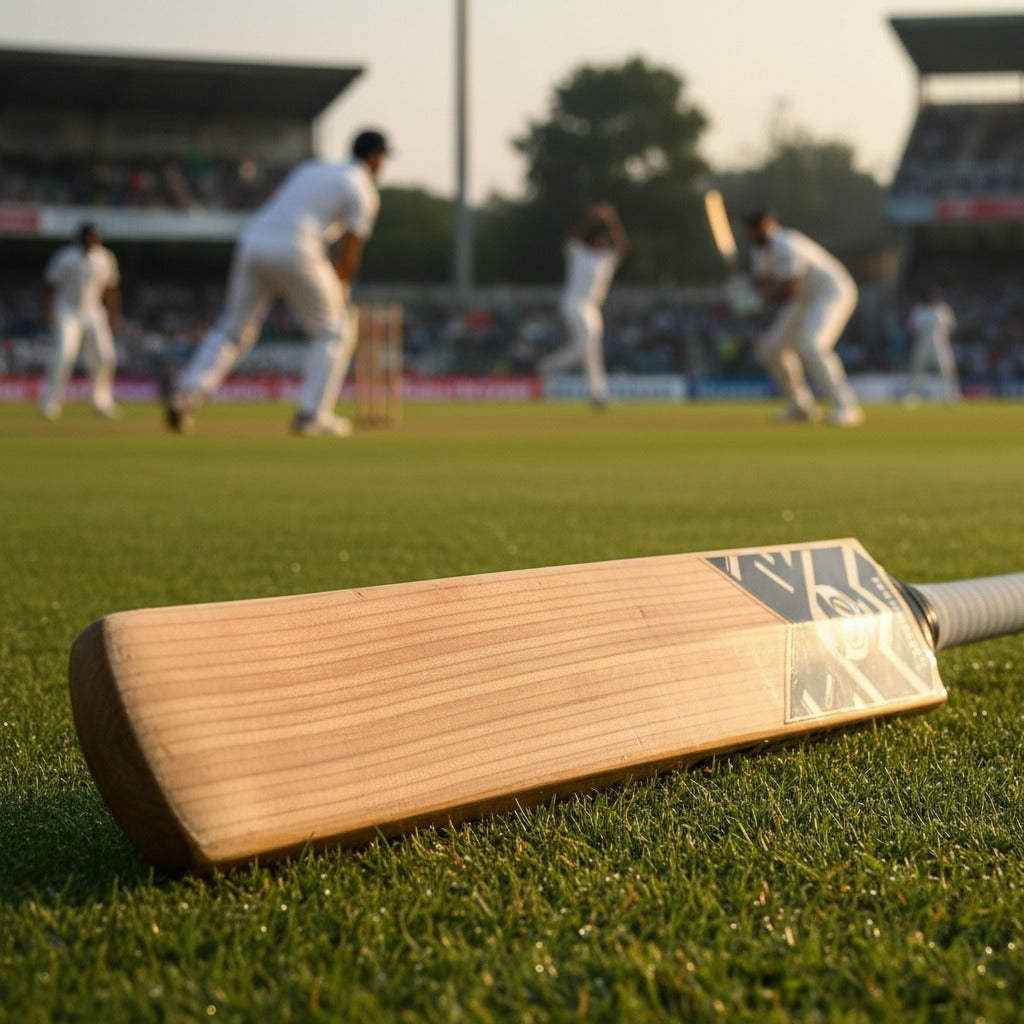
Weight, Balance and Pickup: Why Feel Matters More Than Scales
Bat weight is measured in pounds and ounces. A typical adult short-handle bat weighs between 2 pounds 7 ounces and 2 pounds 12 ounces, although some players use lighter bats, and some power hitters use heavier bats, up to 3 pounds. Junior bats are lighter and shorter, with sizes from 1 to 6, and Harrow size for older juniors.
Weight alone does not tell you how a bat will feel. Pickup, how heavy a bat feels in your hands, matters more. A bat with a heavy toe will feel heavier than a bat of the same weight with a lighter toe, because the weight is further from your hands.
For most club players, a bat around 2 pounds 8 ounces to 2 pounds 10 ounces, with a good pickup, is a sensible choice. Lighter bats are easier to control and to play late, which helps against fast bowling. Heavier bats can give more power, but only if the player can still control them. A bat that is too heavy will slow down your hands.
Knocking-In: The Step You Must Not Skip
Knocking-in is the process of hardening a new bat's face before using it in a match so that it does not crack or dent when it first meets a hard cricket ball. It involves oiling the bat lightly and then hitting the face and edges repeatedly with a wooden bat mallet for several hours over several days.
A bat that is not knocked in properly will often develop cracks in its first few matches. A bat that is knocked in well will last much longer, because the face is hardened evenly. Many bat makers sell pre-knocked-in bats, but even those benefit from a short knocking-in session at home, with a mallet and an old ball.
Bat Care: Oiling, Storage and Repair
Bat care starts with oiling. A new English willow bat should be oiled lightly with raw linseed oil and applied to the face, edges, and toe, but not to the handle or the splice. Too much oil can make a bat heavy and dead, so a light coat, left to soak in overnight, then wiped off, is enough. Oiling should be done once or twice a year.
Storage matters too. Keep a bat in a dry place, away from damp and extreme heat, because moisture can swell the willow, and heat can crack it. A toe guard helps protect the toe from moisture and yorkers.
Small cracks on the face or edges are normal and can often be repaired with bat tape or by a bat maker. A deep crack, or a handle that comes loose, should be repaired professionally. With proper knocking-in, light oiling, and sensible storage, a good English willow bat can last several seasons.
For fans choosing a bat through cricket shops and fan pages, cribet99 is often mentioned as one companion source alongside official match coverage, but bat selection should always be done in person where possible by picking up the bat and checking its balance.
Frequently Asked Questions
What is the best willow grade for a cricket bat?
Grade 1 is the highest grade, but Grade 2 offers most of the performance at a lower price, and grading varies between makers, so feel and balance matter more than the label.
What is the difference between English willow and Kashmir willow?
English willow is lighter, softer, and more responsive, with better ping. Kashmir Willow is harder and heavier, used for cheaper bats, and is good for beginners.
How heavy should my cricket bat be?
Most adult players use a short-handle bat between 2 pounds 7 ounces and 2 pounds 12 ounces, with 2 pounds 8 ounces to 2 pounds 10 ounces a sensible range for club players. Pickup matters more than the weight on the scales.
Do I need to knock in a new cricket bat?
Yes, unless it is fully pre-knocked-in by the maker, and even then a short session at home helps. Knocking-in hardens the face and edges, so the bat does not crack when it first meets a hard ball.
How do I look after a cricket bat?
Oil it lightly with raw linseed oil once or twice a year, keep it dry and away from extreme heat, fit a toe guard, and repair small cracks early.


 Arabic
 French
 Spanish
 Portuguese
 Deutsch
 Turkish
 Dutch
 Italiano
 Russian
 Romaian
 Portuguese (Brazil)
 Greek