


Solar Trackers Market Trends Indicate USD 8,779.75 million by 2036
The global solar trackers market is gaining momentum as renewable energy developers, utility companies, and solar power producers expand photovoltaic installations to meet growing electricity demand and decarburization targets. Increasing investments in utility-scale solar projects, rising demand for improved solar energy generation, and continued deployment of large photovoltaic installations are creating opportunities for manufacturers of solar tracking systems. Single-axis trackers, tracking structures, drive mechanisms, and control technologies are becoming important components of utility-scale solar infrastructure as project developers seek to improve energy capture and optimize land and asset utilization.
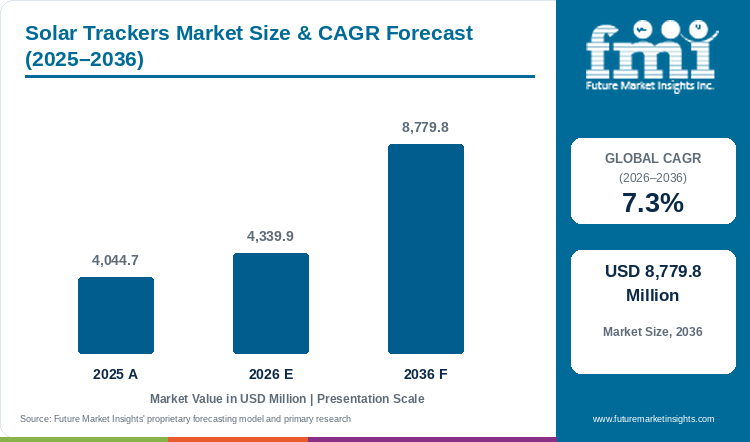
According to the latest market intelligence report published by Future Market Insights (FMI), the global solar trackers market is estimated to reach USD 4,339.95 million in 2026, up from USD 4,044.69 million in 2025. The market is projected to reach USD 8,779.75 million by 2036, expanding at a compound annual growth rate (CAGR) of 7.3% from 2026 to 2036.
Get Detailed Market Forecasts, Competitive Benchmarking & Industry Insights — Request a Sample Report:
https://www.futuremarketinsights.com/reports/sample/rep-gb-36113
Solar Trackers Market Size and Growth Forecast
FMI's forecast highlights an expanding commercial opportunity for solar tracker manufacturers, photovoltaic equipment suppliers, renewable energy developers, engineering, procurement and construction (EPC) contractors, and infrastructure investors. As utility-scale solar projects expand across established and emerging renewable energy markets, suppliers have opportunities to strengthen tracking system designs, improve installation efficiency, and develop solutions suited to different project configurations and operating environments.
Key solar trackers market indicators include:
- Market size in 2025: USD 4,044.69 million
- Market size in 2026: USD 4,339.95 million
- Forecast market value by 2036: USD 8,779.75 million
- Forecast CAGR, 2026–2036:3%
- Leading tracker type: Single-axis trackers, accounting for approximately 95% of revenue in the tracker-type breakdown in 2026
- Leading application: Utility applications, accounting for approximately 95% of revenue in the application breakdown in 2026
These indicators underscore the importance of utility-scale project development, tracking system reliability, equipment integration, installation efficiency, and long-term operating performance as suppliers compete in the expanding solar infrastructure market.
Key Trends Shaping the Solar Trackers Market
- Single-Axis Trackers Strengthen Utility-Scale Solar Deployment
Single-axis trackers are projected to account for approximately 95% of the tracker-type segment in 2026. These systems adjust solar panels along one rotational axis to follow the sun's apparent movement, supporting improved solar energy capture compared with fixed-orientation systems under suitable site conditions.
For solar tracker manufacturers, this concentration creates opportunities to improve mechanical design, drive systems, control technologies, and structural durability. Suppliers can also focus on simplifying installation, reducing maintenance requirements, and developing tracking solutions that accommodate different terrain conditions and project specifications.
- Utility-Scale Projects Drive Market Demand
Utility applications are forecast to account for approximately 95% of the application segment in 2026. Large solar farms represent significant procurement opportunities because they require substantial quantities of tracking structures, actuators, controllers, and related components.
For equipment suppliers, utility-scale demand creates opportunities to establish relationships with project developers, EPC contractors, and renewable energy asset owners. Reliable delivery schedules, competitive project costs, equipment compatibility, and technical support can influence supplier selection during large solar infrastructure projects.
- Renewable Energy Expansion Creates Opportunities for Tracking Equipment
The continued development of solar power infrastructure is increasing the importance of equipment that can support efficient energy generation. Solar trackers are one of several technologies that developers evaluate when determining how to optimize photovoltaic system performance.
Manufacturers can explore opportunities by improving tracking accuracy, control-system integration, and operational reliability. Solutions that account for wind exposure, temperature variations, soil conditions, and local installation requirements can help developers address the operational demands of large solar installations.
- Equipment Reliability and Maintenance Influence Purchasing Decisions
Solar tracking systems operate outdoors and must withstand changing weather conditions throughout their service life. Mechanical wear, environmental exposure, control-system failures, and maintenance requirements can affect project economics and operational continuity.
Suppliers can strengthen their market position through durable materials, dependable drive mechanisms, condition monitoring, and accessible replacement components. Preventive maintenance capabilities and responsive technical support can also help solar project operators manage operating costs and minimize equipment downtime.
Regional Opportunities: Market Expansion Across Solar Energy Economies
The expansion of solar power capacity across established and emerging renewable energy markets creates opportunities for solar tracker manufacturers, component suppliers, and project engineering companies.
Market participants can evaluate opportunities in regions investing in utility-scale photovoltaic generation, grid-connected renewable energy infrastructure, and long-term clean electricity deployment. Demand conditions will vary according to solar resource availability, renewable energy policies, project financing, land characteristics, grid connectivity, and the economics of tracking systems compared with fixed-tilt installations.
Competitive Landscape of the Solar Trackers Market
Competition in the solar trackers market involves manufacturers of tracking structures, drive mechanisms, controllers, and integrated solar mounting solutions. Companies compete on equipment reliability, tracking performance, installation efficiency, project economics, product compatibility, and the ability to meet the requirements of large solar power developments.
Key competitive considerations include:
- Product engineering: Developing tracking systems suited to different photovoltaic configurations and site conditions.
- Operational reliability: Improving structural durability, drive performance, and resistance to environmental stresses.
- Project execution: Supporting large-scale deployments through dependable manufacturing capacity and delivery schedules.
- System integration: Ensuring compatibility with solar modules, monitoring technologies, and project control systems.
- Lifecycle support: Providing maintenance services, replacement components, and technical assistance throughout system operation.
As utility-scale projects continue to shape demand, manufacturers that combine reliable equipment, competitive pricing, scalable production, and effective project support may be better positioned to pursue new contracts.
Related Reports:
Commercial Refrigeration System Market- https://www.futuremarketinsights.com/reports/commercial-refrigeration-system-market
Commercial Heat Pump Market- https://www.futuremarketinsights.com/reports/commercial-heat-pump-market
Commercial Air to Water Heat Pump Market- https://www.futuremarketinsights.com/reports/commercial-air-to-water-heat-pump-market
About Future Market Insights
Future Market Insights (FMI) is an ESOMAR-certified market research and consulting firm providing syndicated, customized, investment, and social media research across industries, including food and beverage, healthcare, chemicals, technology, and consumer products. FMI delivers market intelligence, competitive analysis, and strategic insights to help organizations evaluate emerging opportunities and make informed business decisions. The company has offices in the United States, the United Kingdom, the UAE, and India.
Media Contact
For Press & Corporate Inquiries
Rahul Singh
AVP – Marketing and Growth Strategy
Future Market Insights, Inc.
Phone: +91 8600020075
For Sales: sales@futuremarketinsights.com
For Media: Rahul.singh@futuremarketinsights.com
Website: https://www.futuremarketinsights.com

 English
 Arabic
 French
 Spanish
 Portuguese
 Deutsch
 Turkish
 Dutch
 Italiano
 Romaian
 Portuguese (Brazil)
 Greek