


Choosing a Model in California: Open-Source, Closed API or Fine-Tuned?
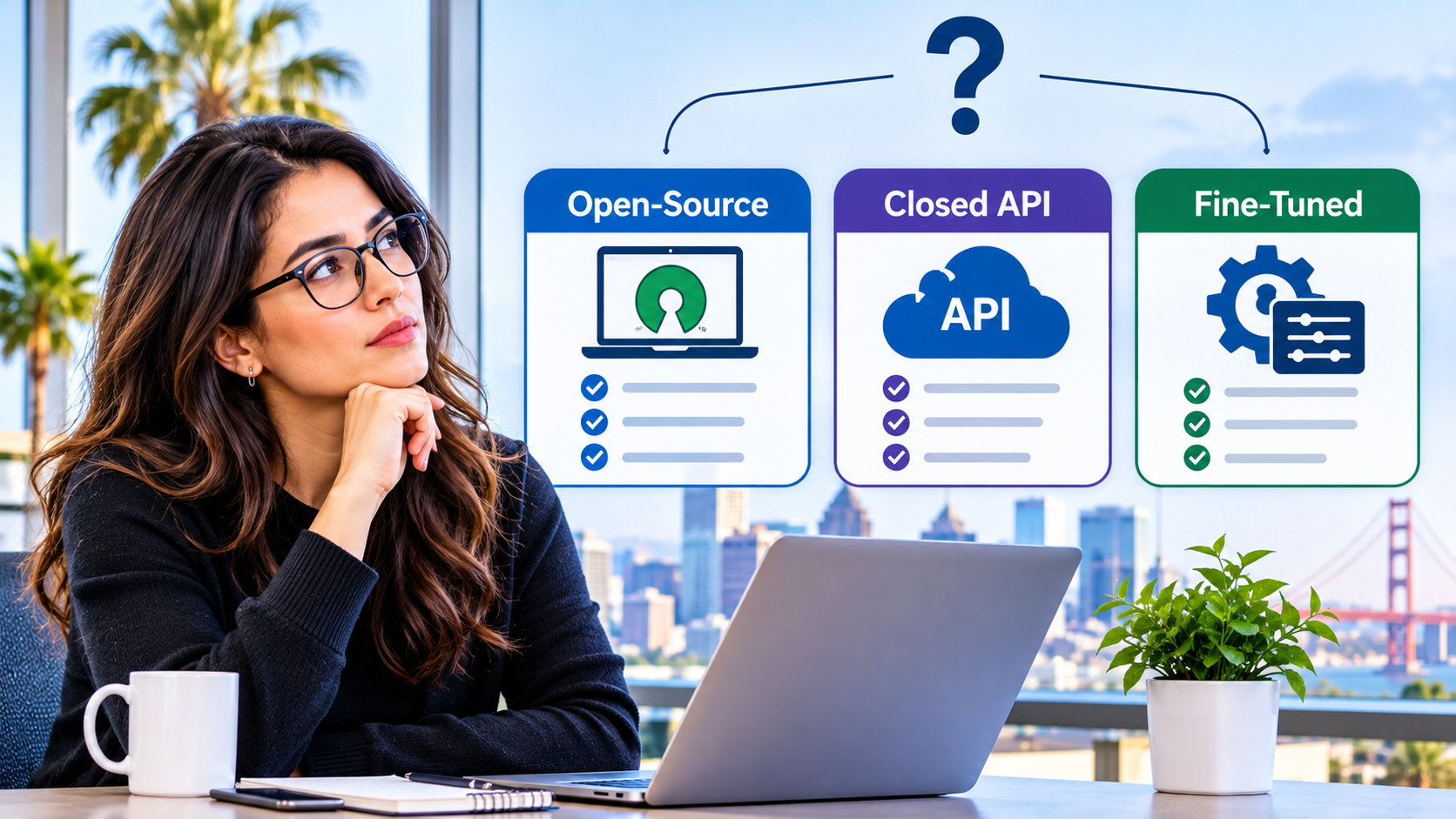
Why the Model Choice Matters More in California
California companies sit closest to the frontier. Many of the leading model developers are headquartered in the Bay Area, and customers here expect AI features to feel current. That creates pressure to adopt the newest release the week it ships.
The same state also has the most active AI rulebook in the country. The California Consumer Privacy Act regulations on automated decision-making technology took effect on January 1, 2026, with some obligations phasing in later. The state's AI training data transparency law, AB 2013, and its frontier model law, SB 53, also began applying in 2026. Which of these touch you depends on whether you build models, deploy them or both. The details change, so confirm with counsel. For this article, the point is practical: where your data goes and how a model reaches decisions are now legal questions, not just technical ones.
The Three Paths Compared
|
Factor |
Closed API model |
Open-weight model, self-hosted |
Fine-tuned model |
|---|---|---|---|
|
Time to first result |
Days |
Weeks |
Weeks to months |
|
Peak capability on general tasks |
Usually highest |
Close, and improving |
Strong on the narrow task, weaker elsewhere |
|
Data control |
Data goes to a provider, subject to its terms |
Data stays in your environment |
Depends on where you train and host |
|
Cost at low volume |
Low, pay as you go |
Higher, because you pay for idle GPUs |
Training cost plus hosting |
|
Cost at very high volume |
Can climb quickly |
Often lower per request |
Lower per request on a small model |
|
Engineering burden |
Light |
Heavy (hosting, scaling, updates) |
Heaviest (data, training, evaluation) |
|
Best for |
Prototypes, general assistants, fast launches |
Regulated data, predictable heavy usage |
Consistent style, classification, domain terminology |
Read the table as a map of trade-offs, not a ranking. A startup in San Francisco with a small team will often start with an API and move selectively later. A healthcare company in San Diego that cannot send patient notes outside its environment may begin with a private deployment.
When Fine-Tuning Is Worth It (and When It Is Not)
Fine-tuning gets oversold. It does not add new facts reliably, and it will not make a weak data pipeline strong. It earns its place in three situations:
-
Consistent format or tone. Support replies, product descriptions, or compliance summaries that must follow a strict house style.
-
Narrow, repeated tasks. Classifying tickets, extracting fields from standard forms, or routing requests, where a smaller tuned model can match a larger general one at a fraction of the cost.
-
Domain vocabulary. Specialized terminology in legal, clinical, or engineering text that general models handle unevenly.
Parameter-efficient methods such as LoRA keep customization affordable by training a small set of added weights instead of the whole model. For knowledge that changes, such as policies, prices, or inventory, retrieval-augmented generation (RAG) is usually better, because you update documents instead of retraining. Where accuracy cannot slip, some teams add retrieval-augmented fine-tuning so the model learns to use retrieved evidence properly.
Model-Agnostic Architecture: The Habit That Saves You Later
Models change fast. A provider can raise prices, retire a version, or ship a better competitor within months. Teams that hard-wire one model into every workflow end up rewriting under pressure.
A model-agnostic design avoids this. Put a thin routing layer between your application and the models, keep prompts and evaluation sets in version control, and test any candidate model against the same benchmark before switching. Multi-model routing, where easy requests go to a small, cheap model and hard ones go to a larger one, can cut cost without a visible drop in quality. Ask any partner how they would make your system portable, and whether they have a financial stake in a particular provider. Mobcoder AI, for example, states that it builds across providers including OpenAI, Anthropic, Google, and open-source models rather than defaulting to one.
Cost Is More Than the Price per Token
Teams often compare models by price per million tokens and stop there. A fuller picture includes:
-
Quality per dollar. A cheaper model that needs two retries or extra human review can cost more than an expensive one that gets it right.
-
Latency. Customer-facing features have a patience limit. A slower, smarter model may lose to a faster one that feels instant.
-
Context and prompt size. Long documents and long instructions multiply cost on every call.
-
Hosting and operations. Self-hosting trades per-call fees for GPU spend, monitoring and on-call engineers.
-
Evaluation and maintenance. Every model or prompt change needs regression testing.
Run a bake-off on your own data. Take 100 to 300 real examples, score outputs on accuracy and on cost per correct answer, and let the numbers settle the debate.
Where California Teams Apply These Choices
Legal and compliance technology. Harvey, a San Francisco legal AI company, sells research and contract analysis tools to law firms. The category shows how much weight buyers put on accuracy, citations, and confidentiality.
Healthcare. Hippocratic AI, based in Palo Alto, focuses on AI agents for healthcare staffing tasks, an area where privacy requirements often push toward tight data controls.
Enterprise AI applications. C3 AI, based in Redwood City, offers pre-built enterprise AI applications for sectors such as manufacturing, energy, and financial services, an example of the buy-versus-build path.
Data and AI platforms. Databricks, based in San Francisco, and NVIDIA, based in Santa Clara, supply much of the platform and compute layer that other companies build on.
None of these examples is a recommendation. They illustrate that California buyers have mature options at every layer, so the real skill is matching the layer to the problem.
How to Run a Practical Model Selection Process
-
Write the task down. Define inputs, outputs, and what a wrong answer costs.
-
Classify the data. Mark what can leave your environment, what cannot, and what needs consent.
-
Build a small evaluation set. Include normal cases, hard cases, and cases where the right answer is "I don't know."
-
Test two or three candidates. Include at least one closed model and one open-weight model where privacy permits.
-
Score on four axes. Accuracy, latency, cost per correct answer, and operational burden.
-
Decide, then keep it reversible. Use a routing layer so switching later is a configuration change, not a rebuild.
This process is the backbone of well-run AI development services, whether the team is internal or external. The deliverable is a decision record your engineers and your lawyers can both read.
Choosing a Partner Who Will Not Push One Model
Your partner's incentives show up in the architecture they propose. Be cautious if every recommendation leads to one cloud, one model provider, or one proprietary platform. Better signs include a written comparison of options, a plan for evaluation and monitoring after launch, and clear answers on data handling. For a wider view of the market beyond California, this guide to choosing an AI development company in USA is a helpful benchmark when comparing proposals.
Frequently Asked Questions
Should I use an open-source or closed AI model?
Choose a closed API model for speed and top general capability when your data can leave your environment. Choose an open-weight model when you need data control, predictable heavy usage, or deep customization. Many teams use both.
Is fine-tuning better than RAG?
They solve different problems. RAG keeps answers grounded in documents that change, while fine-tuning shapes style, format, and narrow-task behavior. Use RAG for knowledge and fine-tuning for behavior, and combine them when both matter.
How much does it cost to fine-tune a model?
It depends on model size, data volume, and method. Parameter-efficient approaches such as LoRA are far cheaper than full training. Include data preparation, evaluation, and hosting in the estimate, since those often outweigh the training run itself.
What should an AI development company in California ask before choosing a model?
It should ask what data is involved, where it may be processed, what accuracy and latency you need, how much traffic to expect, and which regulations apply. If it recommends a model before asking, treat that as a warning sign.
Do California AI laws affect which model I can use?
They can affect how you use a model and what you must disclose or assess, especially around automated decisions that significantly affect people. The rules differ for model developers and deployers and are still evolving, so get legal advice for your situation.
Can I switch models later?
Yes, if you design for it. Keep a routing layer, store prompts and evaluation sets in version control, and re-run your benchmark before every change.

 English
 French
 Spanish
 Portuguese
 Deutsch
 Turkish
 Dutch
 Italiano
 Russian
 Romaian
 Portuguese (Brazil)
 Greek