


Agentic AI vs Generative AI vs AI Agents: What Is the Difference?
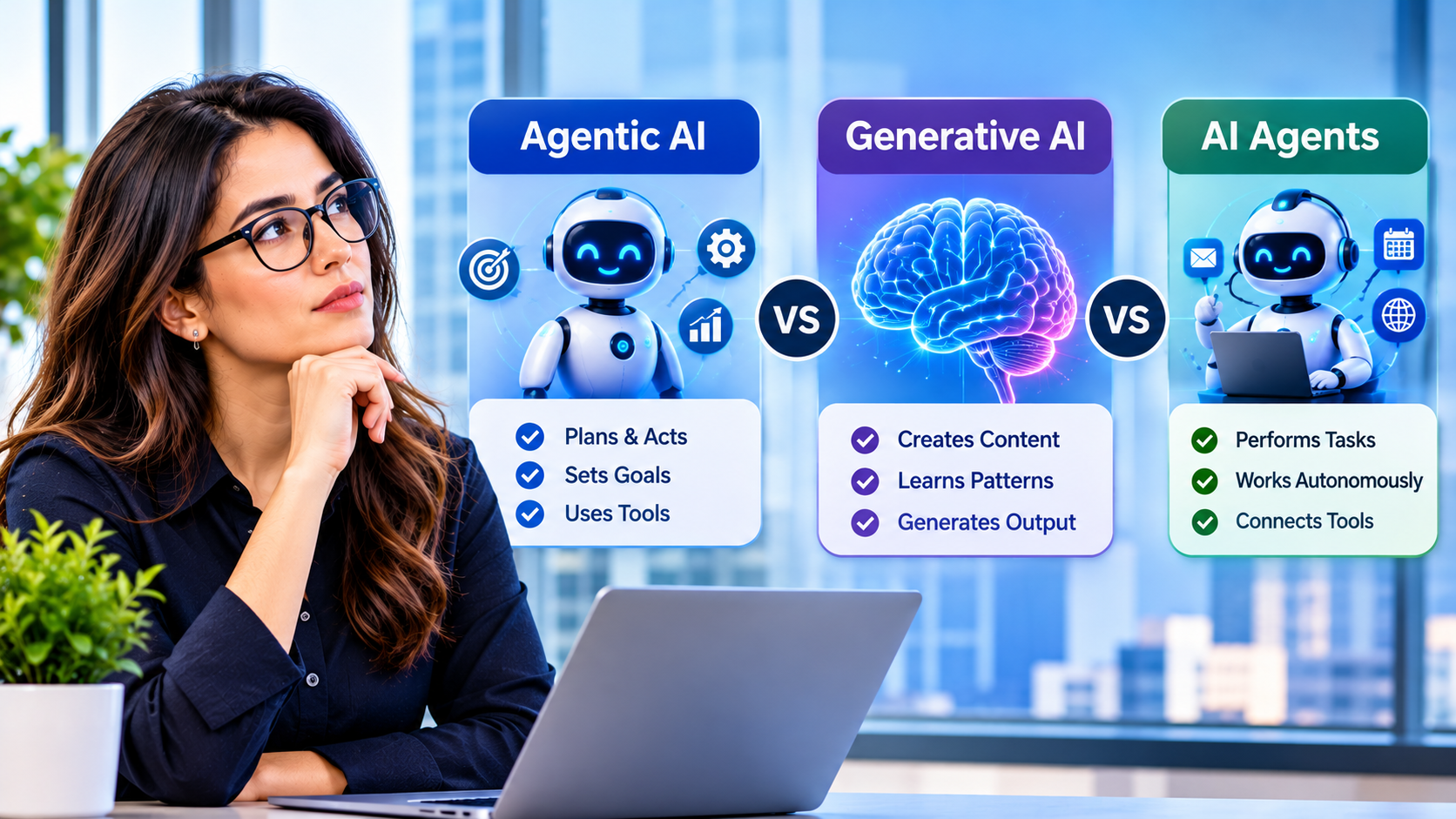
Sit through three vendor pitches this year and you will hear the same three terms used interchangeably: generative AI, AI agents and agentic AI. A chatbot gets called an agent. A script that calls a model once gets called agentic. By the end of the week, your team has a shared vocabulary that means nothing.
The distinction matters because it decides what you build, what it costs and how much can go wrong. This guide gives plain definitions, a side-by-side comparison and a way to match the technology to the job. It also explains what to look for when you evaluate agentic AI development services, so you can separate real engineering from relabeled chat interfaces.
|
Quick answer: Generative AI creates content such as text, images or code when you prompt it. An AI agent is a model wrapped with tools, memory and rules so it can complete a defined task. Agentic AI describes systems in which one or more agents plan, act, check results and adapt across multiple steps with limited human input. Generative AI is the engine, an agent is a worker built on it and agentic AI is the whole coordinated operation. |
The Three Terms, Defined Clearly
Generative AI
Generative AI refers to models that produce new content: written text, images, audio, video, code. You give an input, the model gives an output, and the interaction usually ends there. Drafting a product description, summarizing a report or generating a first version of marketing copy are classic examples. A person remains in the loop for every step, deciding what to do with the result. Teams building these features, from content pipelines to AI-assisted documentation, typically work with generative AI development services that focus on prompt design, grounding in company data and output quality.
AI Agents
An AI agent takes a model and gives it a job. Instead of only producing text, it can call tools such as a CRM, a calendar, a database or an internal API, remember context across interactions and follow rules about what it may and may not do. A well-designed agent is scoped to a role, for example a tier-1 support agent that can look up an order, issue a refund up to a set limit and escalate anything else.
Agentic AI
Agentic AI is the next step up. Here, the system pursues a goal across many steps, often with several agents that hand work to each other. It decides what to do next, uses tools, evaluates its own results, retries or escalates and keeps shared state. Think of a procurement workflow in which one agent reads a purchase request, another checks vendor records, a third validates budget rules and a human approves only the exceptions.
Side-by-Side Comparison
|
Dimension |
Generative AI |
AI agent |
Agentic AI system |
|---|---|---|---|
|
Core job |
Create content on request |
Complete a defined task |
Pursue a goal across many steps |
|
Autonomy |
None, a person drives each step |
Limited, within set rules |
Higher, with planned human checkpoints |
|
Uses tools and APIs |
Rarely |
Yes |
Yes, often many |
|
Memory |
Short, within one conversation |
Persists across interactions |
Shared memory and state across agents |
|
Typical example |
Drafting a blog post or summary |
Support agent that issues refunds |
Multi-agent vendor onboarding workflow |
|
Main risk |
Wrong or low quality content |
Wrong action taken |
Compounding errors across steps |
|
Governance need |
Content review |
Permissions and logging |
Permissions, audit trails and escalation design |
The "main risk" row is the one executives should circle. A bad draft is embarrassing. A wrong refund is expensive. A chain of agents that each trust the previous one's mistake can be both, at scale.
Real Examples Across Industries
Customer service is where agents have gone mainstream. Sierra, co-founded by former Salesforce co-CEO Bret Taylor, builds AI customer service agents for large consumer brands, and Decagon is another venture-backed company in the same space. Both reflect a pattern: the agent handles the routine conversation, uses back-end systems to act and passes the hard cases to people.
Software engineering shows the autonomous end of the range. Cognition's Devin is marketed as an AI system that plans, writes, debugs and deploys code, while tools such as Cursor embed assistance inside the developer's editor. These products sit on a spectrum from copilot to semi-autonomous worker.
Back-office work is quieter but often more valuable. Procurement, vendor management, compliance monitoring, customer onboarding and internal approvals all involve a person moving information between tools. These are strong candidates because the rules are clear and the volume is high.
What the Market Data Says
Adoption is moving fast, and so is the hype. Gartner has predicted that 40 percent of enterprise applications will include task-specific AI agents by the end of 2026, up from less than 5 percent in 2025. The same firm has warned that more than 40 percent of agentic AI projects are likely to be canceled by the end of 2027 because of rising costs, unclear business value or inadequate risk controls. It also flagged "agent washing," where vendors rebrand chatbots and automation as agentic products, and estimated that only a small fraction of the vendors claiming agentic capability offer the real thing.
Read those together and the message is consistent: opportunity is real, and so is the chance of wasting money. Careful scoping is the difference.
How Agentic Systems Are Actually Built
Under the marketing, a production agentic system has six parts.
-
A reasoning model, or several, chosen for the task and cost.
-
Tools, meaning permissioned connections to APIs, databases and applications. Open standards such as the Model Context Protocol, introduced by Anthropic in 2024, are making these connections more consistent.
-
Memory, so the agent can carry context across steps and sessions.
-
Orchestration, the logic that sequences steps, routes work between agents and handles retries. Frameworks such as LangGraph, CrewAI and AutoGen are common starting points.
-
Guardrails, including limits on spending, data access and actions.
-
Human checkpoints and observability, so people approve what matters and every action leaves an audit trail.
Teams that need a role-specific worker, such as a finance or support assistant, often begin with AI agent development services that define decision logic, tool permissions and fallback paths for each agent. Multi-agent systems then coordinate several of them.
Which One Do You Need? A Practical Decision Guide
-
You need faster first drafts or summaries: generative AI with grounding in your documents is enough.
-
You need a repeatable task done inside your systems: build a single agent with tight permissions.
-
You need a process with many handoffs, exceptions and approvals: consider an agentic, multi-agent design.
-
You cannot tolerate a wrong action without review: keep a human approval step before any irreversible action.
-
Your data is messy or your process is undefined: fix those first. An agent will automate confusion at speed.
A useful test is to ask whether a smart new hire could do the task from a written procedure. If the procedure does not exist, the agent has nothing to follow.
Five Mistakes That Sink Agentic Projects
-
Starting with the most complex workflow. Begin with one that has clear rules and a measurable outcome.
-
Giving agents broad access. Grant the minimum permissions each role needs and log every action.
-
Skipping evaluation. Test decision boundaries and failure modes, not only the happy path.
-
Treating governance as paperwork. Security and legal teams need real visibility into what agents can access and do.
-
Forgetting life after launch. Models update, data drifts and prompts need tuning. Budget for monitoring and ownership.
What to Ask Before You Commit
When you compare AI development services from different providers, ask for specifics. Which workflow will you automate first, and how will we measure it? What can the agent do without approval? How do you test for failures, and what does the audit trail look like? Who maintains the system after launch? Concrete answers signal real experience. Slide-deck answers signal agent washing.
Frequently Asked Questions
What is the difference between agentic AI and generative AI?
Generative AI produces content in response to a prompt. Agentic AI uses generative models as part of a system that plans, acts through tools and checks its own results across multiple steps to reach a goal.
Is an AI agent the same as a chatbot?
No. A chatbot mainly converses. An AI agent can also take actions, such as updating a record or issuing a refund, using tools and permissions within defined limits.
What are examples of agentic AI in business?
Common examples include support systems that resolve and escalate tickets, procurement workflows that check vendors and budgets, compliance monitoring that flags issues and onboarding processes that gather and verify documents.
Is agentic AI safe for enterprise use?
It can be, with the right design: limited permissions, human approval for high-impact actions, full audit trails and ongoing monitoring. Without those controls, errors can compound across steps.
How long does it take to build an agentic AI system?
A focused single-workflow agent can take several weeks, while multi-agent systems with many integrations take longer. Discovery, data preparation, integration and testing all contribute, so ask any provider for a phased plan.
Do I need multiple agents or just one?
Start with one agent for one workflow. Add agents only when the process has distinct roles or steps that benefit from separation, such as one agent to retrieve, another to validate and another to act.

 English
 Arabic
 French
 Spanish
 Portuguese
 Deutsch
 Turkish
 Dutch
 Italiano
 Russian
 Romaian
 Portuguese (Brazil)