


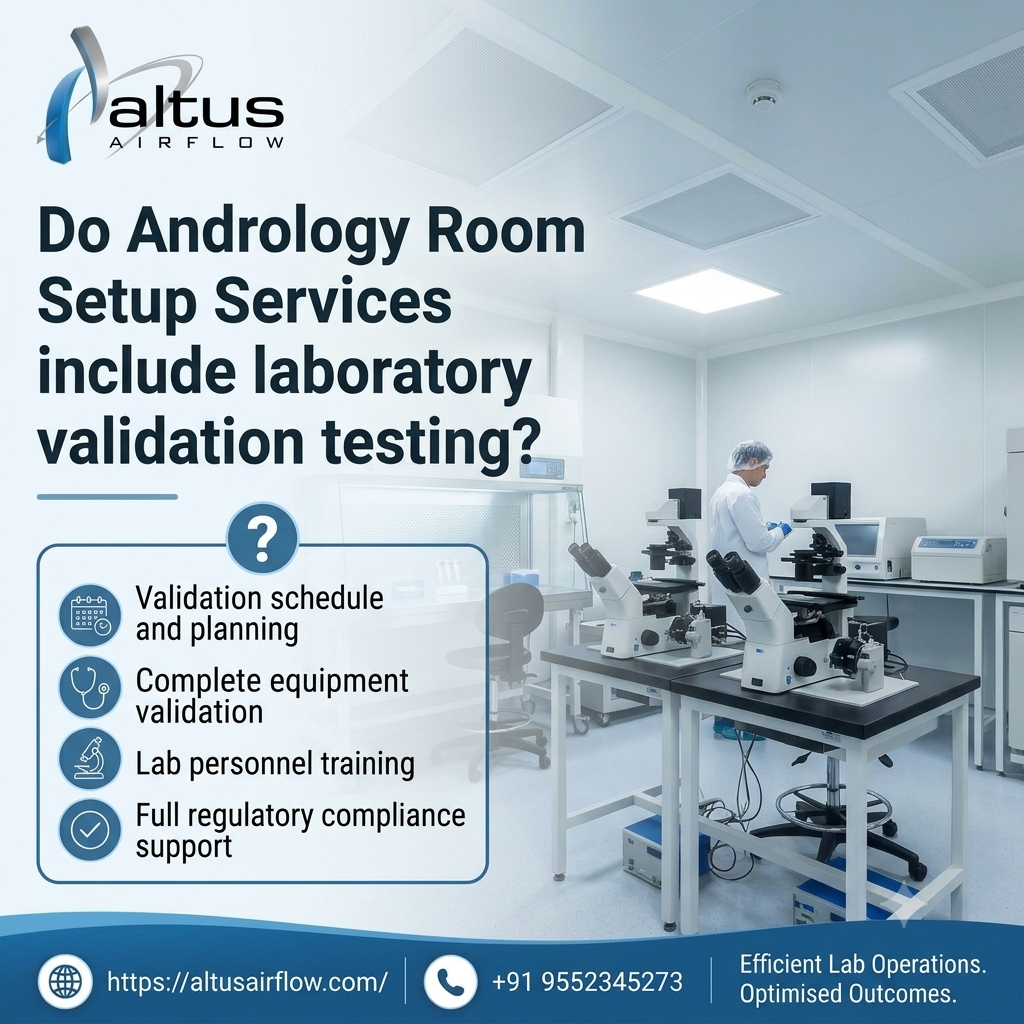
Do Andrology Room Setup Services Include Laboratory Validation Testing?
Introduction
Altus Airflow recognises that setting up an andrology laboratory involves more than installing modular panels, workstations, and specialised equipment. Andrology Room Setup Services can include laboratory validation testing as part of the overall project, depending on the agreed scope and technical requirements. Validation helps confirm whether installed infrastructure, environmental control systems, and laboratory equipment perform according to their approved specifications. The testing process may cover airflow, temperature, humidity, electrical safety, equipment functionality, and other relevant parameters. Proper planning and documentation help fertility centres establish a laboratory environment that is suitable for its intended activities and operational requirements.
1. Understanding Laboratory Validation Testing
Laboratory validation testing is a structured process used to verify that a laboratory's infrastructure, equipment, and relevant environmental conditions meet predefined requirements.
In an andrology laboratory, different systems work together to support activities such as semen analysis, sperm preparation, sample handling, and diagnostic procedures. Therefore, checking individual components and their integration is important before the facility begins routine operations.
Validation-related activities may include:
-
Reviewing approved design specifications.
-
Checking installed modular components.
-
Testing HVAC and environmental control systems.
-
Verifying electrical infrastructure.
-
Checking laboratory equipment functionality.
-
Reviewing monitoring and alarm systems.
-
Recording test results and corrective actions.
The exact testing requirements depend on the laboratory's intended activities, applicable regulations, equipment manufacturers' recommendations, and the project's contractual scope.
2. Are Validation Tests Included in Setup Services?
Yes, validation-related testing can be included in a comprehensive laboratory setup project. However, it is important to distinguish between infrastructure commissioning, equipment qualification, and clinical laboratory process validation.
Infrastructure commissioning verifies that installed systems operate according to the approved engineering design. Equipment qualification checks whether instruments are installed and functioning as specified. Clinical process validation, where required, evaluates whether laboratory procedures consistently achieve their intended results.
These activities may involve different specialists and responsibilities. A project agreement should clearly specify which tests are included, who performs them, what documentation will be supplied, and whether independent certification or specialist laboratory validation is required.
3. HVAC and Airflow Performance Testing
The HVAC system plays an important role in maintaining the environmental conditions required by the laboratory's design. Validation-related checks help determine whether the installed system performs within its specified operating range.
Common checks may include:
Airflow measurement: Testing airflow at designated supply and return points to confirm that the system distributes air as designed.
Air balancing: Checking whether airflow distribution is consistent with the approved HVAC design.
Temperature monitoring: Measuring room temperature at relevant locations to identify variations.
Humidity measurement: Verifying that relative humidity remains within the specified operating range.
Filter inspection: Checking filter installation, condition, and performance documentation according to the selected filtration system.
Pressure verification: Measuring room pressure relationships where pressure control is part of the laboratory design.
These tests should be conducted using appropriate calibrated instruments. Results must be compared with the project's approved specifications rather than assumed universal limits.
4. Temperature and Humidity Validation
Temperature and humidity conditions can influence laboratory equipment performance, sample handling, and the working environment. The required ranges depend on the laboratory's activities, instrument specifications, and relevant procedures.
Validation may involve monitoring environmental conditions over a defined period rather than taking a single measurement.
Important activities include:
-
Measuring temperature at multiple locations.
-
Checking humidity levels using calibrated devices.
-
Reviewing temperature variations during operating hours.
-
Verifying environmental monitoring sensors.
-
Checking alarms for out-of-range conditions.
-
Recording test results for future reference.
If measurements fall outside the specified limits, the engineering team should investigate possible causes. These may include HVAC settings, sensor placement, room leakage, equipment heat loads, or inadequate air distribution.
5. Electrical Safety and Power System Testing
Andrology laboratories may use microscopes, centrifuges, computer-assisted semen analysis systems, refrigerators, computers, and other specialised instruments. Reliable electrical infrastructure is therefore essential.
Electrical testing may include:
-
Checking distribution boards and circuit connections.
-
Verifying protective devices.
-
Testing earthing arrangements.
-
Inspecting power outlets and cable management.
-
Checking dedicated circuits for sensitive equipment.
-
Verifying backup power arrangements where provided.
-
Confirming the functionality of emergency electrical provisions.
The testing should be performed by qualified electrical professionals using suitable procedures and instruments. Equipment-specific electrical checks should also follow manufacturer instructions.
6. Laboratory Equipment Installation and Qualification
Laboratory instruments must be installed in suitable locations and operated according to manufacturer specifications. Equipment qualification is often divided into three stages.
Installation Qualification (IQ): Confirms that the instrument has been delivered, installed, and connected according to the manufacturer's requirements.
Operational Qualification (OQ): Checks whether the equipment operates correctly across its specified operating functions.
Performance Qualification (PQ): Evaluates whether the equipment performs consistently under the conditions and intended use defined by the laboratory.
Not every instrument follows an identical qualification procedure. The applicable approach should be based on equipment type, manufacturer guidance, risk assessment, and laboratory quality requirements.
For example, a microscope may require optical performance checks, while a centrifuge may require verification of speed and other relevant operating parameters. Refrigeration equipment may require temperature mapping and alarm checks.
7. Modular Infrastructure and Finish Inspection
Modular walls, ceilings, doors, and flooring form an important part of the laboratory environment. Their inspection helps verify that the installed components match the approved design and are suitable for the intended maintenance and cleaning procedures.
Inspection activities may include:
-
Checking panel alignment and surface condition.
-
Reviewing joint sealing and finishing.
-
Inspecting doors, locks, and viewing windows.
-
Checking service penetrations.
-
Confirming that flooring finishes are properly installed.
-
Reviewing access for cleaning and maintenance.
-
Checking the integration of lights and service fittings.
Any defects identified during inspection should be recorded and corrected before the final handover. This helps reduce maintenance difficulties and avoid unnecessary modifications after the laboratory becomes operational.
8. Monitoring Systems, Sensors, and Alarms
Modern laboratory infrastructure may include digital monitoring systems for environmental conditions and equipment status. These systems can help staff identify deviations and respond according to established procedures.
Validation checks may cover:
Sensor accuracy: Comparing sensor readings with suitable reference instruments.
Data recording: Confirming that readings are stored and can be retrieved.
Alarm functionality: Checking whether alerts activate when configured limits are exceeded.
Communication: Verifying that connected monitoring devices transmit information correctly.
Power failure response: Checking backup arrangements and alarm behaviour where applicable.
Monitoring systems should be tested against approved settings. Staff should also understand how to interpret alerts, document deviations, and escalate technical issues.
9. Documentation Required After Validation
Documentation provides evidence that testing has been completed and that any identified issues have been addressed. It also supports maintenance, internal quality reviews, and future inspections.
Depending on the project scope, documentation may include:
-
Approved laboratory layout and engineering drawings.
-
HVAC testing and balancing reports.
-
Temperature and humidity measurement records.
-
Electrical inspection reports.
-
Equipment installation and qualification documents.
-
Calibration certificates.
-
Monitoring system test records.
-
Inspection and defect closure reports.
-
Operation and maintenance manuals.
-
Staff training records.
Records should identify the test performed, the instrument used, the acceptance criteria, the results, the person responsible, and any corrective action taken.
10. What Happens When a Test Result Fails?
A failed test does not necessarily mean that the entire laboratory project has failed. It indicates that a particular system or component requires investigation and corrective action before acceptance.
A structured response generally includes:
-
Recording the failed result and relevant conditions.
-
Identifying the system or component involved.
-
Investigating the possible root cause.
-
Implementing corrective measures.
-
Repeating the relevant test.
-
Documenting the new result.
-
Obtaining approval from the responsible technical or quality representative.
For example, if airflow measurements do not meet the approved design criteria, the team may inspect filters, duct connections, dampers, fan settings, and air distribution. After adjustments, the relevant measurements should be repeated.
11. Who Is Responsible for Laboratory Validation?
Responsibility depends on the type of testing and the contractual arrangement.
A modular laboratory engineering provider may coordinate infrastructure installation and commissioning. HVAC specialists may conduct airflow and environmental performance testing. Electrical professionals may verify electrical safety. Equipment manufacturers or authorised service providers may perform instrument installation, calibration, and qualification.
The hospital or fertility centre remains responsible for defining its operational and clinical quality requirements. Laboratory management and quality personnel should review the relevant documentation and ensure that required procedures are established before routine use.
Clear responsibility allocation helps prevent gaps between engineering handover and laboratory readiness.
12. How to Plan Validation Testing During the Project
Validation should be considered during the design stage rather than postponed until the installation is complete. Early planning helps ensure that the necessary test points, access panels, monitoring devices, and documentation arrangements are included.
Practical planning steps include:
-
Define the laboratory's intended activities.
-
Identify applicable standards and regulatory requirements.
-
Prepare an agreed validation and commissioning plan.
-
Confirm acceptance criteria for each system.
-
Select suitable calibrated testing instruments.
-
Coordinate testing with equipment suppliers.
-
Assign responsibilities to qualified professionals.
-
Schedule corrective work and retesting.
-
Maintain organised records for final review.
Including these requirements in the project schedule can reduce delays and make the handover process more systematic.
Conclusion
Laboratory validation testing is an important part of establishing a functional and technically verified andrology facility. It may cover HVAC performance, environmental monitoring, electrical safety, equipment qualification, modular infrastructure inspection, and documentation. However, the exact tests included depend on the agreed project scope and the laboratory's operational requirements.
Andrology Room Setup Services can bring infrastructure installation and commissioning activities together under a coordinated project plan. Altus Airflow focuses on modular healthcare infrastructure and laboratory engineering, helping facilities plan essential installation and testing activities. With clearly defined responsibilities, suitable testing procedures, and complete documentation, Altus Airflow supports a more organised approach to laboratory project handover.
Frequently Asked Questions (FAQs)
1. Do Andrology Room Setup Services include laboratory validation testing?
Andrology Room Setup Services can include infrastructure commissioning and validation-related testing, depending on the agreed scope, technical specifications, and laboratory requirements.
2. Which HVAC parameters are tested in an andrology laboratory?
Common parameters include airflow, temperature, humidity, filtration performance, and room pressure where specified.
3. Is equipment qualification necessary before laboratory operation?
Yes. Relevant equipment should be installed, checked, and qualified according to manufacturer instructions and laboratory quality requirements.
4. Who performs laboratory validation testing?
Qualified HVAC, electrical, equipment, and laboratory quality professionals perform different tests according to their responsibilities.
5. What documents are provided after commissioning?
Documents may include HVAC reports, electrical inspection records, equipment qualification documents, calibration certificates, and maintenance manuals.
Read Our Previous Blog ---------------> How long does it take to complete Turnkey Andrology Room Solutions?

 English
 Arabic
 French
 Spanish
 Portuguese
 Deutsch
 Turkish
 Dutch
 Russian
 Romaian
 Portuguese (Brazil)
 Greek