


Custom Tofu Boxes & Display Boxes: What US Brands Get Wrong Before Ordering
A block of tofu arrives at a grocery store looking like a deflated sponge. The display box holding it has bowed in the middle, and the packaging looks like it survived a minor earthquake.
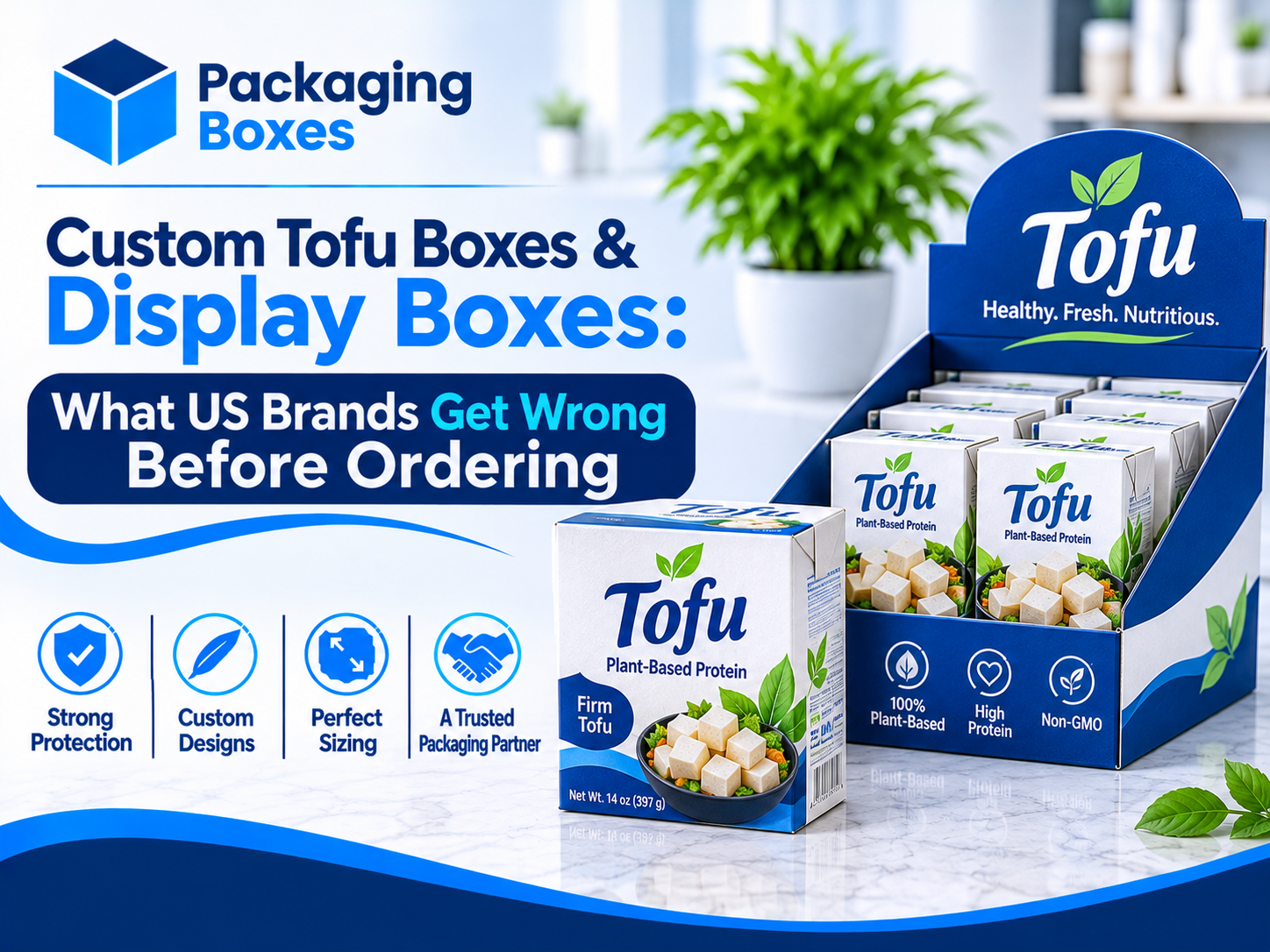
Here is the thing most US food brands learn the hard way: custom tofu boxes and standard display boxes are structural tools, not just marketing materials. Tofu is a delicate, water-heavy product. It bruises if you look at it wrong. A display box has to hold that weight without sagging while still looking clean enough for a premium grocery shelf.
If the cardboard is too thin, or the internal packaging doesn't manage moisture, you get crushed product and soggy shelves.
At Packaging Boxes, we supply both lines to US sellers who need flexibility-no minimum order, fast turnaround, and free design support. Before you order from anyone, here is what actually matters.
Custom Tofu Boxes: Moisture and Crush Are the Enemies
Tofu is mostly water. If you package it wrong, the box gets soggy before it even hits the refrigerated aisle. If you stack it wrong, the bottom blocks get crushed into mush.
The moisture barrier is non-negotiable. Standard paperboard will absorb water from the tofu packaging and lose its structural integrity. You need a box with a moisture-resistant coating or a food-grade liner. If your tofu brand is sitting in a refrigerated case with condensation dripping on it, an uncoated box is going to fail.
Crush resistance starts with the flute. Tofu blocks are dense. When you stack multiple boxes on a pallet or a grocery shelf, the bottom boxes have to hold the weight of the ones above. E-flute corrugated or B-flute handles this well. Thin folding cartons will bow and crush the product inside.
The window question. Many tofu brands want a window so customers can see the product. A full cutout window weakens the box. If you need visibility, spec a smaller window with reinforced edges. Otherwise, skip the window and put a high-quality photo on the box.
Ventilation vs. Protection. Some tofu packaging needs to breathe to prevent condensation from building up inside the box. Punched vents help, but they also weaken the structure. Balance the airflow with the crush resistance you need for stacking.
Display Boxes: The Shelf Is a Harsher Environment Than the Truck
A counter display or shelf-ready tray sits in a grocery environment for weeks. Customers grab products. Staff restock. The box gets pushed, turned, and refilled. If the structure is flimsy, it looks worn out before the product sells.
The structure has to hold under repeated handling. E-flute corrugated or heavy SBS paperboard holds up to restocking. A thin folding carton tray sags after the second refill. I've seen brands save a few cents per unit on display trays and lose the retail placement because the display looked shabby by week three.
The header card is a structural element, not decoration. A header card that tilts forward looks broken. The fold or tab that holds it upright needs to be spec'd for the weight of the card and any hanging product. If you're hanging the display on a pegboard, the hang tab needs reinforcement-a single-layer cardboard tab tears under the weight of a full tray.
Depth matters for restocking. A tray that's too shallow lets product fall forward. Too deep, and the front product hides at the back. Match the tray depth to the product footprint, plus a little clearance so staff can refill without fighting the box.
Windows and cutouts sell. A display box that shows the product through a cutout or window gets more attention than a closed box. Just confirm the cutout doesn't weaken the structure. Cutouts near corners or along fold lines are where displays fail first.
Materials: Where US Food Brands Overspend
You will see three main options pitched for retail packaging. Here is the honest read after working with US sellers.
Corrugated cardboard (E-flute) is the sweet spot for both display and tofu boxes. It is thin, dense, and absorbs shock. It holds up to restocking and handles the weight of stacked tofu. For most US brands, this is the right call.
Folding carton board is single-layer paperboard. It is cheaper and looks great, but it sags under weight and moisture. Fine for a lightweight retail carton that goes inside a larger display, not fine as a standalone shipping box for tofu.
Rigid chipboard is the luxury play. Thick, non-bending, and wrapped in printed paper. It gives your display a premium feel, but it costs more, ships assembled, and takes up warehouse space. Use rigid for high-end boutique displays, not for standard refrigerated grocery cases.
Skip foam for eco-conscious brands. Pulp and molded fiber inserts pair well with cardboard and recycle curbside. Custom box inserts do the structural work; the pulp does the cushioning.
Printing on Cardboard: What Reads and What Doesn't
Cardboard isn't white paper. Brown kraft board shifts ink colors. White corrugated gives accurate color but costs more and shows scuffs.
Dark colors print well on brown. Navy, black, deep green-these read cleanly. Light colors need a white base layer.
Simple typography beats photography. Full-color images look muted on brown board. Solid colors, line art, and bold type look intentional. Design for the material, not for a white page.
Inside printing is underrated. A printed message or logo inside the box looks premium and costs less than full exterior coverage. For tofu boxes, inside printing doesn't matter much because the product is sealed. For display boxes, it does.
Why US Brands Order From Packaging Boxes
I'll be direct because you can get "premium quality" from anyone's homepage.
No minimum order. Testing a new tofu flavor or a seasonal display box? Order a small run and see how it performs before committing to inventory you haven't validated. No MOQ custom tofu boxes and no minimum display boxes change the math for small brands.
Fast standard turnaround. Grocery launches, seasonal drops, restocks-you can't wait weeks for packaging. Our timeline is on the quote.
Free dieline and digital proof. Send your dimensions. Get a dieline you can drop artwork into. Approve a 3D mockup before anything prints. No surprise setup fees.
Free shipping across the USA. Cardboard is bulky, and shipping costs add up fast. Custom tofu boxes with free shipping and display boxes with free shipping keep the landed cost predictable.
Free design support. Can't visualize the finished box? Our team provides templates, mockups, and revisions before production starts.
Reliable customer support. You'll have questions about moisture barriers, flute grades, display structure, and printing. Our team answers them quickly.
The trade-off? We're not the cheapest per-unit at massive volumes. High-volume buyers with rigid specs can find lower quotes elsewhere. For brands doing small-to-mid runs, the flexibility usually beats the per-unit savings.
The Detail That Saves You Money: Structural Testing
Most tofu box failures happen because the box gets wet and loses its crush strength. Most display box failures happen at the fold lines and corners.
For tofu boxes: test the box with the actual product in a refrigerated environment. Does the cardboard soften? Does the stack crush the bottom layer? If it does, you need a moisture barrier or a heavier flute.
For display boxes: test the tray with the product in it. Pull products out. Restock. Does the tray hold its shape? Does the header card stay upright? If it sags, the board is too light.
These tests aren't glamorous. But they're the difference between a product that sells and one that looks damaged on the shelf.
Quick Answers to What US Brands Actually Ask
What's the best material for custom tofu boxes?
Corrugated cardboard with a moisture-resistant coating or food-grade liner. Tofu is water-heavy, and uncoated paperboard will soften and lose structure in a refrigerated environment.
What's the difference between custom tofu boxes and display boxes?
A custom tofu box is built to protect a delicate, water-heavy product from crushing and moisture during shipping and storage. A display box is built for the retail shelf-sturdy, stackable, and designed to hold product for customers to grab.
Can I order a small batch of custom tofu boxes or display boxes?
With Packaging Boxes, yes. No minimum order. Test a new product line or limited retail launch without tying up cash in inventory you haven't validated.
How long does production and shipping take?
We offer fast standard turnaround times after proof approval, plus free shipping anywhere in the USA. Rush options available if you ask upfront.
Bottom line: A tofu box that gets soggy and a display box that sags on the shelf fail for different reasons-but both cost you the retail placement. Don't order from a supplier who won't show you a dieline, won't give you a proof, and won't tell you the turnaround before you pay.
Packaging Boxes does all three. Send your product dimensions and your retail setup. We'll spec the tofu box and the display box-separately-and get you a quote. No minimum, no pressure.

 Arabic
 French
 Spanish
 Portuguese
 Deutsch
 Turkish
 Dutch
 Italiano
 Russian
 Romaian
 Portuguese (Brazil)
 Greek