


Automated Fare Collection Market Report: Size, Share, Growth Analysis & Forecast 2026-2034
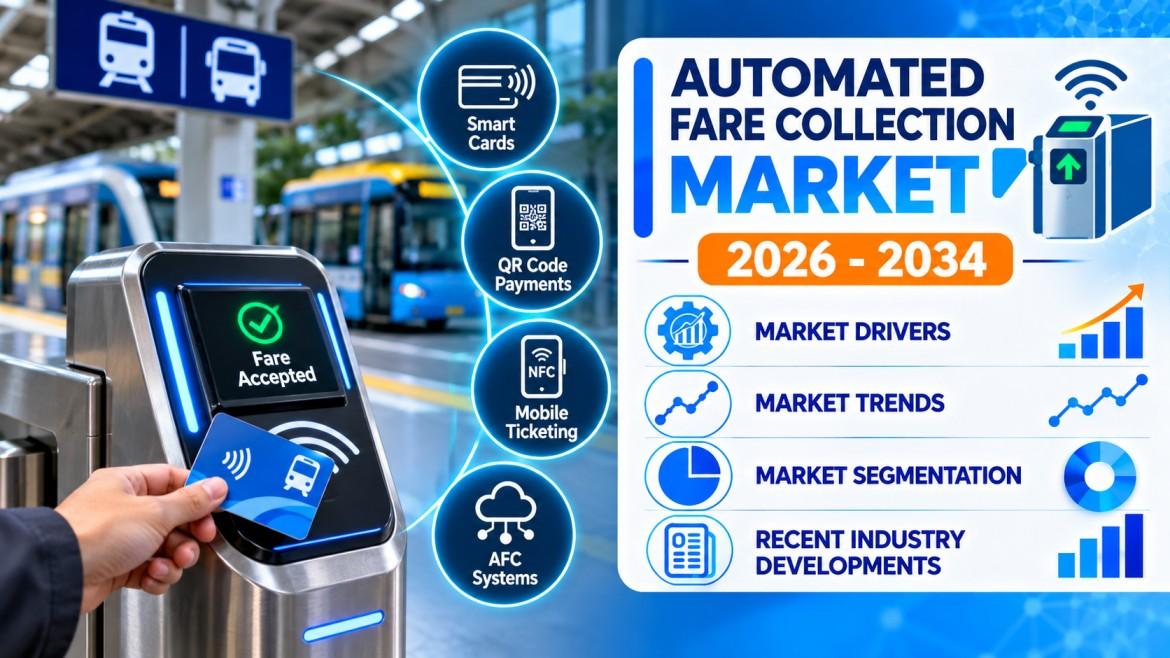
IMARC Group, a leading global market research and management consulting firm, has published its latest market intelligence report on the automated fare collection market. The global automated fare collection market size reached USD 14.94 Billion in 2025 and is projected to reach USD 36.27 Billion by 2034, growing at a CAGR of 10.04% during 2026-2034, driven by rapid urban transit expansion, rising adoption of contactless open-loop payment systems, increasing smart city transit investments, and the growing demand for seamless intermodal passenger mobility worldwide.
The automated fare collection system market is witnessing strong growth as public transportation networks increasingly adopt digital ticketing, contactless payments, and smart mobility solutions. Rising investments in metro and rail infrastructure, urbanization, and the growing demand for seamless passenger experiences are driving the adoption of automated fare collection systems across buses, railways, and other transit networks. The market is experiencing strong growth momentum propelled by the modernization of public transit infrastructure and the widespread digitization of urban transit ticketing. Municipal transport authorities and private fleet operators are transitioning away from high-friction, paper-based ticketing and manual cash handling toward automated, interoperable ticketing architectures. Automated fare collection (AFC) systems significantly reduce commuter queue times, prevent fare evasion, lower operating overhead, and provide transit agencies with real-time passenger flow analytics to optimize service scheduling. Concurrently, the proliferation of contactless bank cards, near field communication (NFC) mobile wallets, and interoperable smart cards is transforming public transport networks into cohesive Mobility-as-a-Service (MaaS) ecosystems across major metropolitan hubs.
How Account-Based Ticketing and Open-Loop Contactless Payments Are Reshaping the Automated Fare Collection Market
- Transition from Card-Centric Architectures to Cloud Account-Based Ticketing (ABT)
- Traditional AFC systems operated on closed-loop, card-centric models where fare balances, trip data, and fare calculation logic were written directly onto the physical chip of a proprietary smart card. Modern transit authorities are migrating toward cloud-hosted Account-Based Ticketing (ABT). In an ABT architecture, the card or digital token serves merely as an identifier linked to a secure passenger profile in a centralized back-office database. Fare engines calculate trip fees, distance-based discounts, and fare capping dynamically in the cloud, allowing agencies to update fare rules instantly without costly firmware updates on thousands of physical gate validators.
- Proliferation of Open-Loop EMV Contactless and Mobile NFC Payments
- Open-loop contactless payment technology has emerged as the defining standard for frictionless urban mobility. Commuters no longer need to purchase dedicated local transit cards, download separate apps, or wait in line at ticket vending kiosks; they can simply tap standard contactless debit or credit cards (EMV) or NFC-enabled smartphones directly at turnstiles and bus validators. By eliminating proprietary transit card issuance and reloading expenses, transport operators can reduce ticketing administration and cash-handling costs by 30% to 40% while delivering a frictionless travel experience for daily commuters and international tourists alike.
- Multimodal Integration and Dynamic Fare Capping Algorithms
- Metropolitan transit systems are integrating disjointed transport modes, including heavy rail, metro, light rail, commuter buses, ferries, and micro-mobility bike-share schemes, into a unified payment ecosystem. Advanced AFC fare calculation software automatically applies daily, weekly, or monthly fare-capping logic. Once a commuter reaches a predetermined spending threshold within a rolling timeframe, subsequent journeys become free, ensuring travelers always receive the best available value without having to calculate complicated multi-zone passes in advance.
Grab a sample PDF of this report: https://www.imarcgroup.com/automated-fare-collection-market/requestsample
Automated Fare Collection Market Trends and Drivers
The global automated fare collection market is witnessing steady expansion, underpinned by supportive government smart city policies and extensive transit capital expenditure programs. In the United States, federal initiatives administered by the Federal Transit Administration (FTA), including the Accelerating Innovative Mobility (AIM) grants, provide dedicated funding to municipal transport agencies to implement open-loop contactless fare gates and mobile ticketing solutions. In Europe, the European Union Intelligent Transport Systems (ITS) Directive and Green Deal mobility goals mandate interoperable cross-border ticketing and carbon-efficient urban transit networks, spurring multi-million-euro transit ticketing overhauls across the United Kingdom, France, Germany, and Spain.
In emerging economies, national standardization mandates are driving rapid fare automation. In India, the Ministry of Housing and Urban Affairs (MoHUA) has enforced the National Common Mobility Card (NCMC) framework, a homegrown "One Nation One Card" contactless standard that enables commuters to pay for metro journeys, suburban trains, city buses, toll plazas, and retail purchases using a single interoperable card. Similarly, transport departments across Southeast Asia, the Middle East, and Latin America are deploying integrated automated fare collection systems to modernize bus rapid transit (BRT) networks and regional rail corridors, replacing legacy paper tokens with secure contactless interfaces.
Massive transit ridership numbers and urban congestion challenges require high-throughput passenger processing equipment. In high-density metro stations, modern optical sensor fare gates process up to 40 to 60 passengers per minute, preventing bottlenecking during peak morning and evening travel periods. Furthermore, automated revenue reconciliation eliminates fraud and revenue leakage associated with manual token booths, ensuring financial transparency for municipal governments and private concessionaires operating public-private partnership (PPP) transit lines.
Ask an analyst for customized report: https://www.imarcgroup.com/request?type=report&id=2942&flag=E
Automated Fare Collection Industry Segmentation
The report has segmented the market into the following categories:
Breakup By Component:
- Hardware
- Software
- Services
Hardware represents the largest component segment, commanding approximately 63.0% of total market revenue. Public transit infrastructure requires substantial upfront capital deployment in physical terminal equipment, including ruggedized turnstiles, optical flap gates, ticket vending machines (TVMs), ticket office machines (TOMs), onboard bus validators, and handheld inspection units designed to withstand intense daily commuter wear. Software represents the fastest-growing category, fueled by demand for cloud-based back-office fare calculation engines, clearinghouse reconciliation software, customer identity management platforms, and fraud detection algorithms. Services encompass systems integration, hardware maintenance, software-as-a-service (SaaS) hosting, and lifecycle technical support, providing recurring revenue streams for solution vendors.
Breakup By System Type:
- Fare Gates
- Ticket Vending Machine (TVM)
- Ticket Office Machine (TOM)
- IC Cards / Smart Cards
Fare gates represent the dominant system type across metro and rail transit networks, acting as the primary automated access control and payment validation barrier. High-speed bidirectional flap barriers and motorized swing gates integrated with optical sensors prevent unauthorized tailgating while processing high passenger volumes seamlessly. Ticket vending machines (TVMs) maintain a significant presence in passenger terminals, allowing travelers to purchase single-journey QR code tickets, reload accounts, and check balances using cash, bank cards, or digital wallets. Ticket office machines (TOMs) support customer service desks for exception handling and card issuance, while IC cards and smart cards continue to serve millions of regular transit users.
Breakup By Technology:
- Smart Card
- Near Field Communication (NFC)
- Magnetic Stripe
- Others
Smart cards lead the technology segment, accounting for approximately 46.0% of global market deployments. Contactless smart cards utilizing high-frequency RFID chips (such as MIFARE and FeliCa protocols) offer exceptional durability, high read speeds under 300 milliseconds, and secure cryptographic encryption for storing trip credentials. Near field communication (NFC) is expanding rapidly, enabled by the ubiquity of smartphones and smartwatches equipped with digital payment credentials like Apple Pay, Google Wallet, and Samsung Pay. Magnetic stripe ticketing is declining sharply due to slow read speeds, mechanical wear, and high maintenance overhead, being systematically replaced by 2D optical QR code ticketing and contactless interfaces.
Breakup By Application:
- Railways and Transportation
- Parking
- Entertainment
- Others
Railways and transportation constitute the primary application segment, generating the overwhelming majority of market revenue. Heavy rail lines, rapid transit subways, commuter rail, light rail transit (LRT), and bus fleets handle billions of daily passenger journeys globally, requiring mission-critical AFC reliability. The parking sector represents a significant growth vertical, where parking garages, municipal curbsides, and park-and-ride transit hubs integrate automated license plate recognition (ALPR) and contactless payment kiosks to eliminate vehicle wait times. The entertainment application covers theme parks, sports stadiums, and event venues utilizing automated access turnstiles and RFID wristbands for ticketing and cashless concessions.
Breakup By Region:
- North America (United States, Canada)
- Asia-Pacific (China, Japan, India, South Korea, Australia, Indonesia, Others)
- Europe (Germany, France, United Kingdom, Italy, Spain, Russia, Others)
- Latin America (Brazil, Mexico, Others)
- Middle East and Africa
North America commands the largest regional share in the global automated fare collection market, holding approximately 35.0% of total revenue. Market dominance is driven by extensive transit modernizations across major metropolitan agencies, including New York's MTA, Chicago's CTA, and the San Francisco Bay Area's BART, which have led large-scale transitions to open-loop contactless fare systems. Europe represents the second-largest market, characterized by mature, high-density public transit networks, pioneer deployments of open-loop EMV payments inspired by Transport for London, and cross-border multimodal integration programs. Asia-Pacific is projected to exhibit the highest growth velocity, catalyzed by massive high-speed rail and urban metro investments across mega-cities in China, India, Indonesia, and Japan, where government funding favors complete transit digitalization.
Competitive Landscape
The report provides a comprehensive analysis of the competitive landscape in the automated fare collection market with detailed profiles of all major companies, including:
- Atos SE
- Conduent Incorporated
- Cubic Corporation (Cubic Transportation Systems)
- Indra Sistemas, S.A.
- LECIP Holdings Corporation
- Nippon Signal Co., Ltd.
- Omron Corporation
- Scheidt & Bachmann GmbH
- Siemens AG
- Singapore Technologies Engineering Ltd (ST Engineering)
- Thales Group
- Vix Technology
According to exhaustive industry findings presented in IMARC's full market report, premier systems integrators and equipment manufacturers are heavily pursuing long-term design-build-operate-maintain (DBOM) contracts, while partnering with global payment networks like Visa and Mastercard to deploy turnkey, cloud-hosted open-loop fare payment platforms.
What Does The Full Report Cover?
If you are tracking the automated fare collection market for transit procurement, municipal bidding, investment evaluation, or technological roadmapping, IMARC Group's report provides complete strategic coverage:
- Full market sizing and revenue evaluations across all defined equipment, technology, and regional segments
- Quantitative evaluation of growth drivers, fare policy reforms, and capital investment budgets
- Comprehensive sub-segment breakdowns across hardware components, software architectures, system types, and application categories
- In-depth country-level analysis covering the United States, Canada, Germany, France, the United Kingdom, Italy, Spain, China, Japan, India, Australia, Brazil, and Mexico
- Competitive profiling of major vendors detailing installed base footprints, proprietary software platforms, and recent transit contract wins
- Technological intelligence on account-based ticketing, open-loop EMV integration, biometric facial recognition gates, and Mobility-as-a-Service platforms
Recent News and Developments in Automated Fare Collection Market
- January 2026: PT Mass Rapid Transit Jakarta awarded Hitachi Rail and PT Softorb Technology Indonesia a major contract to modernize the automated fare collection infrastructure across 13 stations, replacing over 200 fare gates with multi-modal open-loop EMV contactless and QR-based account ticketing systems.
- June 2025: Datamatics Global Services was awarded a major automated fare collection contract for the 23-station Pune Metro Line 3 in India, integrating National Common Mobility Card (NCMC) standards and open-loop QR payment gateways to enable seamless intermodal transit.
- January 2025: Aurionpro Transit partnered with Mastercard and the National Bank of Egypt to deploy open-loop automated fare collection architecture across Egypt's public transport buses and transit terminals, transitioning regional mass mobility toward digital contactless payments.
- April 2024: Indra secured a landmark, multi-million-euro contract with Ireland's National Transport Authority (NTA) to design, build, and operate the nationwide Next Generation Ticketing (NGT) system, deploying a cloud-hosted Account-Based Ticketing (ABT) infrastructure across buses, trains, and trams.
Note: If you require specific details, data, or insights that are not currently included in the scope of this report, we are happy to accommodate your request. As part of our customization service, we will gather and provide the additional information you need, tailored to your specific requirements. Please let us know your exact needs, and we will ensure the report is updated accordingly to meet your expectations.
Key Questions This Report Answers
- What is the current global automated fare collection market size and what is its projected value?
- Which component segment holds the largest share in the global automated fare collection market?
- What are the primary technological and municipal drivers accelerating transit fare automation?
- Which region dominates the global automated fare collection market and why?
- How are account-based ticketing and open-loop contactless EMV payments transforming passenger boarding speeds?
- Who are the leading companies in the global automated fare collection market and what are their competitive strategies?
- What are the high-growth commercial opportunities across urban rail networks, bus fleets, and smart parking facilities?
About Us
IMARC Group is a global management consulting firm that helps the world's most ambitious changemakers to create a lasting impact. The company provides a comprehensive suite of market entry and expansion services. IMARC offerings include thorough market assessment, feasibility studies, company incorporation assistance, factory setup support, regulatory approvals and licensing navigation, branding, marketing and sales strategies, competitive landscape and benchmarking analyses, pricing and cost research, and procurement research.
Media and Sales Contact
IMARC Group
Email: sales@imarcgroup.com
United States: +1-201-971-6302
India: +91-120-433-0800
United Kingdom: +44-753-714-6104

 English
 Arabic
 French
 Spanish
 Portuguese
 Deutsch
 Turkish
 Dutch
 Italiano
 Russian
 Romaian
 Portuguese (Brazil)