


Borrower Risk Assessment in India: Identifying Credit Risks and Strengthening Lending Decisions
Why Borrower Risk Assessment Is the Foundation of Sound Lending
Every lending decision is, at its core, a prediction about the future behaviour of a specific borrower. Will this individual or business repay this loan on the agreed terms? No lender can answer this question with certainty — the future is inherently uncertain, and borrower circumstances can change in ways that even the most thorough assessment cannot fully anticipate. But the quality of the assessment directly determines how accurate the prediction is, how well-priced the credit is for the risk accepted, and how frequently the prediction is wrong in ways that produce losses.
In India's diverse and dynamic lending market — spanning public sector banks, private banks, NBFCs, microfinance institutions, and an expanding digital lending ecosystem — the quality of borrower risk assessment varies enormously. At one end of the spectrum are institutions with sophisticated, data-rich assessment frameworks that make accurate, fast, and inclusive credit decisions. At the other are those relying on limited data, subjective judgment, and collateral-heavy approaches that exclude creditworthy borrowers while failing to accurately identify genuine high-risk ones. Strengthening borrower risk assessment across the lending system is one of the most impactful improvements available for improving both credit access and portfolio quality simultaneously.
The Multi-Dimensional Nature of Borrower Risk
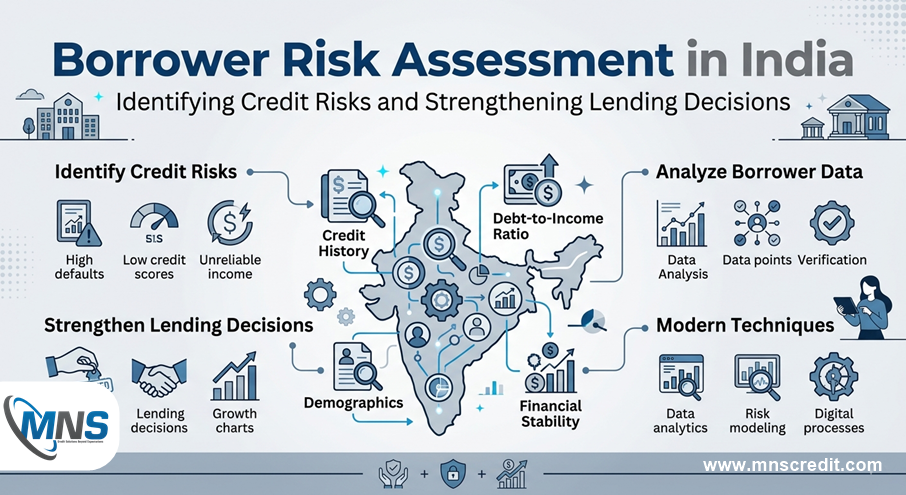
Effective borrower risk assessment in India must address multiple dimensions of risk that together determine the probability and severity of default. No single dimension is sufficient on its own, and the most dangerous assessment failures occur when lenders over-weight one dimension — typically collateral or bureau score — while ignoring others that are equally predictive of actual repayment behaviour.
Financial capacity is the most fundamental dimension: does the borrower have sufficient income or cash flow to service the proposed debt from their ongoing earnings? For individual borrowers, this involves income verification and debt-to-income analysis. For business borrowers, it involves cash flow-based repayment capacity assessment supported by Financial Ratios analysis across multiple years of financial data. Financial capacity assessed at the point of credit application is the baseline; stress-tested capacity — how the borrower's debt serviceability holds up under adverse revenue or income scenarios — is the resilience indicator that distinguishes robust risk assessment from optimistic baseline analysis.
Willingness to repay is a distinct dimension from capacity, and one that is systematically underweighted in mechanistic credit assessment frameworks. A borrower with adequate capacity who has a history of prioritising other obligations over debt repayment represents a higher credit risk than their financial profile alone suggests. Credit bureau payment histories, trade reference data, and behavioural signals from account-level monitoring all contribute to assessing repayment willingness alongside financial capacity.
Credit Bureau Data: Strengths and Limitations
India's credit bureau infrastructure — CIBIL, Experian, Equifax, CRIF High Mark — provides the foundation of borrower risk assessment for much of the formal lending sector. Bureau reports consolidate an individual or business's credit history across multiple lenders into a single, structured view of repayment behaviour, credit utilisation, and default history. For borrowers with substantial bureau histories, this data is highly predictive of future behaviour — the strongest single indicator available to most lenders.
But bureau data has well-documented limitations that are particularly significant in the Indian context. Thin-file borrowers — those with limited or no formal credit history — cannot be adequately assessed through bureau data alone, yet they represent a large proportion of India's potential credit market. Bureau data is retrospective, reflecting past behaviour rather than current financial health, and may not capture recent deterioration that has not yet manifested in missed payments. And bureau scores are point-in-time measures that do not account for the trajectory of financial health — a borrower with a stable moderate score is a very different risk from one with the same score but a deteriorating trend.
Building a Complete Borrower Risk Picture
Addressing the limitations of bureau data requires supplementing it with additional information sources that provide both depth and currency. For business borrowers, a Business Information Report that consolidates independently verified financial data, payment behaviour from trade creditors, corporate registry information, and director history provides the multi-dimensional business risk profile that bureau data alone cannot deliver. Corporate registry data from MCA Master Data confirms the legal standing, compliance behaviour, and directorship history of business borrowers — adding a governance and integrity dimension to purely financial assessment.
Alternative data — GST filing histories, bank transaction data through the Account Aggregator framework, digital payment records, and utility payment histories — extends risk assessment capability to borrowers who are creditworthy but bureau-thin, enabling more inclusive lending without compromising risk accuracy. Machine learning models that integrate bureau data, alternative data, and verification data sources consistently outperform single-source assessment approaches on both accuracy and inclusivity metrics.
The Role of Ongoing Monitoring in Borrower Risk Management
Borrower risk assessment does not end at the point of credit approval. The risk profile of every borrower changes over time, and the lender's view of that risk must change with it. Ongoing monitoring — tracking payment behaviour, account-level signals, and external data sources continuously throughout the credit relationship — converts borrower risk assessment from a point-in-time exercise into a dynamic, current intelligence capability that enables proactive management of deteriorating credits before they become defaults.
Financial Ratios reviewed annually from updated filed accounts, combined with continuous behavioural monitoring and periodic MCA data checks, provide the multi-source ongoing assessment that allows lenders to detect the early warning signals of deterioration in time to act. The lenders that consistently outperform on credit quality metrics are those that have built this ongoing monitoring capability into their standard account management processes — not as an exception for problem accounts but as a routine for all material credit relationships.
Conclusion
Borrower risk assessment in India is both a risk management discipline and an opportunity driver. Done well — with multi-dimensional data, rigorous analytical frameworks, independent verification, and ongoing monitoring — it enables lenders to make accurate credit decisions that serve a broader population of creditworthy borrowers while protecting portfolio quality. The investment in building better borrower risk assessment capabilities is not just a risk management cost — it is the foundation of lending that is both commercially excellent and genuinely inclusive. In India's dynamic credit market, that combination is the most sustainable competitive advantage available to any lending institution.

 English
 Arabic
 French
 Spanish
 Portuguese
 Deutsch
 Turkish
 Dutch
Dutch
 Italiano
 Russian
 Portuguese (Brazil)
 Greek
Greek