


Singapore Company Compliance Unpacked: Your Month-by-Month ACRA Guide
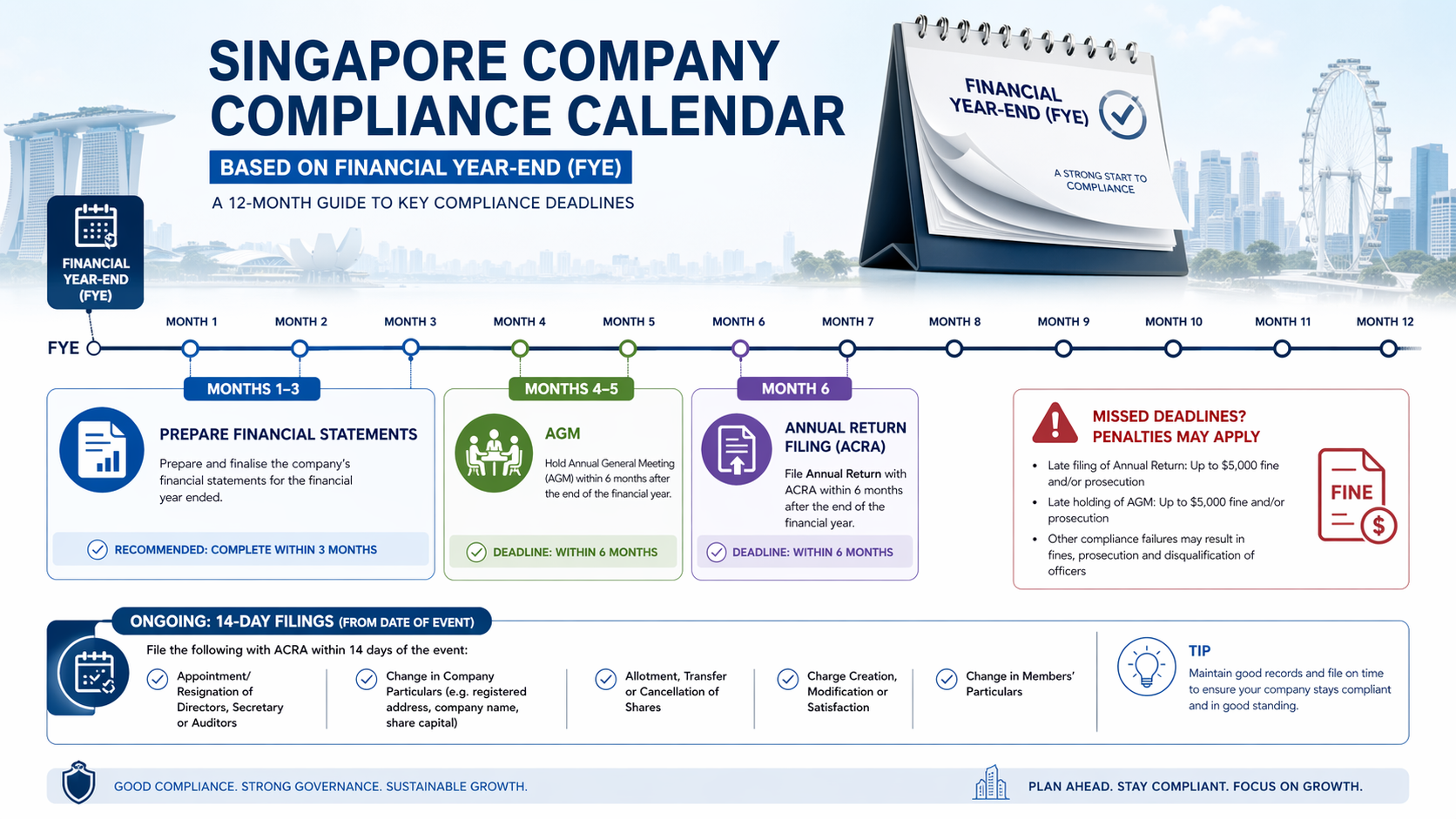
Directorship in Singapore carries a non-negotiable responsibility: meeting statutory filing deadlines without exception. The Accounting and Corporate Regulatory Authority administers a strict enforcement regime. A single late submission triggers penalties starting at SGD 300. Continued non-compliance exposes directors to personal liability. In the most severe cases, ACRA exercises its authority to dissolve the company entirely.
The framework, however, is not designed to punish the prepared. It is cyclical and entirely foreseeable. Your financial year-end establishes the tempo. Every obligation that follows can be plotted in advance. This article is your practical field guide. Distribute it among your fellow directors. Integrate it into your governance rituals. We will now explore each season of the compliance year.
Anchor Everything to Your Financial Year-End
Your financial year-end (FYE) is the date when your company's accounting period concludes. December 31 is the conventional choice for most Singapore enterprises, though you retain the freedom to select any date that aligns with your operational rhythm.
This single date commands your entire compliance universe. All subsequent deadlines orbit around it. Ensure it is visible to your finance function, your board, and any external consultants engaged. Should you need to modify your FYE later, ACRA requires formal application. Until then, treat it as your immovable reference point.
The Spring Rush: Months 1 to 6 After FYE
The first half-year following your books' closure is your period of maximum statutory activity. The majority of filings concentrate in this window.
Months 1 to 3: Forge Your Financial Statements
Begin the moment your accounting period closes. Gather all source documents. Reconcile every bank account against your general ledger. Construct your profit and loss account, balance sheet, and all supporting disclosures. If your company is subject to statutory audit, engage your auditors without delay. Even audit-exempt entities must produce financial statements for shareholder scrutiny.
Delay is your enemy here. Rushed preparation breeds errors. Errors require correction. Correction postpones your AGM, which compresses your Annual Return timeline. Allocate generous lead time from the outset.
Months 4 and 5: Convene Your AGM
Private companies must hold an Annual General Meeting within six months of their FYE. Shareholders examine the financial statements. The board may propose dividends. Directors may face re-election depending on your constitution.
Your corporate secretarial services provider manages the event logistics. They draft the meeting notice, prepare resolutions, and record formal minutes. These documents form part of your permanent statutory record. Preserve them with appropriate care.
Where unanimous shareholder consent is obtainable, written resolutions may replace a physical meeting entirely. This mechanism is swifter and equally valid. Your company secretary services advisor ensures the documentation satisfies all formal requirements, whether resolutions are passed at a convened meeting or by written means.
Month 6: Transmit Your Annual Return
This is your most consequential filing. Within one month following your AGM, you must lodge your Annual Return via ACRA's BizFile+ portal. The submission captures your financial summary, current director particulars, shareholder composition, and registered office details.
The prescribed fee for timely filing is SGD 60. Late submissions attract penalties commencing at SGD 300, escalating with the duration of delay. Directors may face enforcement action for habitual non-compliance. This deadline warrants your most scrupulous attention.
Directors who engage professional company secretary services often find this filing transitions from a source of anxiety into a routine administrative event. A capable provider verifies data integrity, assembles supporting documentation, and submits with comfortable temporal margin.
The Autumn Lull: Months 7 to 12 After FYE
With the Annual Return successfully lodged, operational intensity diminishes. Yet governance vigilance must not be suspended.
Dedicate this interval to reconciling your statutory registers with actual corporate events. Did the company allot additional shares? Appoint fresh directors? Relocate its registered premises? Each event requires contemporaneous internal recording and ACRA notification within the statutory window.
Rectify any deferred updates from earlier periods. Late notifications carry autonomous penalties. Real-time maintenance is substantially less burdensome than retrospective reconstruction.
This quieter period also affords opportunity to critically evaluate your compliance infrastructure. Are records systematically organized? Is your current support team appropriately responsive? Have you established automated reminders for the approaching cycle? Modest enhancements now generate significant future dividends.
The Fortnight Standard: Continuous Disclosure Obligations
Certain corporate developments do not integrate into the AGM cycle. They activate immediate, standalone reporting duties.
Examine these representative scenarios:
- Appointment of a new director to the board: file notification within 14 days
- Resignation of an existing director: identical 14-day requirement
- Modification of registered office address: 14-day disclosure window
- Allotment or transfer of shares: 14-day filing deadline
- Adoption of a new corporate name: 14-day notification period
These deadlines are enforced with algorithmic precision. ACRA's electronic surveillance systems identify late submissions without exception. Penalties attach to each discrete violation. When multiple changes occur in proximity, resist consolidating them. Submit each filing separately and promptly.
Your corporate secretarial services partner should monitor these triggers as they arise. However, directors retain ultimate legal responsibility. Demand filing confirmations. Review compliance status reports. Never interpret delegation as absolution from oversight.
The Rationale for Professional Engagement
Simultaneously directing a business and managing this compliance calendar presents genuine difficulty. Your principal energies belong with customers, product development, and revenue generation. Statutory obligations, while mandatory, sit outside your core operational competence.
This is the precise domain where company secretary services generate value. A qualified provider maintains continuous vigilance over your deadline landscape. They draft resolutions. They execute filings. They issue advance warnings. You operate with informed confidence rather than nagging uncertainty.
The company secretary role extends considerably beyond clerical functions. This professional maintains statutory registers, ensures AGM and Annual Return documentation satisfies regulatory standards, and counsels on governance evolution. Engaging external corporate secretarial services Singapore delivers specialized expertise without the commitment of a permanent internal appointment.
Scalability represents an additional consideration. As your enterprise expands, establishes subsidiary entities, or penetrates new markets, compliance complexity increases correspondingly. An established provider adapts organically. No vendor transition is required. You simply expand your engagement parameters to accommodate your growing footprint.
Institutionalized Practices for Sustained Compliance
Embed the following disciplines to fortify your governance foundation.
Activate calendar alerts immediately upon FYE closure. Record your AGM deadline and Annual Return due date. Embed substantive preparation buffers to accommodate unforeseen complications.
Enable ACRA BizFile+ notification channels. Maintain current contact coordinates. Configure email systems to prevent official correspondence from being diverted to spam repositories.
Construct a unified compliance archive. Consolidate board resolutions, meeting minutes, and filing receipts in a single accessible repository. Digital storage is entirely acceptable provided logical organization and backup protocols are maintained.
Align internal stakeholders. Orient your finance lead on financial statement production timelines. Secure early board commitment to AGM scheduling.
Conduct annual advisor assessments. Are your professional partners anticipatory or merely reactive? Do they communicate regulatory developments with clarity? If responsiveness deteriorates, do not hesitate to transition. Dependability outweighs marginal cost savings.
Seasonal Reference: December 31 Financial Year-End
For companies concluding their accounting period on December 31:
- January through March: Complete financial statements and audit (where required)
- April through May: Convene AGM or execute written resolutions
- June: Lodge Annual Return with ACRA
- Throughout the year: Report material changes within 14 days of occurrence
- July through December: Maintain registers, refine systems, prepare for subsequent cycle
Organizations with alternative FYE dates should translate these months proportionally. The sequential logic and relative intervals remain invariant.
Concluding Reflections
Statutory compliance will never capture the imagination. Yet it constitutes the bedrock of your company's legal continuity. It shields directors from financial penalties. It cultivates institutional credibility with financial institutions, investors, and commercial counterparties.
Comprehensive regulatory memorization is unnecessary. What is required is a robust operational system. Identify your FYE. Comprehend your deadline architecture. Deploy professional company secretary services where internal expertise is insufficient. Exploit technology for tracking and alerting. Maintain disciplined organizational habits.
Where the administrative burden appears disproportionate to internal capacity, reputable corporate secretarial services offer structured resolution. They impose order upon complexity. They guarantee statutory adherence. They liberate your attention for value-creating strategic initiatives.
The cumulative benefits of consistency are substantial. Establish sound governance habits now. Each successive year becomes progressively more manageable. Your future self, and all company stakeholders, will recognize the perspicacity of this foundational investment.

 English
 Arabic
 Spanish
 Portuguese
 Deutsch
 Turkish
 Dutch
Dutch
 Italiano
 Russian
 Romaian
 Portuguese (Brazil)
 Greek
Greek