


GDS Software Development: Building the Future of Travel Technology
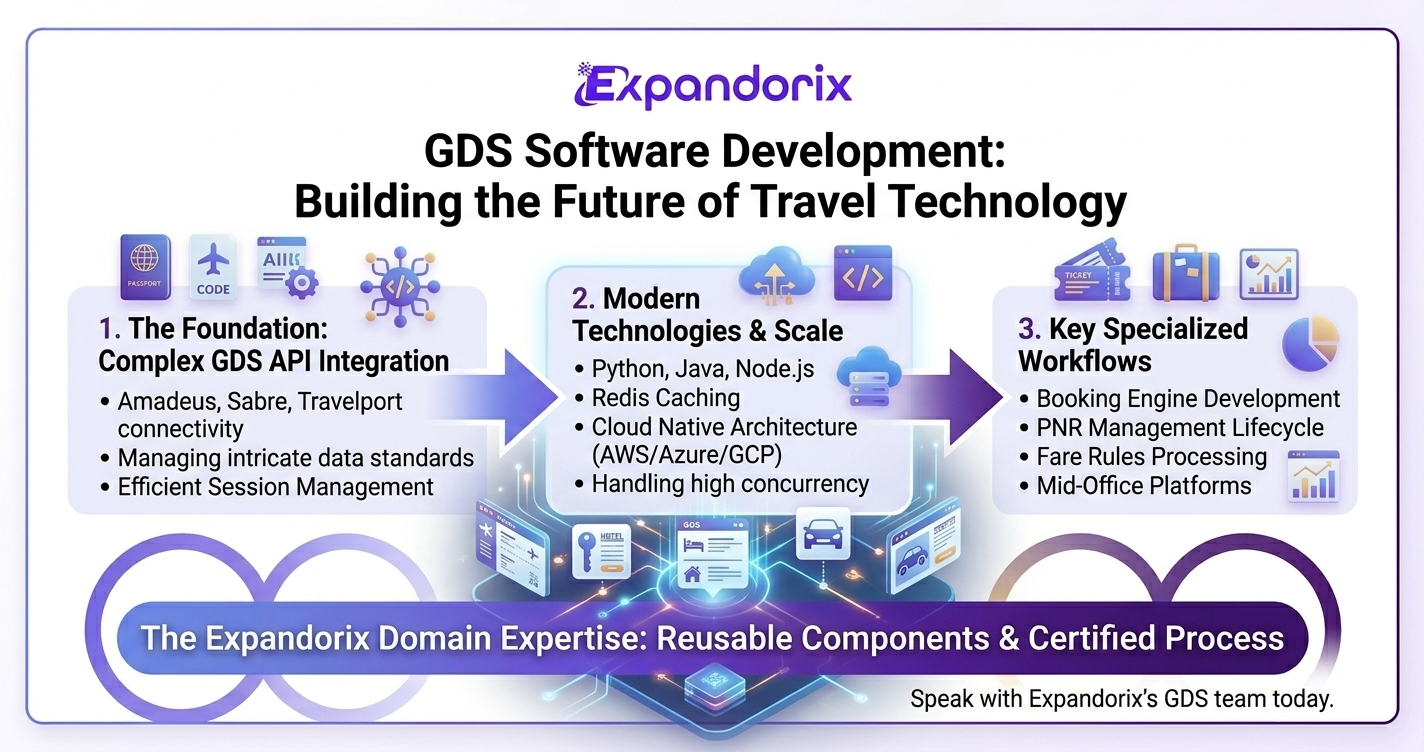
The travel industry runs on software. Behind every flight booking, hotel reservation, and travel itinerary is a complex stack of interconnected systems — booking engines, inventory management tools, payment processors, mid-office platforms, and at the center of it all, the Global Distribution System integration that ties travel inventory to travel commerce.
GDS software development is a specialized discipline that combines deep technical expertise in software engineering with domain knowledge in travel industry operations, data standards, and commercial frameworks. It is far more demanding than typical enterprise software development, and the quality of the software built matters enormously — because when GDS-powered booking software fails, the consequences are immediate and directly measurable in lost revenue and frustrated customers.
In this comprehensive guide, we explore what GDS software development involves, what technologies and methodologies are used, what the most challenging aspects of the development process are, and how Expandorix has built a reputation as a leading GDS software development company trusted by travel businesses around the world.
What Is GDS Software Development?
GDS software development refers to the design, construction, and maintenance of software systems that integrate with Global Distribution Systems — the networks operated by Amadeus, Sabre, and Travelport that distribute travel inventory to agencies and booking platforms worldwide.
In practice, GDS software development encompasses several types of work:
GDS API Integration Development — Building the code that communicates with GDS APIs, sends queries, parses responses, and manages booking sessions. This is the core technical work of connecting your platform to the GDS.
Booking Engine Development — Building the front-end and back-end systems that allow customers to search, browse, and book travel products. The booking engine depends on the GDS integration for its inventory data.
Middleware and Aggregation Layer Development — For platforms that source content from multiple GDS providers or combine GDS content with direct supplier content, middleware is needed to aggregate, deduplicate, and normalize data from multiple sources.
PNR Management Systems — Software that manages the lifecycle of Passenger Name Records (PNRs) — the GDS's representation of a booking — including creation, modification, retrieval, and synchronization with internal booking databases.
Mid-Office Development — The back-office systems that travel agencies and OTAs use to manage bookings, generate reports, handle ticketing, and process settlements.
Reporting and Analytics — GDS-connected platforms generate rich data. Reporting and analytics software transforms this data into actionable business intelligence.
Customer-Facing Applications — Web platforms, mobile apps, and other customer-facing interfaces that present GDS content and booking capabilities to end users.
Core Technologies in GDS Software Development
GDS software development draws on a wide range of technologies. The specific stack varies by project and GDS provider, but there are consistent patterns.
API Communication Technologies
The dominant communication paradigm for modern GDS APIs is REST (Representational State Transfer), using JSON as the data format and OAuth 2.0 for authentication. Amadeus's modern APIs are fully REST-based. Sabre and Travelport have both REST and legacy SOAP/XML interfaces.
For legacy SOAP/XML APIs, developers work with WSDL (Web Services Description Language) files that define the API interface, and use SOAP (Simple Object Access Protocol) to structure requests and responses. This older paradigm is more verbose and complex than REST, but it remains important because much of the GDS's full functionality is still only available through these legacy interfaces.
Developers working on GDS software development need to be proficient in both paradigms.
Server-Side Development Languages
GDS integration logic is typically implemented in server-side languages. Popular choices include:
Java and Spring Framework — A common enterprise choice for GDS integration due to Java's strong typing, extensive library ecosystem, and mature tooling for XML processing (important for SOAP/XML integrations).
Python — Popular for its readability, rapid development speed, and strong library support. Python is often used for data transformation, middleware logic, and API orchestration.
Node.js — JavaScript runtime that is well-suited for high-concurrency API-heavy applications. Its event-driven, non-blocking I/O model is a good fit for GDS query handling where many concurrent API calls need to be managed.
C# and .NET — Common in Microsoft-centric enterprise environments, with good library support for SOAP/XML processing and REST API development.
The choice of language depends on the client's existing technology stack, team expertise, and performance requirements.
Data Storage and Caching
GDS search data is transient — pricing and availability change frequently. Effective GDS software development uses caching intelligently to improve performance while ensuring data freshness.
Redis is commonly used for caching GDS search results, session data, and frequently-accessed reference data (like airport codes and airline names). Redis's speed and TTL (time-to-live) support make it ideal for this use case.
PostgreSQL and MySQL are used for persistent storage of booking data, customer records, and transactional data. For high-volume platforms, distributed databases or sharding strategies may be required.
Elasticsearch is sometimes used for full-text search capabilities over travel content, particularly for hotel and destination search features.
Front-End Development
The customer-facing interface for a GDS-powered booking platform is typically built with modern JavaScript frameworks:
React — The most widely used framework for building dynamic, responsive booking interfaces. React's component-based architecture works well for building reusable flight search, hotel search, and booking form components.
Vue.js and Angular — Also used in travel platform development, with their own communities and ecosystem.
Mobile Development — React Native or Flutter for cross-platform mobile apps, or Swift/Kotlin for native iOS/Android apps.
DevOps and Infrastructure
GDS-powered platforms need reliable, scalable infrastructure:
Cloud Platforms — AWS, Google Cloud, and Azure are all used for hosting GDS-integrated platforms. Cloud infrastructure enables the elastic scaling that travel platforms need to handle demand spikes during popular booking windows.
Containerization — Docker and Kubernetes are standard for deploying GDS integration services, enabling consistent environments and easy scaling.
CI/CD Pipelines — Automated testing and deployment pipelines are essential for maintaining the high release cadence that modern software development demands without sacrificing stability.
Monitoring and Observability — Tools like Datadog, New Relic, or the ELK stack are used to monitor GDS API performance, track error rates, and detect anomalies that could indicate integration problems.
Key GDS Software Development Challenges
Challenge 1: Managing GDS API Complexity
GDS APIs are among the most complex interfaces in the enterprise software world. A single flight availability response can contain thousands of data elements — fare components, tax codes, booking class indicators, fare basis codes, equipment types, and more. Parsing this data correctly and completely requires deep domain expertise and meticulous implementation.
Expandorix's GDS software development team has invested years in building comprehensive data parsing libraries and data models that correctly handle the full complexity of GDS responses. This existing intellectual property dramatically reduces development time and error rates for clients.
Challenge 2: Handling Concurrency at Scale
When a popular travel platform runs a flight search, it might trigger hundreds of concurrent GDS API calls in parallel — searching for the fastest routes, the cheapest fares, alternative dates, nearby airports, and so on. Managing this concurrency correctly, without exceeding GDS rate limits or overwhelming backend systems, requires careful software architecture.
Expandorix designs GDS software with concurrency as a first-class concern. Rate limiting, request queuing, connection pooling, and circuit breakers are all built into the integration layer from the start.
Challenge 3: Session Management
GDS booking flows are stateful — they involve a sequence of related API calls that must maintain context. A user who selects a flight and proceeds to enter passenger details triggers a series of GDS API calls that are linked by a session identifier. If the session is lost or expires, the booking must restart. Managing sessions reliably, across multiple server instances and in the face of network issues, is a non-trivial software engineering challenge.
Expandorix's GDS software development methodology includes detailed patterns for session management that have been validated in production environments.
Challenge 4: Handling GDS Errors Gracefully
GDS APIs can return a wide variety of error conditions — pricing changes between search and booking, seat sold out, passenger data validation failures, credit limit exceeded, and many more. Each of these needs to be handled in a way that is useful to the customer and correctly recorded for operational purposes.
Building a comprehensive error handling framework that covers all GDS error codes and presents them meaningfully is a significant software development effort. Expandorix has built this framework across multiple projects and brings it as a ready foundation to new client engagements.
Challenge 5: Fare Rules Processing
GDS fare data includes extremely complex rules — advance purchase requirements, minimum stay conditions, penalty calculations for changes and cancellations, and routing restrictions. Processing these rules correctly and presenting them clearly to customers is one of the most demanding aspects of GDS software development.
Expandorix has developed a fare rules processing engine as part of its GDS software development toolkit, capable of interpreting and presenting fare rules accurately across all major GDS providers.
Challenge 6: Regulatory and Compliance Requirements
GDS-connected platforms handling ticketing must comply with IATA's Billing and Settlement Plan (BSP) requirements, PCI DSS for payment card handling, GDPR for European customers' personal data, and various national airline ticketing regulations. Building software that meets all of these compliance requirements while still being feature-rich and performant requires careful design.
Expandorix incorporates compliance requirements into the software architecture from the start, rather than trying to retrofit compliance onto a completed system.
Expandorix's GDS Software Development Methodology
Expandorix has developed a proven methodology for GDS software development that consistently delivers high-quality results. The methodology is informed by lessons learned across dozens of GDS projects and is continuously refined based on new experiences.
- Discovery and Requirements Definition — Every project begins with a structured discovery phase that produces a detailed functional specification. This document defines exactly what the software will do, how it will handle edge cases, and what performance characteristics it must meet. This investment in upfront clarity pays dividends throughout the project.
- Architecture Design — Before writing application code, the Expandorix team designs the system architecture. This includes the GDS API integration layer, the application services layer, the data model, the caching strategy, and the deployment architecture. Architecture review by senior engineers ensures that design decisions will hold up at scale.
- Iterative Development with Continuous Integration — Development is organized in two-week sprints, with working software delivered at the end of each sprint. Continuous integration pipelines run automated tests on every code commit, catching issues early. Regular demos ensure that the client can see and provide feedback on progress.
- GDS Testing Environment Management — Expandorix manages sandbox environments for all three major GDS providers, enabling thorough testing without incurring live booking charges. Test scenarios cover happy paths, edge cases, error conditions, and performance under load.
- Certification Support — Expandorix guides clients through the GDS certification process, preparing all required technical documentation and managing communication with GDS providers.
- Production Deployment and Monitoring — Go-live is carefully managed with feature flags, gradual traffic rollout, and intensive monitoring to catch any issues before they affect significant numbers of customers.
- Post-Launch Support — A dedicated support team monitors production systems, applies API updates, and responds to issues with defined SLAs.
Why Travel Businesses Choose Expandorix for GDS Software Development
The choice of GDS software development partner is a decision that travel businesses take seriously, and increasingly they are choosing Expandorix. Here is why:
- Travel Domain Expertise — The Expandorix team is not a generalist software development shop that occasionally works on travel projects. Travel technology is the core of what Expandorix does. This domain focus means the team understands the business context of every technical decision, not just the code.
- Reusable GDS Components — Years of GDS software development have produced a library of reusable components — API clients, data parsers, fare rules engines, PNR managers — that Expandorix brings to every new project. This gives clients faster development timelines and higher quality than starting from scratch.
- Engineering Excellence — Expandorix engineers are experienced, senior-level developers with specific GDS expertise. Code quality, test coverage, and documentation standards are maintained at enterprise level.
- Long-Term Partnership — Expandorix builds lasting relationships with clients. Many clients have been working with Expandorix for years, adding new capabilities and expanding their platforms over time. This long-term partnership model means Expandorix develops deep knowledge of each client's platform and business, making future development more efficient and effective.
Conclusion
GDS software development is a specialized, demanding discipline that is critical to the success of any travel business that relies on GDS connectivity. The software built through this process is not just a technical artifact — it is the operational heart of your booking platform.
Building this software well requires deep GDS API expertise, strong software engineering capabilities, a proven development methodology, and genuine travel industry knowledge. These qualities are precisely what Expandorix brings to every GDS software development engagement.
If you are planning a new GDS-connected platform or looking to modernize an existing one, Expandorix is the development partner that can make it happen — on time, on budget, and to the high standards that your business and your customers deserve.
*Speak with Expandorix's GDS software development team today. Your travel platform deserves the best.*

 English
 Arabic
 French
 Spanish
 Portuguese
 Deutsch
 Turkish
 Dutch
Dutch
 Italiano
 Russian
 Portuguese (Brazil)
 Greek
Greek