


Recovering Your Singapore Company After ACRA Strikes It Off
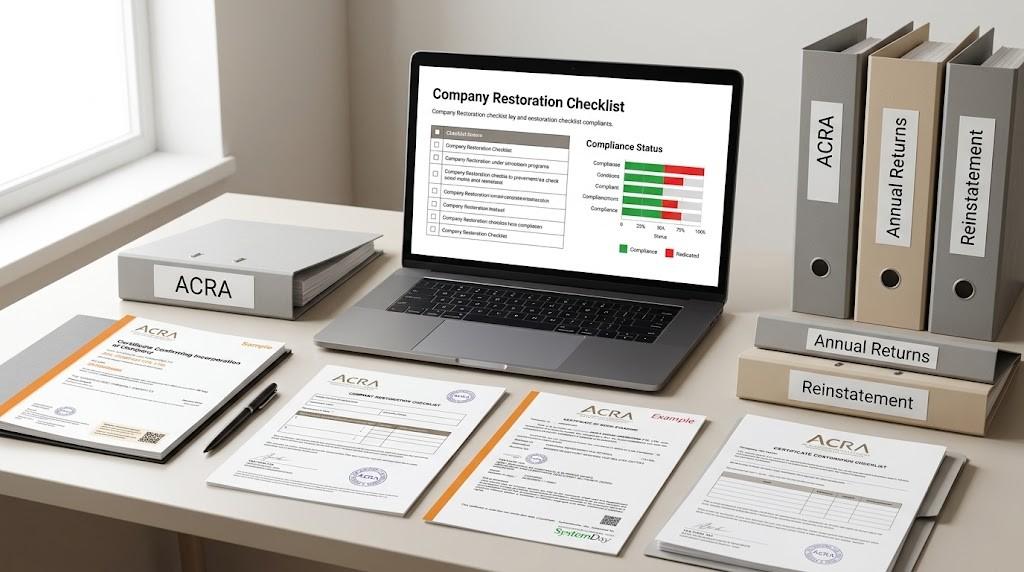
ACRA removes companies from the register when they appear dormant, breach compliance requirements, or fail to file annual returns for two or more consecutive years. Once struck off, a company is no longer a legal entity in Singapore—but restoration is possible, and more common than most business owners realise.
What Being Struck Off Entails
A struck-off company loses its legal existence. Bank accounts are frozen. Contracts become unenforceable. The company name is removed from the public register.
Directors and shareholders cannot act on behalf of the company. Any property it owned may vest in the government as bona vacantia—ownerless property the state claims by default.
ACRA usually begins the striking-off process after a company misses compliance deadlines, fails to respond to notices, or has no known officers at its registered address. The company gets a formal warning before the strike-off takes effect. Many directors only discover the problem after the fact, often when a bank account stops working or a contract counterparty flags the issue.
You have six years from the date of striking off to apply for restoration. Beyond that window, the process becomes substantially harder and may not be available at all.
Who Can Apply
ACRA accepts restoration applications from a former director, member, creditor, or anyone else aggrieved by the striking-off. In practice, most applications come from directors or shareholders who need the company reinstated to deal with unresolved assets, live contracts, or pending regulatory matters.
A company struck off voluntarily can also be restored, but the original reasons for striking off must be addressed before ACRA will approve reinstatement.
The Restoration Process
The application is filed through BizFile+, ACRA's online portal. Before filing, several things need to be in order.
Appoint a Registered Filing Agent or Company Secretary
Since the company no longer exists in the register, individual directors often cannot file directly without a CorpPass account linked to the company. Most applicants engage corporate secretarial help at this stage. A qualified company secretary knows what ACRA expects, what documents are required, and how to avoid the most common grounds for rejection. This is where engaging company secretary services early proves invaluable.
Resolve All Outstanding Compliance Issues
ACRA will not restore a company that still carries unresolved compliance failures. Overdue annual returns must be filed, outstanding penalties paid, and any issues with IRAS sorted before the application goes in. Financial statements also need to be brought up to date.
Directors frequently underestimate this step, assuming ACRA will look past the history once the application is submitted. It does not.
Prepare the Supporting Documents
The application requires a written explanation of why the company should be reinstated, evidence of the applicant's standing, and a declaration of the company's intended purpose going forward. If the striking-off was involuntary, documentation showing the company was still active at the time strengthens the case considerably.
File and Pay the Fee
The application fee is S$60 for administrative restoration and S$200 for court-ordered restoration. ACRA processes most straightforward administrative applications within 14 to 30 working days. Court-ordered restorations, which involve a formal court application and a hearing, take considerably longer.
Administrative Restoration vs Court-Ordered Restoration
Administrative restoration applies when the company was struck off within the last six months. ACRA handles it directly with no court involvement. This is the faster route, and for most applicants who act quickly, it is the only route they need.
Court-ordered restoration applies when more than six months have passed since striking off, or when ACRA rejects an administrative application. You file an originating summons in the High Court, serve it on the Registrar of Companies, and attend a hearing. The strength of the case you present matters significantly here—which is why most directors in this position work with a lawyer alongside their corporate secretarial services Singapore provider.
Why Company Secretary Services Matter at Every Stage
A company secretary in Singapore is not an administrative formality. Under the Companies Act, every Singapore-incorporated company must appoint a qualified company secretary. During restoration, the company technically lacks one because it has ceased to exist. Reappointing a qualified company secretary is one of the first actions required after reinstatement.
Before reinstatement, professional company secretary services handle the preparation work: reviewing what outstanding filings exist, coordinating with IRAS if needed, structuring the application letter, and filing on your behalf. Directors who attempt this without help frequently get rejected on procedural grounds—missing documents, incomplete statements, or undiscovered penalties.
After reinstatement, corporate secretarial services keep the company compliant going forward. This means managing annual return filings, maintaining statutory registers, and making sure AGM deadlines are not missed. In many cases, the compliance failure that led to striking off was preventable with the right secretarial support in place from the start.
Moving Forward After Reinstatement
Restoration returns the company to the register as if the striking-off had not occurred. The company regains its legal standing, bank accounts can be unfrozen, and contracts become enforceable again. Property that vested in the government during the struck-off period can be reclaimed, though this sometimes requires a separate application.
The practical priority after reinstatement is getting all statutory obligations current fast. Annual returns, director updates, registered address confirmations—these need to happen immediately so the company does not slip back into the same position.
A structured handover from your company secretary services provider, with a compliance calendar going forward, is what makes reinstatement stick.
Restoration is a real option for most struck-off companies, but the window is limited and the paperwork is unforgiving. Acting early, resolving compliance issues before filing, and working with qualified secretarial services throughout the process are what separate successful applications from rejected ones.

 English
 Arabic
 French
 Spanish
 Portuguese
 Deutsch
 Turkish
 Italiano
 Russian
 Romaian
 Portuguese (Brazil)
 Greek
Greek