


Industry-Specific Insights: SAP S/4HANA for Manufacturing & Smart Factory Operations

Why Manufacturing Is SAP's Most Transformed Vertical in 2026
The manufacturing sector has been one that has always involved large amounts of data. However, for many years, the information was segregated – the data recorded by machines was not in sync with that recorded in ERP; the quality control data was not aligned with procurement data, among other instances. With SAP S/4HANA, all this is set to change in a big way.
The year 2026 will see how in-memory ERP, AI and real-time IoT integration, together with cloud-native technology, make the "smart factory" move beyond its conceptual stage and into actual implementation for manufacturers in discrete manufacturing, process manufacturing, and hybrid manufacturing environments.
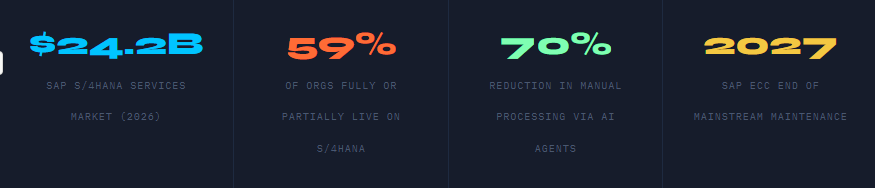
However, migrating to SAP S/4HANA is not simply an issue of software. Manufacturers who are currently using SAP ECC have only until 2027 to upgrade before their current software stops receiving mainstream support.
The Architecture: How SAP S/4HANA Powers Smart Factories
SAP S/4HANA's manufacturing architecture rests on three interlocking layers that work together to create a fully connected, intelligent factory environment:
1. Digital Core — SAP S/4HANA
Backbone of transactions and analytics. Using the SAP HANA in-memory database technology, it is able to process financial, manufacturing, procurement, and logistic data in real-time. There are no longer any batch processing delays experienced in previous ERP versions. All of the modules including PP (Production Planning), PM (Plant Maintenance), QM (Quality Management), and MM (Material Management) work on a common data model.
2. Execution Layer — SAP Digital Manufacturing (DM)
Cloud MES, which provides connectivity between ERP and the shop floor, where execution takes place. This system manages work order execution, human resources management, quality inspections, materials, and instruction to the operators, all integrated into S/4HANA in real-time. The system is like the last mile between your production orders and your machinery.
3. Intelligence Layer — SAP BTP + Business AI
The SAP BTP is located above the core and acts as the platform for innovation. The platform supports agents and integrations, the flow of integration, the generative AI hub, and low-code extension without touching on the core of the ERP system. This is what constitutes the "Clean Core" principle.
SAP Digital Manufacturing Cloud: The Bridge from Top Floor to Shop Floor
SAP Digital Manufacturing (SAP DM) is the evolution of traditional MES — built cloud-native, designed to integrate seamlessly with S/4HANA, and capable of connecting to IIoT devices, PLCs, and automation layers directly.
It comes in two functional components:
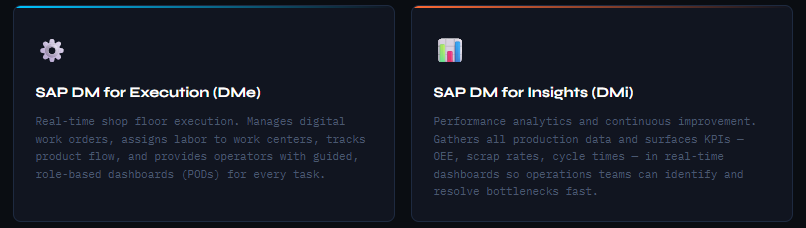
What sets SAP DM apart is the Production Connector, which is a state-of-the-art integration layer that connects cloud-based manufacturing applications to the programmable logic controllers (PLCs), industrial internet of things (IIoT) sensors, and other plant automation solutions. Thus, raw machine data gets transferred directly to the SAP environment without any manual input or batching files.
For Example: At the Hannover Messe event in 2026, SAP together with Uhlmann showed an "intelligent packaging" solution in a fast-paced production setting. The end-to-end solution started with SAP S/4HANA production orders, continued with SAP Digital Manufacturing execution, and concluded with autonomous mobile robots doing their job on the physical level.AI Agents Reshaping Manufacturing Operations in 2026
The most significant shift in the 2026 SAP manufacturing landscape isn't a new module — it's the arrival of agentic AI: AI that doesn't just analyze and report, but acts inside core workflows. SAP has moved from AI as a reporting layer to AI as an execution layer.
At Hannover Messe 2026, SAP unveiled a suite of purpose-built manufacturing agents:
· Production Master Data Agent: Validation and management of BOMs, routings, and work center configurations. Eliminates master data inaccuracies leading to expensive production downtime later in the process.
· Production Planning & Operations Agent: Helps schedulers make constraint-based decisions, identifies conflicting information, and suggests resequencing as material and capacity conditions change.
· Asset Health Agent: Tracks machine performance data, detects any signs of wear and tear, and issues work orders for proactive maintenance to prevent potential failures in S/4HANA PM.
· Outbound Task Orchestration Agent: Orchestrates outbound processes in the warehouse by managing reservations and logistics planning from production completion to order fulfillment.
· Field Service Dispatcher Agent: Automatically schedules maintenance activities according to the available personnel's skill set, location, and availability of spare parts to decrease MTTR.
· Alert Processing Agent: Filters alerts and exceptions generated by the system and prioritizes them in a more effective manner for appropriate action from responsible parties.
The strategic implication for manufacturers: now is the time to assess where agentic automation can compress the lag between detecting an exception and acting on it — whether that means validating production constraints, reserving materials, dispatching technicians, or orchestrating outbound tasks.
IoT & IIoT Integration: Real-Time Intelligence from Machine to ERP
Smart factories are defined by their ability to act on live machine data — and SAP S/4HANA's IoT integration capability is what makes this operational rather than aspirational.
Through SAP's IoT integration layer, sensor data — temperature, pressure, vibration, energy consumption, cycle counts — flows continuously from shop floor equipment into the ERP digital core. This eliminates the information delay that causes reactive management, late quality failures, and unplanned downtime.
Key IoT-Enabled Capabilities in S/4HANA Manufacturing
· Automated Quality Control: SAP S/4HANA uses pre-defined parameters to generate warnings whenever there is deviation from quality specifications, even making adjustments on the machinery to ensure consistency in product quality without the need for human intervention.
· IoT-Enabled Supply Chain Transparency: The capabilities of IoT devices are not limited to the shop floor; they extend into the supply chain to provide live monitoring of materials and products , offering procurement, manufacturing, and logistics teams visibility across all stages of inventory management and transportation.
· Automated Replenishment Signals: By monitoring IoT-enabled stock in work centers and stores, where the stock level drops below dynamic levels according to demand trends and seasonal variations, SAP Service can trigger automatic replenishment requests within the predefined parameters of suppliers and budgets.
· Digital Twin Integration: Connecting intelligent assets to SAP S/4HANA systems allows maintenance personnel to conduct real-time monitoring of asset performance based on their digital twins — simulations of the actual machine allowing them to make proactive decisions.
Supply Chain Orchestration: The Nerve Center of the Enterprise
SAP’s vision for 2026 extends to the supply chain and beyond the plant perimeter. Supply chain orchestration in S/4HANA is the nerve center of planning, logistics, manufacturing execution, and business network information.
AI in the system takes all the outside cues into consideration – whether it be weather, shipping delays at the ports, issues with suppliers, or political risks – and makes necessary adjustments to production plans instantly. Rather than having planners respond to supplier emails manually, the system considers all possibilities and gives corrective suggestions on how to manage those risks.
· SAP IBP — Demand Sensing: Demand Sensing: Leveraging AI algorithms, SAP IBP helps forecast future demands based on actual market information and usage patterns to give better plans for short-term decisions.
· SAP Business Network Integration: Integrates your S/4HANA system with all the third parties including suppliers, logistics companies, and other partners.
ROI Framework: What Manufacturers Should Expect and When
ROI from SAP S/4HANA manufacturing implementations follows a well-documented two-stage pattern. Understanding this timeline is critical for setting board-level expectations and building the business case.
|
Time Horizon |
Expected Gains |
Key Drivers |
|
6–18 Months |
Faster financial close, improved inventory visibility, reduced manual data entry, better production reporting |
Operational Efficiency |
|
18–36 Months |
Predictive maintenance activation, AI-assisted scheduling, demand sensing deployment, quality automation |
AI & Automation |
|
2–5 Years |
Supply chain optimization, reduced product costs through data-driven decisions, full smart factory operations |
Strategic Value |
Notable benchmarks from 2026 implementations: AI agents in accounts payable have delivered 70% reductions in manual invoice processing time. Inventory AI agents monitoring multi-site warehouses have driven 18% reductions in stockout incidents. Predictive maintenance deployments consistently reduce unplanned downtime by 30–50% within 24 months of activation.
Your 2026 SAP S/4HANA Manufacturing Migration Roadmap
With SAP ECC mainstream maintenance ending in March 2027, 2026 is the last full year to plan and execute a migration with adequate runway. Here's the proven five-phase roadmap for manufacturing organizations:
1. Landscape Assessment & Migration Path Selection: Evaluate your current ECC customizations, determine Greenfield (new implementation), Brownfield (system conversion), or Selective Data Transition (SDT). Manufacturing organizations with significant custom PP/PM logic often benefit from a hybrid approach that preserves critical industry logic while adopting clean core principles for new capabilities.
2. Business Blueprinting with Industry Best Practices: Map current production planning, shop floor execution, quality management, and maintenance processes to SAP's pre-packaged industry content. Identify where standard processes can replace custom code — this is where clean core begins. Engage business process owners, not just IT.
3. Data Harmonization & Code Remediation: The #1 cited migration challenge (49% of organizations). Clean production master data — BOMs, routings, work centers, material masters. Remediate or rebuild custom ABAP that modifies the core. Build BTP-based extensions for essential custom logic that cannot be standardized.
4. Go-Live & Stabilization: Implement cutover into production with plant-by-plant rollout where feasible to minimize risks. Focus on training operators on new SAP DM interfaces and Joule-driven processes. Create a production control room with KPI dashboards for the first 90 days after go live.
5. Continuous Value Realization: The go-live phase opens the door to value. Deploy AI agents step by step, integrate IoT sources, implement predictive maintenance models, and develop the supply chain orchestration layer. Tie each deployment to specific business results and measure performance quarter by quarter.

 English
 Arabic
 French
 Spanish
 Portuguese
 Deutsch
 Turkish
 Dutch
Dutch
 Russian
 Romaian
 Portuguese (Brazil)
 Greek
Greek