


ACS Citation Format for Journals Explained
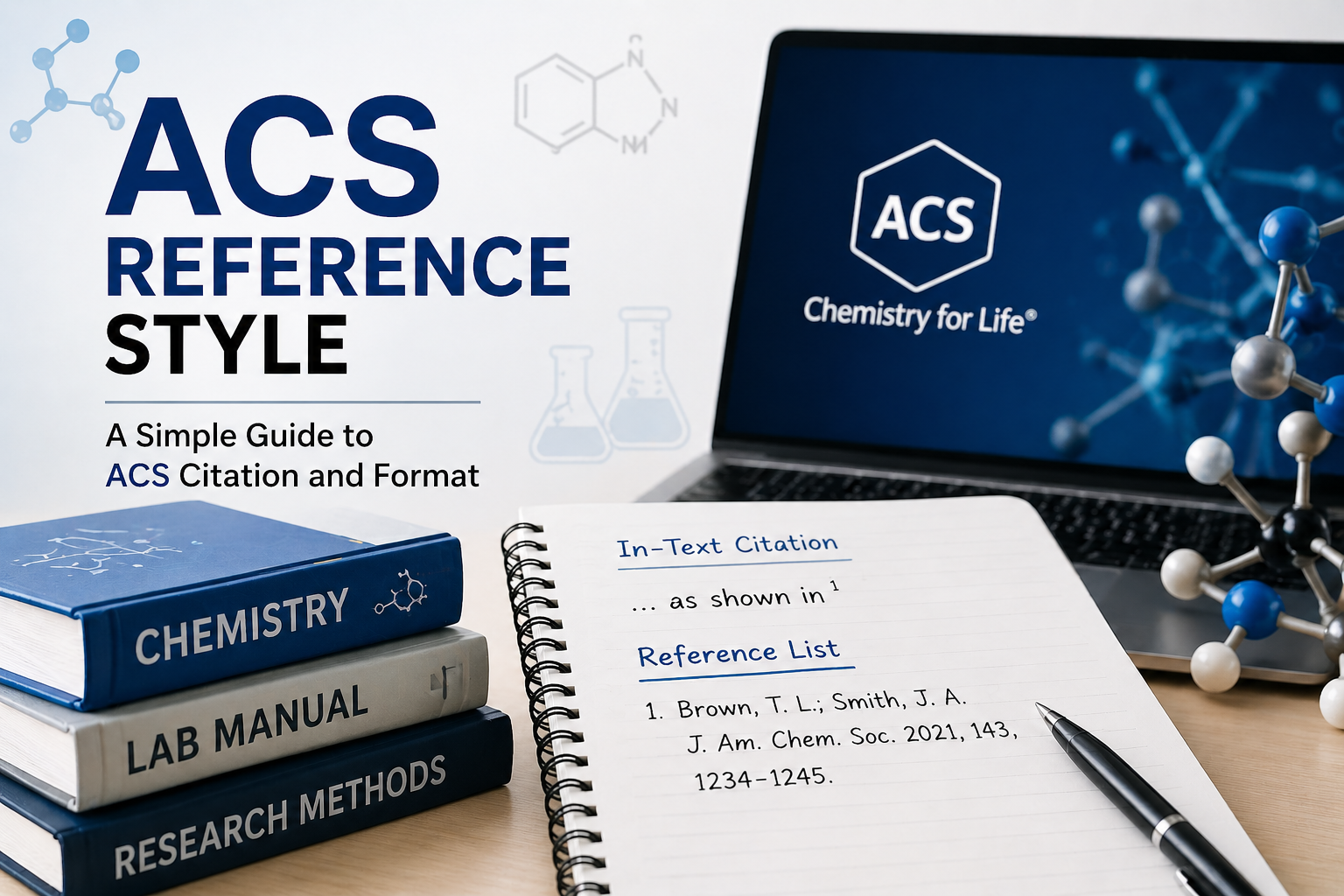
You’ve done the research. You’ve written the article. Everything looks solid.
Then comes citations… and suddenly things slow down.
I used to treat citations like a last-minute chore. But over time, I realized something. If your references look clean, your whole article feels stronger.
That’s especially true when you’re working with acs citation format.
So instead of throwing rules at you, I’ll walk you through it like a simple system you can reuse again and again.
Why ACS Format Feels Hard at First
ACS citation format feels difficult at first because it follows a fixed sequence for every reference, where even small details like punctuation, abbreviations, and order must be exact to maintain accuracy.
That’s where most people get stuck.
Not because it’s complex, but because it’s precise.
Once you understand the structure, the confusion fades.
A Different Way to Think About ACS Citation
Let me explain it differently.
Imagine you're giving someone directions to a place.
You wouldn’t skip steps, right?
Same thing with acs format citation.
Each part guides the reader:
-
Author shows who created the work
-
Title explains what it’s about
-
Journal shows where it lives
-
Year and pages help locate it
It’s just a roadmap.
The Structure You Should Always Follow
Here’s the standard acs journal reference format:
Author(s). Article Title. Journal Abbreviation Year, Volume, Page Range.
That’s your template.
Let’s break it into simple parts so you don’t mix anything up.
Author Names Come First
Start with the last name. Then initials.
Example:
Sheikh, M.
For multiple authors:
Sheikh, M.; Adams, R.; Chen, Y.
Separate each author with a semicolon.
I always double-check this part because it’s easy to overlook small errors.
Article Title Comes Next
Write the title in sentence case.
Example:
Influence of catalysts on reaction speed
No quotation marks.
Keep it plain and direct.
Journal Name Must Be Abbreviated
This is important.
Never write the full journal name.
Example:
J. Catal.
If you’re unsure, look it up. It takes seconds and prevents mistakes.
Add Year, Volume, and Pages
Now include the publication details.
Example:
2018, 360, 45–52.
Follow this exact order:
-
Year
-
Volume
-
Page range
Full Example
Here’s how everything fits together:
Sheikh, M.; Adams, R. Influence of catalysts on reaction speed. J. Catal. 2018, 360, 45–52.
That’s a correct ACS citation.
How to Add In-Text Citations
ACS citation format allows in-text citations through superscript numbers, bracketed numbers, or author-date style, each connecting directly to a numbered reference list for easy source tracking.
Let’s look at each option.
Superscript Numbers
Example:
Catalysts increase reaction speed.^1
This is the most compact style.
Numbers in Parentheses
Example:
Catalysts increase reaction speed (1).
Still simple and clear.
Author-Date Style
Example:
Sheikh (2018) studied catalyst effects.
This works well in explanatory writing.
Choose one style and stick with it throughout your article.
Mistakes That Can Make Your Article Look Weak
I’ve seen these issues many times.
Avoid them, and your content will feel more polished.
Wrong Order of Information
If you change the sequence, the format breaks.
Always follow:
Author → Title → Journal → Year → Volume → Pages
Writing Full Names
Don’t use full first names.
Wrong:
Muhammad Sheikh
Right:
Sheikh, M.
Missing Page Numbers
Page numbers are essential.
Without them, your citation feels incomplete.
Ignoring Journal Abbreviations
Full journal names don’t belong here.
Always use abbreviations.
A Simple Habit That Makes Everything Easier
Here’s something that changed things for me.
I stopped trying to memorize rules.
Instead, I saved one perfect citation.
Whenever I needed a new one, I copied that structure and replaced the details.
This helped me:
-
Avoid mistakes
-
Save time
-
Stay consistent
You can do the same.
Writing Content That Feels Human
Let’s not forget something important.
Your goal isn’t just correct acs citation format.
Your goal is content people actually enjoy reading.
So while handling citations:
-
Keep your sentences short
-
Avoid unnecessary words
-
Stay clear and direct
Because good writing always wins.
Using Keywords Without Breaking Flow
You’re targeting:
-
acs citation format
-
acs format citation
-
acs journal reference format
The trick is simple.
Use them naturally.
Example:
“When using acs format citation, getting the structure right is the first step.”
No forcing. No repetition.
Just smooth integration.
A Real Example You Can Follow
Let’s make this practical.
Text:
Catalysts play a key role in speeding up reactions.^1 Many experiments support this idea.
Reference:
-
Sheikh, M. Catalyst effects in chemical reactions. J. Catal. 2017, 350, 120–128.
Use this as a guide when writing your own references.
Why Clean Citations Improve Your Blog
Here’s something many people overlook.
Citations affect how your content feels.
When your acs citation format is correct:
-
Your article looks more reliable
-
Readers stay longer
-
Your content feels structured
And that helps with overall performance.
My Personal Approach
I keep things simple.
I don’t overthink citations.
I follow one correct format and repeat it.
After a few times, it becomes second nature.
That’s the goal.
Final Thoughts
ACS citation format may seem strict, but it’s actually predictable once you understand the structure.
Focus on the pattern. Stay consistent. Check small details.
Do that, and your content won’t just look better—it’ll feel stronger to every reader who visits your blog.

 English
 Arabic
 French
 Spanish
 Portuguese
 Deutsch
 Turkish
 Dutch
Dutch
 Russian
 Romaian
 Portuguese (Brazil)
 Greek
Greek