


Share Transfer UAE: A Practical Guide for Business Owners and Investors
Business ownership structures often evolve with time. Whether it’s due to new investments, partner exits, succession planning, or corporate restructuring, companies frequently need to transfer ownership shares. In the UAE, this process is governed by specific legal and regulatory procedures that businesses must carefully follow.
Understanding the process of share transfer UAE is essential for ensuring compliance, avoiding disputes, and maintaining smooth business operations.
A share transfer refers to the legal process of transferring ownership shares from one shareholder to another. This can happen between existing partners, family members, investors, or third-party buyers. In the UAE, the process differs depending on whether the company is established in the mainland, free zone, or offshore jurisdiction.
One of the first steps in any share transfer is reviewing the company’s Memorandum of Association (MOA) and shareholder agreements. These documents usually contain clauses regarding ownership restrictions, partner approvals, and rights of first refusal. In many UAE companies, existing shareholders have priority rights before shares can be transferred to an external party.
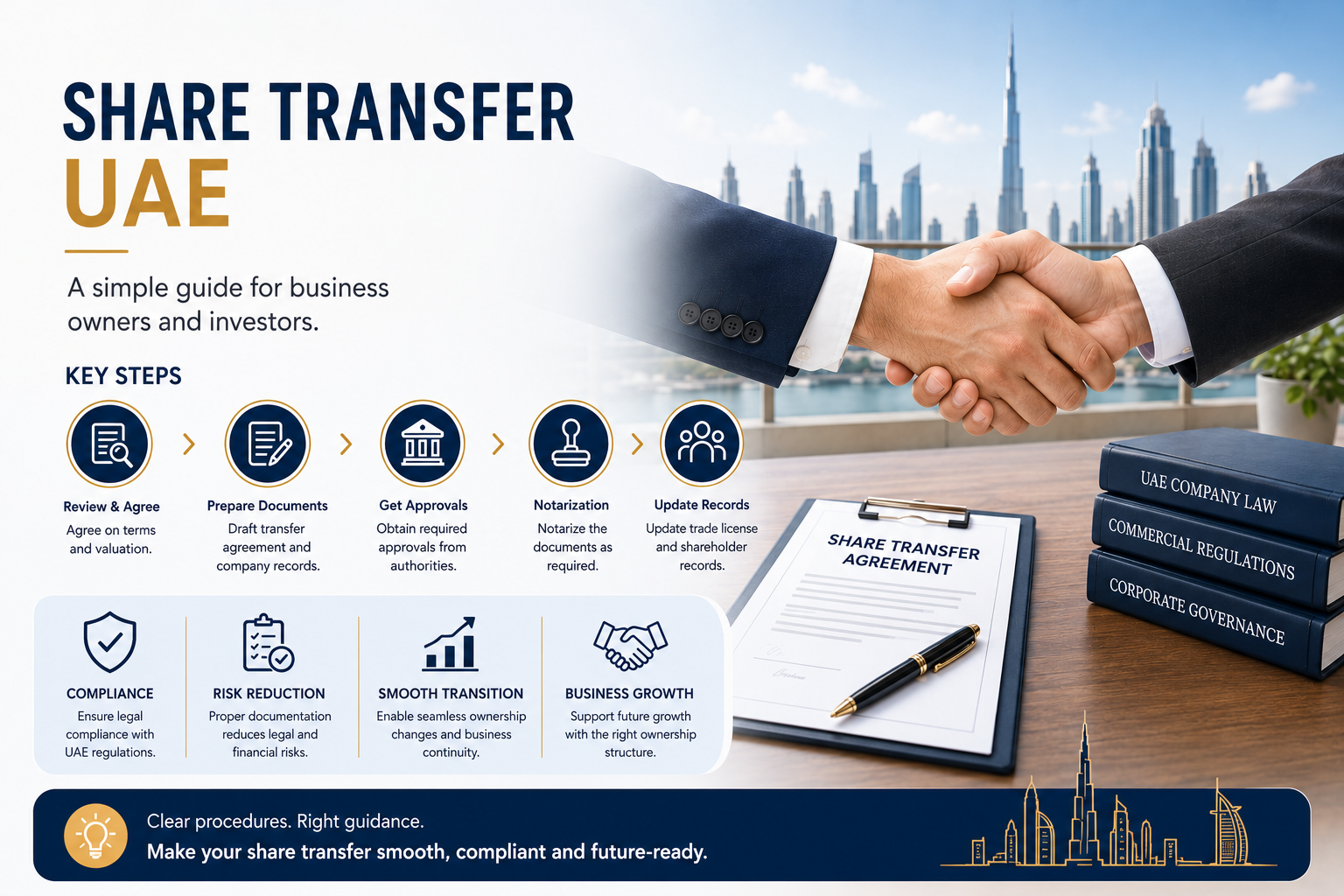
The share transfer process generally involves several stages. First, both parties agree on the transfer terms and valuation of the shares. Next, the required legal documents are prepared, including the share transfer agreement and amendments to company records. Depending on the jurisdiction, approvals may also be required from regulatory authorities, free zone authorities, or the Department of Economic Development (DED).
For mainland companies, notarization is often mandatory. UAE authorities require the transfer agreement to be signed before a notary public to make the transaction legally valid. Once the transfer is approved, the company’s trade license and shareholder records are updated accordingly.
Businesses should also consider the financial and tax implications of a share transfer. While the UAE remains a business-friendly jurisdiction, corporate tax regulations and compliance requirements have become increasingly important for companies operating in the region. Proper documentation and valuation help businesses maintain transparency and reduce future legal risks.
Another important factor in share transfer UAE transactions is due diligence. Buyers often review the company’s liabilities, contracts, financial records, and operational history before finalizing the transaction. This helps both parties make informed decisions and minimizes the risk of unexpected obligations after the transfer is completed.
Because UAE regulations may vary across jurisdictions, many companies seek professional guidance to manage the process efficiently. Working with experienced business consultants and legal advisors can help ensure that all approvals, documentation, and compliance requirements are handled correctly.
At Stratrich, businesses receive strategic support for corporate restructuring, ownership changes, and legal compliance across mainland and free zone jurisdictions in the UAE. With the right expertise, companies can complete share transfers smoothly while protecting their long-term business interests.
As the UAE continues to attract global investors and entrepreneurs, having a clear understanding of share transfer procedures is becoming increasingly important. A well-managed transfer process not only protects stakeholders but also supports business continuity and future growth.

 English
 French
 Spanish
 Portuguese
 Deutsch
 Turkish
 Dutch
Dutch
 Italiano
 Russian
 Romaian
 Portuguese (Brazil)
 Greek
Greek