


No-Code to Pro-Code: How SAP Fiori Development Is Changing in 2026
The world of SAP Fiori development is experiencing one of its biggest transformations yet. For years, building SAP applications required extensive expertise in SAPUI5, JavaScript, OData services, and backend integrations. Today, the landscape is changing rapidly as organizations embrace a blend of no-code, low-code, and pro-code development approaches. In 2026, SAP is pushing this evolution even further with AI-powered tools, intelligent assistants, and development platforms that allow both business users and professional developers to collaborate on enterprise applications.
The shift is not about replacing developers. Instead, it is about accelerating innovation and enabling organizations to build applications faster while maintaining enterprise-grade quality and governance. In SAP Service vision revolves around what many experts call fusion development, where citizen developers, business experts, and professional developers work together within the same ecosystem. Technologies such as SAP Build Apps, SAP Build Code, and Joule AI are making this vision a reality. As a result, SAP Fiori is no longer just a framework for creating modern user experiences; it is becoming part of a broader intelligent development ecosystem designed to shorten development cycles and improve business outcomes.
The Evolution of SAP Fiori Development
When SAP Fiori was first introduced, its primary objective was to modernize the user experience of traditional SAP systems. Developers relied heavily on SAPUI5 frameworks, JavaScript coding, XML views, and backend services to create applications. While this approach offered maximum flexibility, it often required significant technical expertise and lengthy development timelines. Organizations needed specialized developers who understood both business processes and technical implementation details.
Over time, business demands changed dramatically. Companies needed faster application delivery, more frequent updates, and greater flexibility. This demand led SAP to invest heavily in low-code and no-code capabilities. Instead of requiring developers to write every line of code manually, visual development environments began handling much of the application structure. Business users gained the ability to participate directly in application creation, reducing dependency on IT departments for every enhancement request. This transition laid the foundation for the modern SAP Build ecosystem, which now supports both no-code and pro-code development models.
Why 2026 Is a Turning Point for SAP Fiori
The year 2026 represents a major milestone because artificial intelligence is becoming deeply integrated into the SAP development experience. SAP's AI assistant, Joule, is transforming how applications are designed, built, and maintained. Rather than starting with technical specifications and manually creating application structures, developers can increasingly describe business requirements using natural language. AI then generates application logic, data models, workflows, and even testing artifacts.
Another significant factor driving change is the increasing pressure on organizations to accelerate digital transformation. Businesses can no longer afford lengthy development cycles for every new application or process improvement. SAP's latest tools focus on reducing the gap between business ideas and working software. According to SAP, solutions such as Joule Studio can generate structured development artifacts, technical specifications, and working prototypes within minutes rather than days. This dramatically shortens the journey from concept to deployment and enables organizations to respond faster to changing market conditions.
The Role of SAP Build in Modern Fiori Development
The SAP Build ecosystem sits at the center of this transformation. It combines low-code, no-code, and professional development tools into a unified platform that supports a wide range of users. One of its biggest strengths is its ability to bridge the gap between business stakeholders and technical teams. Instead of operating in separate environments, everyone can contribute within a shared development framework.
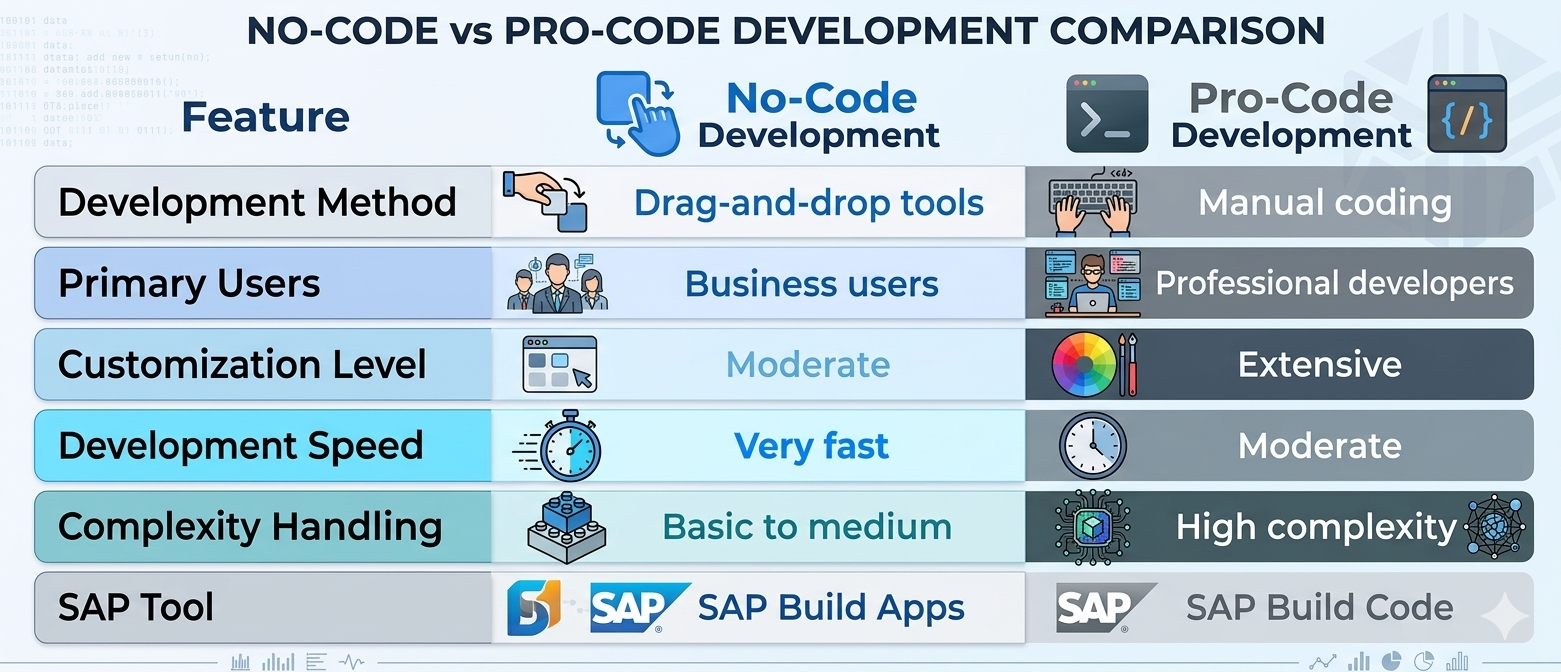
SAP Build Apps enables business users and citizen developers to create enterprise applications through drag-and-drop interfaces without extensive coding knowledge. These users can build workflows, forms, and user interfaces while leveraging enterprise-grade security and governance. On the other hand, SAP Build Code provides professional developers with advanced coding environments optimized for SAP technologies such as SAP Fiori, SAPUI5, CAP, Java, JavaScript, and ABAP. This dual approach ensures that simple applications can be developed quickly while complex enterprise solutions still benefit from professional development standards.
How AI Is Reshaping Fiori Development
Artificial intelligence is no longer a future concept in SAP development. It is actively changing how Fiori applications are created today. Joule acts as an intelligent development assistant capable of generating application logic, suggesting code improvements, creating test cases, and helping developers understand complex business requirements. Rather than spending hours writing repetitive code, developers can focus on architecture, innovation, and business value creation.
One of the most exciting developments is intent-based application creation. Users can describe a business requirement using natural language, and AI can generate a substantial portion of the application framework automatically. Imagine telling a system, "Create a procurement approval dashboard with mobile access and workflow notifications," and receiving a working prototype within minutes. This capability significantly reduces development effort while improving collaboration between technical and non-technical teams. The result is a more agile development process that aligns closely with business needs and strategic objectives.
No-Code vs Pro-Code in SAP Fiori
Many organizations wonder whether no-code development will eventually replace professional developers. The answer is no. Instead, both approaches serve different purposes and complement each other. No-code tools excel when businesses need rapid application development for straightforward processes. They empower business users to create solutions independently, reducing bottlenecks and increasing innovation speed.
Pro-code development remains essential for complex enterprise applications, integrations, custom business logic, and advanced user experiences. Large-scale SAP implementations often require extensive customization, security controls, performance optimization, and integration with multiple systems. These tasks still require experienced developers with deep technical knowledge. The future of SAP Fiori lies not in choosing one approach over the other but in combining both effectively. Organizations that successfully integrate no-code and pro-code strategies will be better positioned to innovate quickly while maintaining quality and scalability.
Fusion Development: The New Standard
Fusion development is emerging as one of the most important trends in SAP's development strategy. This concept brings together citizen developers, business analysts, and professional developers within a shared development environment. Rather than operating in isolated silos, teams collaborate throughout the application lifecycle.
The benefits are substantial. Business users contribute process knowledge and requirements directly into the development process. Citizen developers create initial prototypes and workflows. Professional developers refine, extend, and optimize these solutions for enterprise deployment. This collaborative model reduces communication gaps, accelerates project delivery, and improves alignment between business objectives and technical execution. SAP Build and Joule are specifically designed to support this collaborative approach, making fusion development a practical reality for organizations worldwide.
Skills Required for Fiori Developers in 2026
The role of the SAP Fiori developer is evolving rapidly. Traditional skills such as SAPUI5, JavaScript, OData, and ABAP remain highly valuable, but they are no longer sufficient on their own. Developers must also understand AI-assisted development workflows, cloud-native architectures, and SAP Business Technology Platform services.
Business knowledge is becoming equally important. Developers who understand business processes can leverage AI tools more effectively and create solutions that deliver measurable value. Knowledge of SAP Build, SAP BTP, CAP development, AI integration, and workflow automation is increasingly becoming a competitive advantage. Rather than writing every line of code manually, developers are now expected to orchestrate intelligent tools, validate AI-generated outputs, and ensure enterprise-quality implementation. This shift transforms developers from pure coders into strategic solution architects.
Future Outlook for SAP Fiori Development
Looking ahead, SAP Fiori development is expected to become even more intelligent and business-centric. The introduction of Joule Studio and AI-driven development environments suggests a future where applications, workflows, and AI agents can be created through a combination of visual design, natural language instructions, and professional coding techniques. SAP is investing heavily in agentic AI, enabling organizations to build intelligent agents capable of automating business processes across SAP and non-SAP systems.
The distinction between no-code and pro-code development will likely become less important over time. Instead, organizations will focus on selecting the most efficient approach for each project requirement. Developers will spend less time on repetitive coding tasks and more time on innovation, governance, architecture, and business transformation. As SAP continues expanding AI capabilities across its ecosystem, SAP Fiori will evolve from a user experience framework into a central component of intelligent enterprise application development. The organizations that embrace this shift early will gain significant advantages in agility, productivity, and digital innovation.
Conclusion
SAP Fiori development in 2026 is undergoing a remarkable transformation driven by AI, fusion development, and the convergence of no-code and pro-code approaches. Tools such as SAP Build Apps, SAP Build Code, and Joule are enabling organizations to build applications faster while maintaining enterprise-grade quality. Rather than replacing developers, these technologies empower them to focus on higher-value activities while business users actively contribute to innovation.
The future belongs to organizations that can combine the speed of no-code development with the flexibility and power of pro-code solutions. As AI continues to reshape the development landscape, SAP Fiori developers who embrace these new capabilities will play a crucial role in delivering intelligent, scalable, and business-focused enterprise applications.

 English
 Arabic
 French
 Spanish
 Portuguese
 Deutsch
 Turkish
 Italiano
 Russian
 Romaian
 Portuguese (Brazil)
 Greek
Greek