


The Ultimate Guide to Travel Insurance: What It Covers and Why You Need It
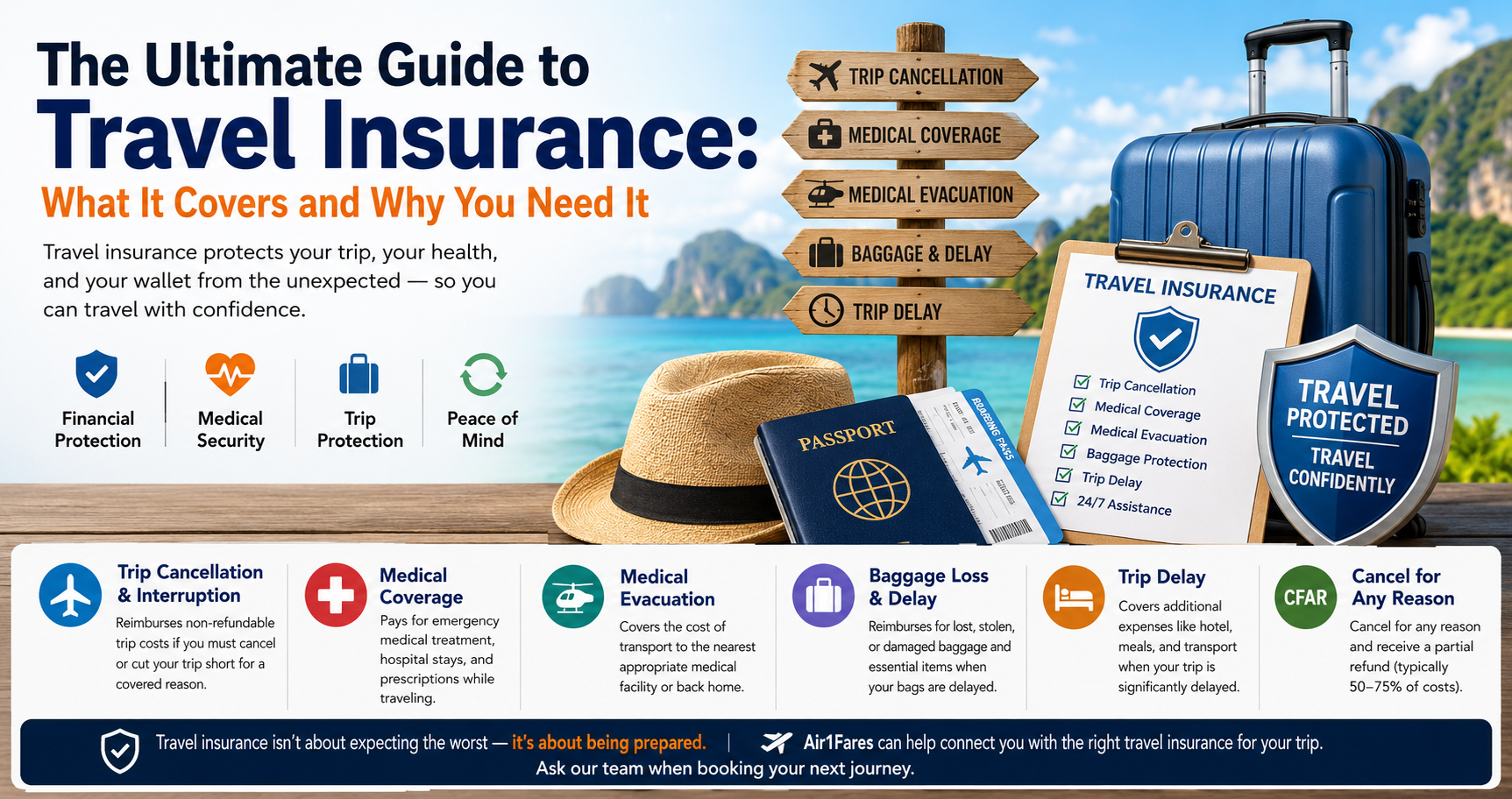
Travel insurance is one of the most misunderstood and underutilized tools in the traveler's toolkit. Many people view it as an unnecessary expense — until they need it. A medical evacuation from a remote destination can cost $50,000 or more. A cancelled trip due to illness can mean losing thousands of dollars in non-refundable bookings. Trip delay coverage can mean the difference between sleeping in an airport and sleeping in a hotel bed when your connection falls through. Understanding what travel insurance covers, what it doesn't, and how to choose the right policy is essential for any traveler.
The Core Categories of Travel Insurance
Travel insurance policies are collections of coverage types bundled together. Understanding each component helps you evaluate what you genuinely need. The primary categories are:
Trip Cancellation and Interruption covers the non-refundable cost of your trip if you must cancel or cut it short due to a covered reason. Covered reasons typically include illness, injury, or death of you, a travel companion, or an immediate family member; job loss; jury duty; natural disasters at your destination; airline bankruptcy; and travel supplier default. This coverage reimburses the non-refundable portions of your trip — flights, hotels, tours, and other pre-paid expenses.
Medical Coverage pays for emergency medical treatment while traveling. Standard health insurance plans — including Medicare — provide little or no coverage outside the United States. Even travelers with excellent domestic health coverage often find themselves completely uninsured when abroad. Medical coverage pays for hospital stays, emergency surgery, diagnostic tests, and prescription medications.
Medical Evacuation Coverage is separate from medical treatment and covers the potentially enormous cost of transporting you to a facility capable of treating your condition. In remote areas or developing countries with limited medical infrastructure, evacuation to a properly equipped hospital might require a private air ambulance — costs that regularly exceed $50,000–$100,000.
Baggage Loss and Delay Coverage reimburses you for lost, stolen, or damaged luggage, as well as essential purchases when your bags are delayed. If your checked bag goes missing in Bangkok and you need to buy a week's worth of clothing, this coverage pays for it.
Trip Delay Coverage kicks in when your trip is delayed beyond a specified threshold — usually six to twelve hours — due to a covered reason. It reimburses reasonable expenses: hotel room, meals, and transportation to the hotel during the delay.
Cancel for Any Reason (CFAR) Coverage
Standard trip cancellation coverage only pays for specific covered reasons. Cancel for Any Reason (CFAR) upgrades allow you to cancel your trip for literally any reason — anxiety, changed plans, a better opportunity arose — and receive a partial refund, typically 50–75% of your non-refundable costs. CFAR significantly increases the cost of a policy and must usually be purchased within a specific window after your initial trip deposit (often 14–21 days). For travelers who are uncertain about their plans or traveling during uncertain times, CFAR provides genuine peace of mind.
When to Buy Travel Insurance
The optimal time to purchase travel insurance is immediately after making your first trip payment. This ensures coverage begins immediately for covered cancellation events and typically keeps you within the window for optional add-ons like CFAR and pre-existing condition waivers. If you wait until the week before your trip to buy insurance, you may find that the pre-existing condition waiver is no longer available, or that events already in the news (a hurricane threatening your destination, for example) are excluded as known risks.
Pre-Existing Conditions
Pre-existing medical conditions are one of the most important considerations in travel insurance. Standard policies exclude coverage for conditions that existed before the policy was purchased. However, many policies offer a pre-existing condition waiver if you purchase within a specified window after your initial trip deposit — typically 14–21 days. The waiver removes the exclusion, allowing the policy to cover medical emergencies related to your pre-existing conditions.
If you have any ongoing medical condition — diabetes, heart disease, asthma, a recent surgery — the pre-existing condition waiver is essential, and timing your purchase accordingly is critical.
What Travel Insurance Does Not Cover
Understanding exclusions is as important as understanding coverage. Standard travel insurance does not cover: cancellations due to fear of travel (unless you have CFAR); pre-existing conditions without a waiver; self-inflicted injuries; extreme sports unless specifically covered; travel to destinations under government advisories; losses due to intoxication; and losses resulting from illegal activity.
The pandemic revealed limitations many travelers hadn't considered: travel insurance typically did not cover cancellations due to COVID-19 in the early stages of the crisis because epidemics and pandemics were explicitly excluded. Many insurers have since added pandemic coverage options, but reading the specific policy language remains essential.
Credit Card Travel Insurance: What It Actually Covers
Many premium travel credit cards include travel insurance as a benefit — trip cancellation, trip delay, baggage delay, and even primary car rental insurance. These benefits are genuinely valuable and often sufficient for straightforward domestic travel. However, credit card travel insurance typically lacks medical coverage and medical evacuation coverage — the two most financially catastrophic risks of international travel.
If you're traveling internationally, particularly to destinations with limited medical infrastructure, supplementing your credit card coverage with a standalone policy that includes robust medical and evacuation coverage is wise.
How to Choose the Right Policy
Start by identifying your specific risks and coverage gaps. What is the total non-refundable value of your trip? Do you have adequate health insurance abroad? Is your destination high-risk for political instability, natural disasters, or limited medical care? Are you participating in adventure activities?
Once you know what you need, compare policies through an insurance comparison site. Look beyond premium price to compare coverage limits, deductibles, exclusions, and the financial strength of the underwriting insurance company. A cheap policy from a financially weak insurer provides false security.
Travel insurance is not about expecting disasters — it's about ensuring that if something does go wrong, the financial impact doesn't compound the personal impact. Air1Fares can help connect you with appropriate travel insurance options for your trip — ask our team when booking your next journey.

 Arabic
 French
 Spanish
 Portuguese
 Deutsch
 Turkish
 Dutch
Dutch
 Italiano
 Russian
 Romaian
 Portuguese (Brazil)
 Greek
Greek