


How Is Infection Control Managed in Cardiac OT Setups?
Introduction
Infection control is one of the most critical aspects of modern cardiac surgery environments. Cardiac procedures are often lengthy, complex, and involve highly sensitive surgical interventions, making patients more vulnerable to infections. Even minor contamination within an operation theatre can lead to serious complications, prolonged hospital stays, increased healthcare costs, and adverse patient outcomes. For this reason, hospitals invest heavily in advanced operation theatre infrastructure designed specifically to minimize infection risks.
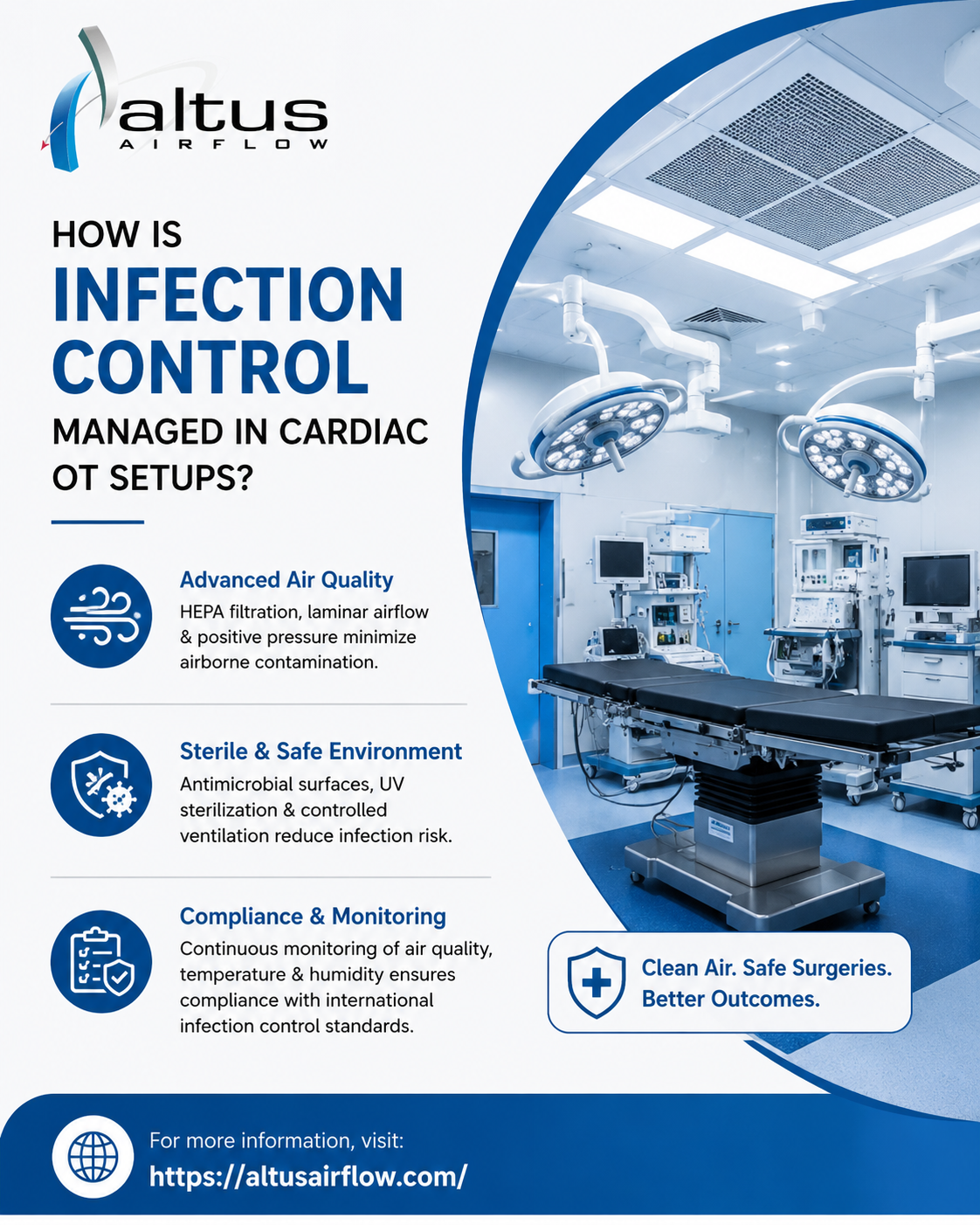
A professional Modular Cardiac OT Setup Company plays a vital role in designing and constructing operation theatres that meet strict infection control requirements. Modern modular cardiac operation theatres incorporate advanced HVAC systems, HEPA filtration, laminar airflow technology, antimicrobial surfaces, pressure-controlled environments, and strict workflow planning to maintain sterile surgical conditions. Every component within the OT is carefully engineered to reduce contamination and support patient safety.
Importance of Infection Control in Cardiac Surgery
Cardiac surgeries often involve open-heart procedures, bypass surgeries, valve replacements, and other highly complex interventions.
Patients undergoing these procedures are particularly susceptible to infections because:
- Surgical wounds are extensive.
- Procedures can last several hours.
- Patients may have weakened immune systems.
- Critical organs are exposed during surgery.
Effective infection control helps improve patient recovery and surgical outcomes.
Understanding Sources of Infection in Cardiac OTs
Infections can originate from various sources inside the operation theatre.
Common sources include:
- Airborne particles
- Contaminated surfaces
- Medical equipment
- Healthcare personnel
- Improper ventilation
Managing these risks requires a comprehensive infection control strategy.
Role of Modular OT Design in Infection Prevention
Modern cardiac OTs are designed with infection control as a primary objective.
A specialized Modular Cardiac OT Setup Company incorporates architectural and engineering solutions that reduce contamination risks while supporting efficient surgical workflows.
The modular design allows better environmental control compared to traditional operation theatres.
Controlled Air Quality Systems
Air quality management is one of the most important aspects of infection prevention.
Airborne microorganisms can significantly increase the risk of surgical site infections.
Modern cardiac OTs utilize advanced air handling systems to maintain clean air throughout the surgical environment.
HEPA Filtration Systems
HEPA filters are essential components of infection control infrastructure.
These filters can remove up to 99.97% of microscopic airborne particles.
Benefits include:
- Reduced airborne contamination
- Cleaner surgical environments
- Improved patient safety
- Enhanced air quality
HEPA filtration serves as the first line of defense against airborne pathogens.
Laminar Airflow Technology
Laminar airflow systems provide a continuous flow of filtered air across the surgical area.
This controlled airflow helps:
- Remove contaminants from the operating zone
- Prevent particle accumulation
- Maintain sterile conditions
Laminar airflow is widely used in advanced cardiac operation theatres.
Positive Pressure Ventilation
Positive pressure systems prevent contaminated air from entering the operation theatre.
The OT maintains a higher air pressure than adjacent areas.
This approach:
- Blocks external contaminants
- Supports sterile conditions
- Reduces infection risks
Positive pressure is a critical infection control feature.
HVAC Systems and Environmental Control
The HVAC system regulates environmental conditions inside the operation theatre.
Key functions include:
- Temperature control
- Humidity management
- Air circulation
- Ventilation control
Stable environmental conditions help minimize microbial growth.
Humidity Control
Humidity levels directly affect microbial survival.
Proper humidity management helps:
- Reduce bacterial growth
- Prevent condensation
- Protect medical equipment
Maintaining optimal humidity contributes to infection prevention.
Temperature Management
Consistent temperatures support both patient comfort and infection control.
Temperature regulation helps:
- Maintain environmental stability
- Improve equipment performance
- Support sterile conditions
Well-designed HVAC systems ensure accurate temperature control.
Seamless Wall Panels
Modern cardiac OTs use modular wall panels with smooth, non-porous surfaces.
Advantages include:
- Easy cleaning
- Reduced dust accumulation
- Improved hygiene
Seamless construction eliminates areas where contaminants can accumulate.
Antimicrobial Surface Materials
Many operation theatres incorporate antimicrobial coatings and materials.
These surfaces help:
- Reduce microbial growth
- Improve cleanliness
- Support infection prevention
Antimicrobial technologies enhance long-term hygiene management.
Specialized Flooring Systems
Flooring materials play an important role in infection control.
Common characteristics include:
- Seamless installation
- Chemical resistance
- Easy cleaning
Specialized flooring prevents contamination buildup.
Hermetically Sealed Doors
Hermetic doors help maintain environmental control.
Benefits include:
- Air-tight sealing
- Pressure maintenance
- Reduced contamination transfer
These doors contribute to cleaner operation theatre environments.
Controlled Access Management
Limiting access to the operation theatre helps reduce contamination risks.
Hospitals often implement:
- Restricted entry systems
- Authorized personnel access
- Traffic flow controls
Reducing unnecessary movement supports infection control.
Proper Surgical Zoning
Operation theatres are often divided into specific zones.
Examples include:
- Sterile zones
- Semi-sterile zones
- Non-sterile zones
This separation minimizes cross-contamination.
Staff Hygiene Protocols
Healthcare personnel are critical participants in infection prevention.
Protocols typically include:
- Surgical hand scrubbing
- Sterile gowning
- Mask usage
- Glove protocols
Strict compliance reduces contamination risks.
Sterilization of Surgical Instruments
All surgical instruments must undergo rigorous sterilization procedures.
Common methods include:
- Steam sterilization
- Chemical sterilization
- Plasma sterilization
Proper sterilization ensures patient safety.
Medical Equipment Maintenance
Equipment must be regularly inspected and cleaned.
Maintenance programs help:
- Ensure functionality
- Prevent contamination
- Maintain performance standards
Well-maintained equipment supports safer surgeries.
Environmental Cleaning Procedures
Routine cleaning is essential for infection control.
Cleaning programs focus on:
- Floors
- Walls
- Ceilings
- Equipment surfaces
Regular sanitation reduces microbial contamination.
Air Quality Monitoring Systems
Modern OTs often include real-time air quality monitoring.
These systems track:
- Particle counts
- Pressure levels
- Airflow performance
Continuous monitoring helps maintain compliance.
Environmental Monitoring Programs
Hospitals conduct regular environmental testing to verify cleanliness.
Monitoring may include:
- Surface sampling
- Air sampling
- Microbial testing
These assessments help identify potential risks.
Waste Management Systems
Proper medical waste disposal is essential.
Effective waste management helps:
- Prevent contamination
- Protect staff
- Maintain cleanliness
Waste handling protocols are integrated into OT operations.
Infection Surveillance Programs
Hospitals monitor infection rates to evaluate effectiveness.
Surveillance activities include:
- Data collection
- Trend analysis
- Corrective actions
Continuous improvement strengthens infection control.
Staff Training and Education
Regular training ensures that healthcare workers understand infection prevention practices.
Training topics may include:
- Sterility procedures
- Equipment handling
- Environmental protocols
Education supports consistent compliance.
Role of Automation in Infection Control
Modern cardiac OTs increasingly use automated technologies.
Examples include:
- Automated environmental monitoring
- Digital control systems
- Smart HVAC management
Automation improves reliability and consistency.
Compliance with Healthcare Standards
Cardiac operation theatres must comply with healthcare regulations and guidelines.
These standards address:
- Air quality
- Cleanroom practices
- Environmental controls
- Safety procedures
Compliance ensures consistent infection prevention.
Why Integrated Systems Matter
A successful infection control strategy relies on multiple systems working together.
An experienced Modular Cardiac OT Setup Company integrates HVAC systems, filtration technologies, construction materials, airflow management, and monitoring tools into a unified solution.
This coordinated approach delivers superior infection control performance.
Future Trends in Infection Prevention
Healthcare facilities continue to adopt advanced infection control technologies.
Emerging innovations include:
- Smart filtration systems
- AI-driven monitoring
- Self-disinfecting surfaces
- Predictive environmental controls
These developments will further improve patient safety.
Conclusion
A modern cardiac OT requires expertise from a trusted Modular Cardiac OT Setup Company that understands the unique challenges of infection prevention in surgical environments. Companies such as Altus Airflow specialize in designing advanced modular operation theatres that incorporate world-class infection control technologies and healthcare engineering solutions. By partnering with experienced providers like Altus Airflow, hospitals can create highly efficient, compliant, and future-ready cardiac operation theatres that support safer surgeries and better patient care.
FAQs
1. How does a Modular Cardiac OT Setup Company help manage infection control?
A Modular Cardiac OT Setup Company designs operation theatres with HEPA filtration, laminar airflow, HVAC systems, positive pressure controls, antimicrobial surfaces, and environmental monitoring systems to reduce contamination risks.
2. Why is HEPA filtration important in cardiac OTs?
HEPA filters remove airborne particles and microorganisms, helping maintain clean and sterile surgical environments.
3. What role does laminar airflow play in infection prevention?
Laminar airflow provides a controlled stream of filtered air that removes contaminants from the surgical area.
4. Why are positive pressure systems used in operation theatres?
Positive pressure prevents contaminated air from entering the OT from surrounding areas.
5. How are surfaces designed for infection control?
Modular OTs use smooth, seamless, and antimicrobial surfaces that are easy to clean and disinfect.
Read Our Previous Blog ---------------> Do andrology room design companies offer turnkey solutions?

 English
 Arabic
 French
 Spanish
 Portuguese
 Deutsch
 Turkish
 Dutch
Dutch
 Italiano
 Russian
 Romaian
 Portuguese (Brazil)