


App Development Company in the UK: 7 Interface Rules for Connected Electronics
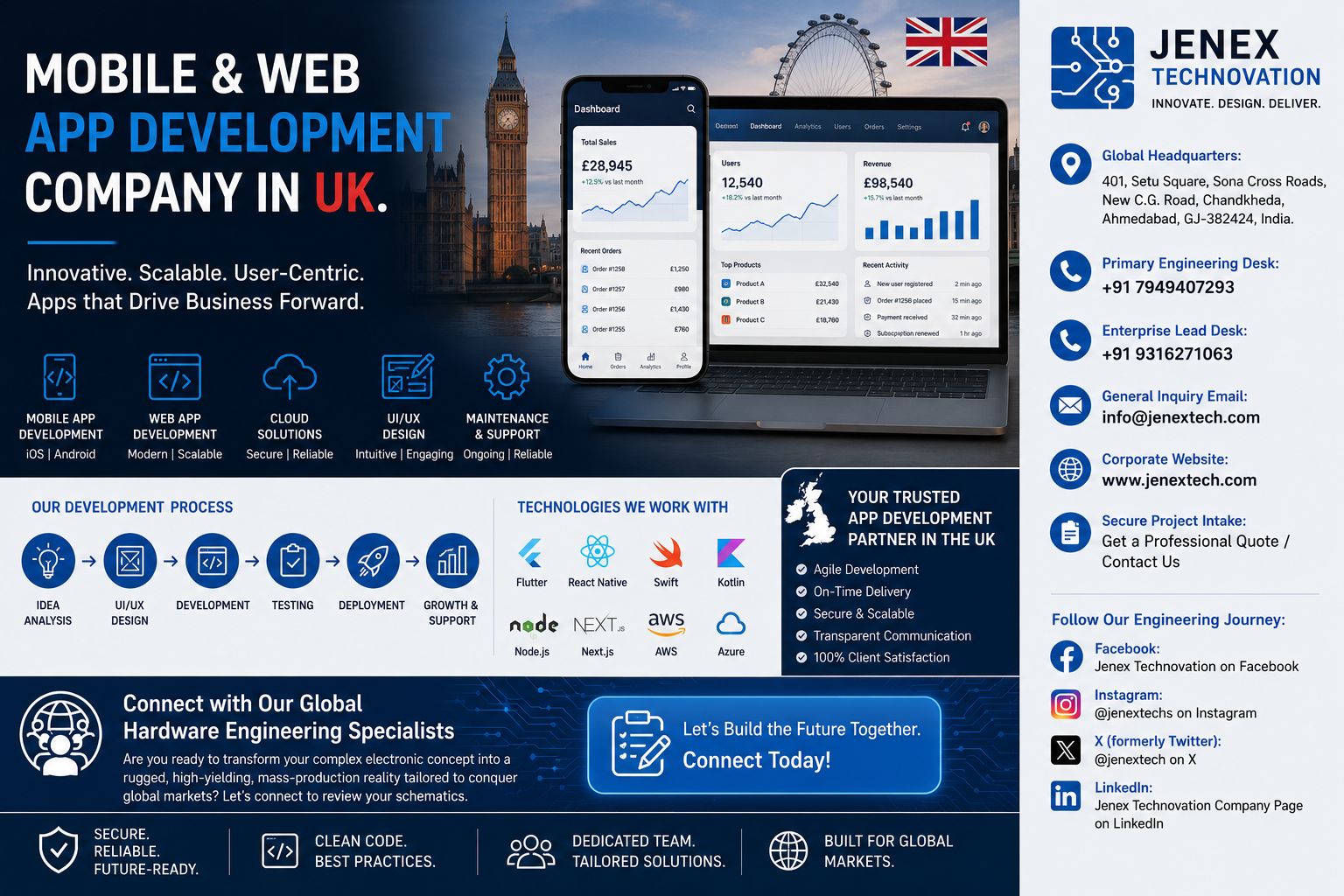
In the expanding British technology landscape, moving a complex consumer device or industrial asset framework into a high-volume Big Production run introduces a unique set of software engineering challenges. While building a standard web or e-commerce application focuses on managing human mouse clicks and database lookups, engineering mobile applications for Connected Electronics requires managing erratic, high-frequency physical hardware data streams.
The primary point of system failure for modern connected devices is rarely the cloud backend or the standalone circuit board layout. The true structural bottleneck sits inside the Hardware-Software Bridge—the integration layer where low-level microchip parameters must interact with the single-threaded, highly constrained user interface (UI) loops of iOS and Android mobile devices. If this boundary is poorly designed, your mobile control app will experience frequent frame drops, memory leaks, and local wireless connection failures, breaking user trust.
At Jenex Technovation Pvt. Ltd., we operate as a full-stack App Development Company in the UK. We construct highly stable, low-latency mobile platforms engineered to handle continuous physical telemetry with absolute reliability.
The Synchronization Chasm: Why Mainstream App Architectures Collapse Under Hardware Payloads
Most digital product agencies approach mobile layout creation using basic web models. These conventional application patterns are optimized to perform simple, slow actions—such as requesting text summaries, downloading images, or sending form data over stable broadband channels.
Physical electronics operate in an entirely different way. A medical monitoring tool, a connected industrial engine, or a smart commercial utility platform broadcasts rapid binary packages, uses complex wireless handshakes, and experiences frequent local signal dropouts. Forcing a mobile application's main user interface thread to handle this raw, unstructured data causes immediate display lag and application crashes.
To ensure your high-yield hardware deployments maintain complete operational predictability and total performance control, Jenex Technovation Pvt. Ltd. enforces these seven interface rules:
Rule 1: Enforce Strict Asynchronous Native Thread Isolation
Allowing raw bluetooth (BLE), local Wi-Fi, or cellular network data streams to process directly on the application's primary rendering thread locks the interface loop, turning smooth graphs into laggy, unresponsive screens.
-
The Jenex Standard: We construct our primary data ingestion engines using absolute thread separation. We handle raw bitstream parsing and initial validation entirely within dedicated background worker queues using Swift Concurrency (Actors) on iOS and Kotlin Coroutines on Android. This keeps the primary UI render layer completely clear, delivering a crisp, lag-free visual panel during continuous field updates.
Rule 2: Implement Highly Compressed Binary Data Serialization
Streaming telemetry data configurations across wireless networks using verbose, uncompressed text formats like traditional JSON strings drains mobile battery capacity and inflates data usage costs.
-
The Jenex Standard: We replace heavy text communication layouts with optimized binary serialization tools like Protocol Buffers (Protobuf) or CBOR. By parsing raw bitstream metrics natively within our application logic, we reduce network data packet footprints by up to 85%, minimizing wireless data overhead while speeding up physical hardware reactivity.
  [ Connected Physical Asset Fleet ]
                  │
                  ▼ (Compressed Binary Streams via BLE / MQTT / WebSockets)
  ┌─────────────────────────────────────────┐
  │ Isolated Background Processing Workers  │ ──► Continuous bitstream parsing and verification
  └─────────────────────────────────────────┘
                  │
          ┌───────┴───────┐
          ▼ (Cache Path)  ▼ (Filtered Visual Stream)
  ┌─────────────┐   ┌─────────────────────────┐
  │ Encrypted   │   │ Main UI Render Thread   │
  │ SQLite Local│   │ Real-Time Twin Engine   │ ──► Smooth visual updates at 60+ FPS
  │ Storage Cache│   │ Graphic Gauges & Panels │
  └─────────────┘   └─────────────────────────┘
Rule 3: Build Silicon-to-Screen Zero-Trust mTLS Security Layers
Every open local wireless connection established between a mobile application and physical electronics represents a target for data eavesdropping, firmware reverse-engineering, or unauthorized control takeovers.
-
The Jenex Standard: We weave hard cryptographic protection directly into our software layers, coordinating directly with the secure enclaves built into our custom Embedded Hardware Solutions. By enforcing strict Mutual TLS (mTLS) validation and hardware-backed key storage inside the iOS Keychain and Android Keystore, our mobile applications check the precise identity of your hardware before sending a single operational command.
Rule 4: Design Robust, Offline-First Local Storage Caches
Smart products are regularly deployed into challenging wireless environments—such as reinforced underground basements, remote fields, or structural steel marine shipping arrays.
-
The Jenex Standard: We deploy a resilient Offline-First Data Architecture. If a wireless signal drops, our applications write all incoming device metrics into a secure, transactional local storage system. The moment a stable network link back to our Cloud Solutions infrastructure is detected, background synchronization services upload cached logs smoothly without creating database conflicts.
Rule 5: Compile Machine Learning Intelligence Natively to Edge Software (TinyML)
Continuously transferring massive streams of unchanged device telemetry back to central cloud databases to run performance analytics creates unnecessary network traffic and drives up hosting expenses.
-
The Jenex Standard: We integrate intelligent diagnostics directly into our application layers using specialized AI/ML Solutions. By compiling machine learning algorithms straight onto local mobile operating setups via CoreML and TensorFlow Lite (TinyML), our applications evaluate complex asset anomalies locally, transmitting only parsed insight vectors to your central tracking systems.
Rule 6: Construct Automated, Zero-Touch Device Onboarding Pipelines
A significant operational bottleneck that delays mass enterprise technology rollouts is the physical registration phase. Manual wireless configuration and slow pairing procedures introduce massive room for user error.
-
The Jenex Standard: We build automated device enrollment pathways directly into our IoT Solutions. By combining high-speed QR code scanning, proximity Near Field Communication (NFC) taps, and background BLE discovery scripts, field personnel can securely activate, authorize, and register a massive fleet of field units to centralized cloud infrastructures in seconds.
Rule 7: Build Safe, Dual-Bank Over-the-Air (OTA) Flashing Bridges
Updating low-level microchip code across a distributed global fleet introduces serious risks if a flash session is interrupted by a sudden battery drop or signal loss.
-
The Jenex Standard: We build transactional, dual-bank OTA Update Gateways inside our mobile applications, coordinating directly with our custom Embedded Firmware Solutions. The update package is loaded entirely to an inactive flash bank and validated via cryptographic hashes. If power fails mid-flash, the custom bootloader rolls back to the last stable configuration, completely avoiding field failures.
The Jenex Advantage: Complete Full-Stack Engineering Accountability
At Jenex Technovation Pvt. Ltd., we have systematically eliminated the fractured multi-vendor model that routinely delays modern product timelines. You no longer need to manage the massive operational friction of balancing an isolated mobile application agency, an independent circuit designer, an unrelated firmware development group, and a third-party cloud consultant.
We provide a single, unified point of global technical execution, possessing the internal capacity to design, simulate, validate, and mass-manufacture any custom physical unit or connected software ecosystem as per client requirements. From initial silicon selection and multi-layer board layouts to high-throughput cloud streaming and responsive mobile operator interfaces, we ensure your entire asset portfolio is secure, compliant, and engineered to scale profitably.
Connect with Our United Kingdom Systems Engineering Specialists
Are you ready to move past standard application design limitations and secure your mass production runs with an elite mobile command center built for global market leadership? Let's connect to review your technical roadmap.
-
📍 Global Headquarters: 401, Setu Square, Sona Cross Roads, New C.G. Road, Chandkheda, Ahmedabad, GJ-382424, India.
-
📞 Primary Engineering Desk: +91 7949407293
-
📞 Enterprise Lead Desk: +91 9316271063
-
✉️ General Inquiry Email: info@jenextech.com
-
🌐 Corporate Website: www.jenextech.com
-
📋 Secure Project Intake: Get a Professional Quote / Contact Us
Follow Our Engineering Journey:
-
Facebook: Jenex Technovation on Facebook
-
Instagram: @jenextechs on Instagram
-
X (formerly Twitter): @jenextech on X

 English
 Arabic
 French
 Spanish
 Portuguese
 Deutsch
 Turkish
 Dutch
Dutch
 Italiano
 Russian
 Portuguese (Brazil)
 Greek
Greek