


The Role of Carbon Nanodispersion in Lightweight Materials
Introduction
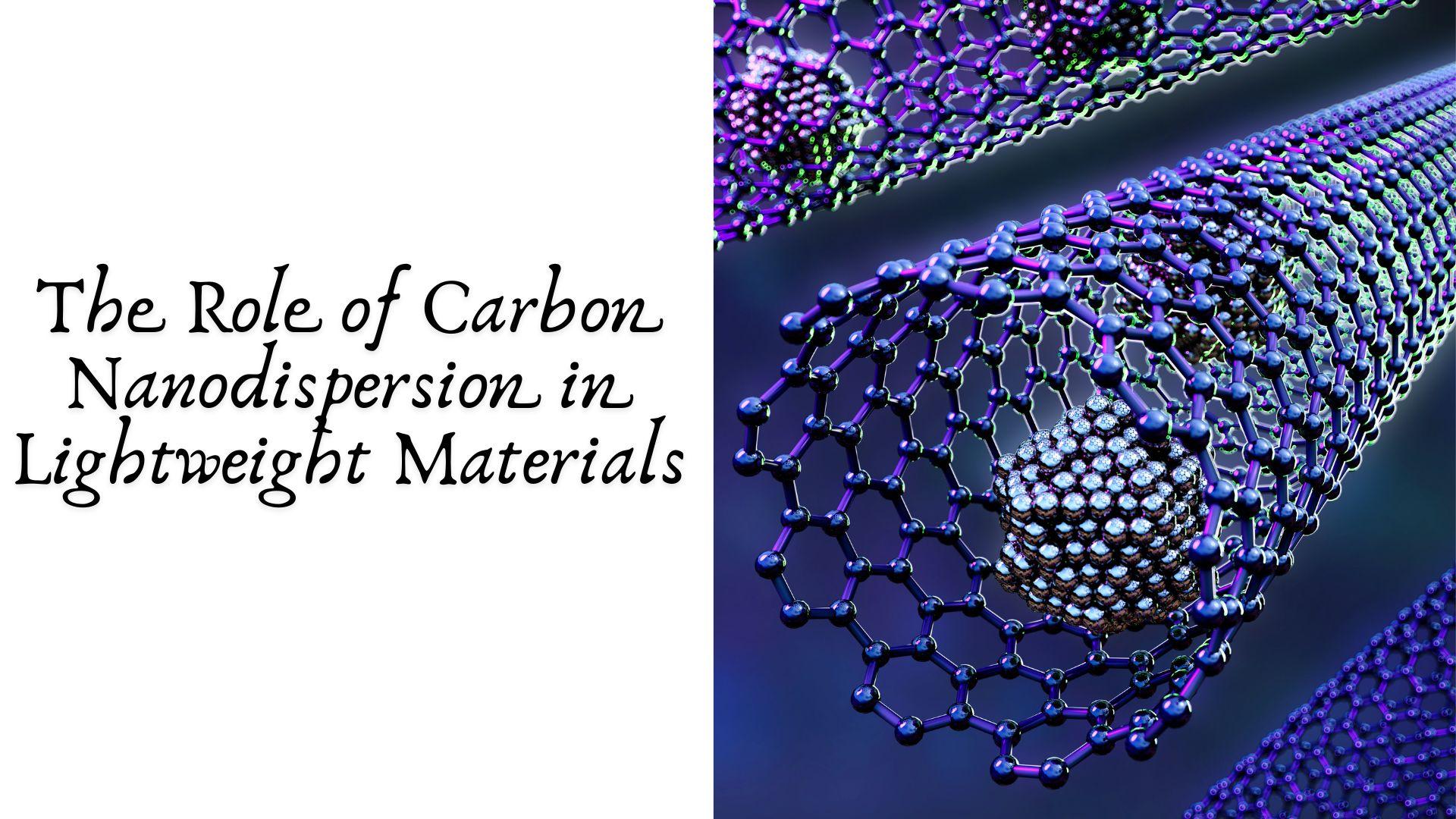
In the pursuit of lighter, stronger, and more efficient materials, industries across aerospace, automotive, construction, electronics, and renewable energy are turning to nanotechnology for solutions. Among the most impactful innovations is carbon nanodispersion—the uniform distribution of carbon-based nanomaterials such as carbon nanotubes (CNTs), graphene, and carbon black within a host matrix. This technology is playing a transformative role in the development of lightweight materials that do not compromise on strength, durability, or performance.
Carbon nanodispersion bridges the gap between weight reduction and high functionality, enabling manufacturers to design advanced composites that meet modern demands for sustainability, efficiency, and mechanical excellence.
Understanding Carbon Nanodispersion
Carbon nanodispersion refers to the process of evenly dispersing carbon nanoparticles at the nanoscale within polymers, metals, ceramics, or hybrid matrices. Proper dispersion is critical because carbon nanomaterials tend to agglomerate due to strong van der Waals forces. When well-dispersed, these nanomaterials create an interconnected network that significantly enhances material properties even at very low loading levels.
Common carbon nanomaterials used include:
-
Carbon nanotubes (single-walled and multi-walled)
-
Graphene and graphene nanoplatelets
-
Carbon black
-
Fullerenes and other carbon nanostructures
Each of these materials contributes unique mechanical, electrical, and thermal advantages when effectively dispersed.
Why Lightweight Materials Matter
Lightweight materials are essential for improving energy efficiency, reducing emissions, and enhancing performance. Lower material weight translates to:
-
Improved fuel efficiency in vehicles and aircraft
-
Reduced structural loads and material consumption
-
Enhanced portability and flexibility in electronics
-
Lower transportation and operational costs
Carbon nanodispersion enables these benefits while simultaneously improving mechanical integrity—an achievement that traditional materials often struggle to deliver.
Mechanical Reinforcement Through Nanodispersion
One of the most significant contributions of carbon nanodispersion is mechanical reinforcement. Carbon nanomaterials possess extraordinary intrinsic properties, including high tensile strength and elastic modulus. When dispersed uniformly:
-
Tensile strength increases without adding bulk
-
Impact resistance improves, reducing material failure
-
Fatigue life extends, particularly in cyclic loading applications
In lightweight polymer composites, even a small percentage of well-dispersed carbon nanotubes or graphene can outperform conventional fiber-reinforced materials while maintaining a lower overall weight.
Enhancing Structural Integrity at Low Filler Loadings
Traditional fillers often require high loadings, increasing density and negatively affecting processability. Carbon nanodispersion changes this paradigm. Because carbon nanomaterials operate at the nanoscale with a high aspect ratio, they deliver performance improvements at very low concentrations.
This allows manufacturers to:
-
Maintain lightweight characteristics
-
Preserve flexibility and formability
-
Achieve superior strength-to-weight ratios
Such advantages are particularly valuable in aerospace panels, automotive body components, and sports equipment.
Thermal and Electrical Benefits in Lightweight Systems
Carbon nanodispersion also introduces multifunctionality into lightweight materials.
Thermal Conductivity
Uniformly dispersed graphene or CNTs create efficient thermal pathways, enhancing heat dissipation in lightweight components used in electronics, batteries, and electric vehicles.
Electrical Conductivity
Carbon nanomaterials enable electrical conductivity in otherwise insulating polymers. This is crucial for:
-
Electromagnetic interference (EMI) shielding
-
Antistatic lightweight components
-
Smart and sensor-integrated structures
These features reduce the need for additional conductive layers, further lowering weight and complexity.
Carbon Nanodispersion in Polymer Composites
Polymer composites are among the biggest beneficiaries of carbon nanodispersion. Lightweight polymers such as polypropylene, polyethylene, epoxy resins, and thermoplastics gain substantial performance enhancements when reinforced with dispersed carbon nanomaterials.
Key improvements include:
-
Higher stiffness and strength
-
Improved wear and abrasion resistance
-
Enhanced dimensional stability
This makes them ideal for automotive interiors, aircraft cabins, consumer electronics housings, and medical devices.
Applications in Aerospace and Automotive Industries
Aerospace
In aerospace engineering, weight reduction directly impacts fuel efficiency and payload capacity. Carbon nanodispersion supports the development of:
-
Lightweight structural panels
-
Advanced coatings with enhanced durability
-
High-performance insulation materials
These composites meet strict safety and performance standards while reducing overall aircraft weight.
Automotive
In the automotive sector, carbon nanodispersed materials contribute to:
-
Lightweight body panels
-
Strong yet thin structural components
-
Electrically conductive parts for electric vehicles
This aligns with global efforts to improve fuel economy and reduce carbon emissions.
Sustainability and Material Efficiency
Carbon nanodispersion supports sustainability in multiple ways:
-
Material reduction: Stronger materials require less raw material
-
Energy savings: Lightweight components reduce energy consumption during use
-
Extended lifespan: Improved durability lowers replacement frequency
Additionally, research is advancing toward eco-friendly dispersion techniques and bio-based polymer matrices, further enhancing environmental benefits.
Challenges in Carbon Nanodispersion
Despite its advantages, achieving uniform carbon nanodispersion remains technically challenging. Common issues include:
-
Nanoparticle agglomeration
-
Increased processing costs
-
Compatibility between nanomaterials and host matrices
However, advancements in surface functionalization, high-shear mixing, ultrasonication, and in-situ polymerization are steadily overcoming these barriers.
Future Outlook
The future of lightweight materials is closely tied to improvements in carbon nanodispersion technologies. Emerging trends include:
-
AI-assisted dispersion optimization
-
Scalable manufacturing processes
-
Hybrid nanofiller systems for multifunctional performance
As these technologies mature, carbon nanodispersion will become a standard approach in next-generation lightweight materials.
Conclusion
Carbon nanodispersion plays a pivotal role in the evolution of lightweight materials by delivering exceptional strength, durability, and multifunctionality without adding unnecessary weight. By enabling superior performance at low filler loadings, it addresses critical challenges faced by modern industries striving for efficiency, sustainability, and innovation.
As research and industrial adoption continue to advance, carbon nanodispersion is set to remain a cornerstone technology in the development of high-performance, lightweight materials for the future.

 English
 Arabic
 French
 Spanish
 Portuguese
 Deutsch
 Turkish
 Italiano
 Russian
 Romaian
 Portuguese (Brazil)
 Greek
Greek