


Primary Care Medical Billing Solution: Streamlining Revenue for Better Patient Care
Introduction
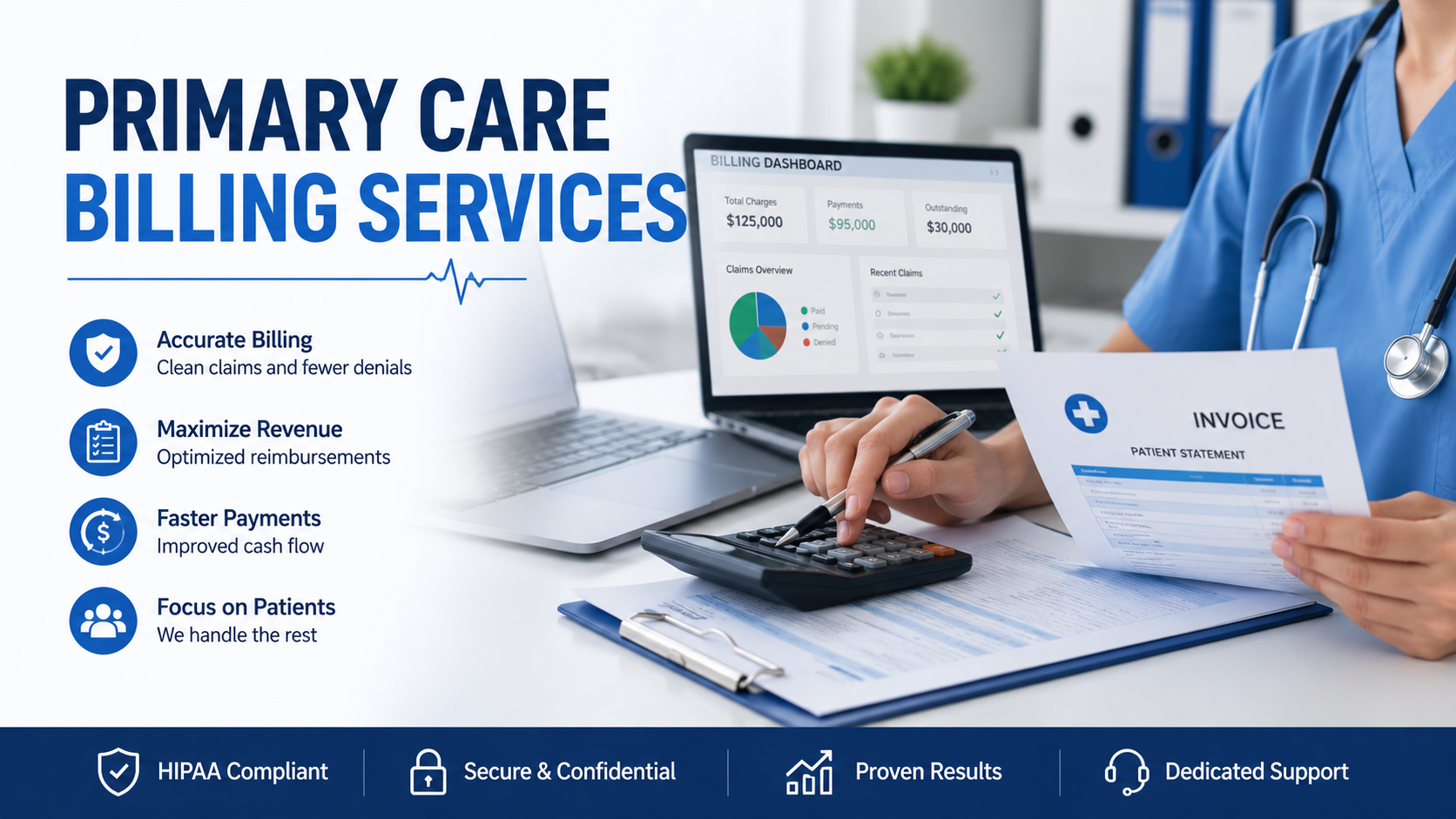
Primary care practices sit at the center of the healthcare system, managing everything from preventive care to chronic disease management. But while patient care is the priority, financial stability depends heavily on how efficiently billing is handled. This is where a primary care medical billing solution becomes essential.
Billing in primary care is often more complex than it appears. Multiple payers, evolving coding rules, denied claims, and patient responsibility calculations can quickly slow down revenue cycles. Even small errors can lead to delayed reimbursements or lost income.
A structured and technology-driven billing solution helps practices reduce administrative burden, improve accuracy, and ensure steady cash flow. More importantly, it allows physicians and staff to focus more on patients rather than paperwork.
In this article, we will explore how a primary care medical billing solution works, its key benefits, challenges it solves, and why practices are increasingly outsourcing or upgrading their billing systems for better financial performance.
Why Primary Care Practices Need a Strong Medical Billing Solution
Primary care providers deal with a high volume of patient visits daily. Each visit involves documentation, coding, claim submission, and follow-ups. Without a reliable billing system, this process becomes overwhelming.
A dedicated primary care medical billing solution ensures that every step of the revenue cycle is handled systematically:
- Accurate patient eligibility verification before visits
- Proper ICD-10 and CPT coding for primary care services
- Timely claim submission to insurance companies
- Denial management and resubmission processes
- Patient billing and collections support
One of the biggest challenges in primary care billing is claim denials due to coding errors or missing information. A structured billing solution reduces these errors by standardizing workflows and ensuring compliance with payer requirements.
Another major issue is delayed reimbursements. When claims are not submitted correctly or tracked efficiently, it can take weeks or even months to receive payments. A proper billing system helps reduce these delays by ensuring clean claim submission from the start.
Additionally, primary care practices often struggle with staff shortages. Front desk employees may not always have the expertise to handle complex billing tasks. A dedicated solution fills this gap by providing specialized knowledge and support.
Key Features of an Effective Primary Care Medical Billing Solution
A high-performing primary care medical billing solution is not just about submitting claims—it is about managing the entire revenue cycle efficiently. Here are some essential features that make a solution effective:
1. Accurate Medical Coding Support
Coding is the foundation of medical billing. Primary care services include preventive visits, chronic care management, immunizations, and minor procedures. Each service requires precise CPT and ICD coding.
An advanced billing solution ensures correct coding by reducing human errors and staying updated with the latest coding guidelines. This minimizes claim rejections and improves reimbursement rates.
2. Real-Time Eligibility Verification
Before providing services, verifying patient insurance eligibility is crucial. A strong billing solution checks coverage details in real time, reducing the chances of claim denials later.
This feature also helps in informing patients about their financial responsibility upfront, improving transparency and collection rates.
3. Efficient Claim Submission and Tracking
Submitting claims quickly is important, but tracking them is even more critical. A good billing solution ensures:
- Clean claim submission
- Automated error checks
- Real-time claim tracking
- Fast follow-up on pending claims
This reduces revenue leakage and improves cash flow consistency.
4. Denial Management System
Denied claims are a major challenge in primary care billing. A structured denial management process identifies the reason for rejection, corrects errors, and resubmits claims promptly.
Common denial reasons include:
- Incorrect patient details
- Missing documentation
- Coding mismatches
- Authorization issues
A strong billing system ensures these issues are addressed proactively to prevent future denials.
5. Patient Billing and Payment Handling
Today, patient responsibility has increased significantly due to high-deductible insurance plans. A complete billing solution includes patient-friendly billing statements, online payment options, and follow-up systems for outstanding balances.
This improves collection rates and enhances patient satisfaction.
Benefits of Using a Primary Care Medical Billing Solution
Implementing a primary care medical billing solution offers several advantages that directly impact a practice’s financial health and operational efficiency.
Improved Revenue Cycle Management
One of the biggest benefits is faster revenue collection. Clean claims, accurate coding, and efficient follow-ups ensure that payments are received without unnecessary delays.
Reduced Administrative Burden
Medical staff often spend too much time on billing-related tasks. By using a structured solution, administrative workload is significantly reduced, allowing staff to focus more on patient care.
Fewer Claim Denials
With built-in checks and professional oversight, billing errors are minimized. This leads to fewer claim rejections and higher approval rates from insurance companies.
Better Compliance and Accuracy
Healthcare regulations and insurance policies change frequently. A professional billing solution ensures compliance with all updated rules, reducing the risk of penalties or audits.
Scalable for Growing Practices
As a primary care practice grows, the volume of patients and claims increases. A scalable billing solution adapts easily without compromising accuracy or speed.
Challenges Faced Without a Proper Billing System
Practices that rely on outdated or manual billing processes often face several issues:
- Frequent claim rejections
- Slow reimbursement cycles
- Increased administrative workload
- Revenue leakage due to coding mistakes
- Lack of visibility into financial performance
These challenges not only affect revenue but also create stress for healthcare providers. In many cases, physicians end up spending more time on billing problems than patient care.
A structured primary care medical billing solution helps eliminate these challenges by introducing automation, expertise, and consistency into the billing process.
FAQs on Primary Care Medical Billing Solution
1. What is a primary care medical billing solution?
It is a structured system or service that manages billing processes for primary care practices, including coding, claim submission, denial management, and payment tracking.
2. Why is billing important in primary care?
Billing ensures that healthcare providers are reimbursed accurately and on time for services provided. Without proper billing, practices may face revenue loss and cash flow issues.
3. Can small clinics benefit from a billing solution?
Yes, even small clinics benefit significantly. A billing solution reduces errors, improves collections, and allows small teams to manage finances more efficiently.
4. What causes claim denials in primary care?
Common causes include incorrect coding, missing patient information, eligibility issues, and lack of proper documentation.
5. Is outsourcing medical billing a good option?
Many practices choose outsourcing because it reduces workload, improves accuracy, and provides access to experienced billing professionals.
Conclusion
A reliable primary care medical billing solution is no longer optional—it is a necessity for modern healthcare practices. As billing complexity continues to grow, having a structured system in place ensures financial stability, operational efficiency, and better patient care.
From accurate coding and claim submission to denial management and patient collections, every step in the revenue cycle plays a crucial role in practice success.
For healthcare providers looking to improve efficiency and reduce administrative burden, partnering with professional Medical Billing Services can make a significant difference. It allows practices to focus on what truly matters—delivering quality care while ensuring consistent revenue flow.

 English
 Arabic
 French
 Spanish
 Portuguese
 Deutsch
 Turkish
 Dutch
Dutch
 Italiano
 Romaian
 Portuguese (Brazil)
 Greek
Greek