Mental health care has become a vital part of the healthcare system in the USA. More people are seeking support for conditions such as anxiety, depression, trauma, substance use disorders, and behavioral health concerns than ever before. While providers focus on delivering quality care, managing billing can become one of the biggest operational challenges.
Medical billing for mental health services involves much more than submitting insurance claims. It requires accurate documentation, proper coding, payer-specific knowledge, and continuous follow-up to ensure providers receive timely reimbursement. Even a small mistake can result in denied claims, delayed payments, or compliance concerns.
Understanding how the billing process works can help mental health practices improve cash flow, reduce administrative stress, and spend more time caring for patients.
Why Mental Health Billing Is Different
Mental health billing differs from many other medical specialties because treatment often includes ongoing therapy sessions, psychiatric evaluations, medication management, and telehealth appointments. Each service has unique documentation and coding requirements.
Insurance companies also have varying rules regarding:
- Session duration
- Medical necessity
- Prior authorization
- Frequency limits
- Telehealth coverage
- Provider eligibility
These differences make accurate billing essential for maintaining a healthy financial workflow.
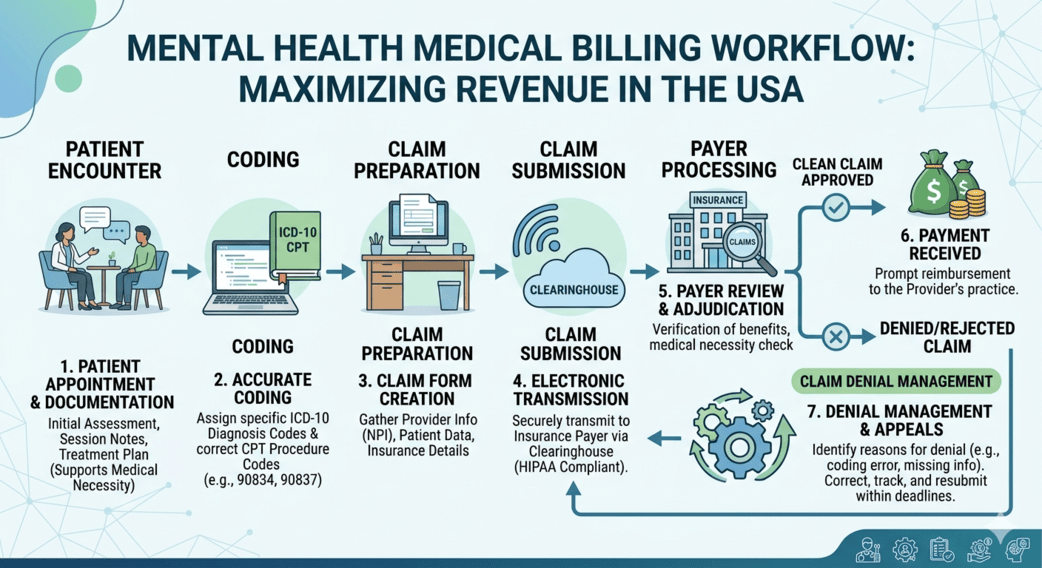
The Complete Medical Billing Process for Mental Health Services
Every successful claim follows a series of important steps.
Patient Registration and Insurance Verification
The billing process begins before the patient's first appointment.
Front-office staff should verify:
- Active insurance coverage
- Behavioral health benefits
- Copay and deductible amounts
- Referral requirements
- Prior authorization needs
Verifying insurance early helps reduce claim denesials and unexpected patient balances.
Accurate Clinical Documentation
Mental health documentation must clearly support the services provided.
Providers should record:
- Diagnosis
- Treatment goals
- Session duration
- Progress notes
- Medical necessity
- Follow-up recommendations
Incomplete or inconsistent documentation often leads to rejected claims during payer reviews.
Medical Coding
After documentation is complete, services must be translated into standardized codes.
This includes:
- Diagnosis codes
- Procedure codes
- Modifiers when required
Accurate medical coding services play an important role in reducing billing errors and ensuring claims match payer requirements.
Claim Submission
Claims are submitted electronically to insurance companies after verification.
Before submission, billing teams review claims for:
- Missing information
- Coding accuracy
- Provider credentials
- Authorization status
- Insurance eligibility
Clean claims have a much higher chance of being processed quickly.
Payment Posting and Follow-Up
Once insurers process claims, payments are posted and any remaining balances are identified.
If claims are denied or underpaid, billing specialists investigate the reason and submit corrections or appeals when appropriate.
Consistent follow-up helps recover revenue that might otherwise be lost.
Common Challenges in Medical Billing for Mental Health Services
Mental health practices frequently encounter billing obstacles that affect reimbursement.
Frequent Claim Denials
Common reasons include:
- Incorrect diagnosis codes
- Missing modifiers
- Expired authorizations
- Incomplete documentation
- Eligibility issues
Many of these denials can be prevented through careful claim review before submission.
Changing Insurance Policies
Behavioral health coverage continues to evolve.
Insurance companies regularly update:
- Covered services
- Telehealth policies
- Documentation standards
- Authorization rules
Billing teams must stay informed to avoid unnecessary payment delays.
Telehealth Billing Requirements
Virtual mental health visits have become increasingly common.
Although telehealth improves patient access, billing requires careful attention to:
- Correct modifiers
- Place of service codes
- Payer-specific telehealth guidelines
- Documentation requirements
Incorrect telehealth billing often results in rejected claims.
Coordination Between Clinical and Billing Teams
Strong communication between providers and billing professionals improves claim accuracy.
When documentation, coding, and billing work together, practices experience fewer payment interruptions.
Best Practices for Successful Mental Health Billing
Improving billing performance doesn't always require major changes. Consistent attention to detail often delivers significant results.
Verify Benefits Before Every Visit
Insurance information can change at any time.
Confirming benefits before appointments helps identify:
- Coverage changes
- Authorization updates
- Copayment responsibilities
Document Medical Necessity Clearly
Insurance companies require evidence that treatment is medically necessary.
Clinical notes should explain:
- Patient symptoms
- Diagnosis
- Treatment provided
- Progress toward goals
Clear documentation supports successful reimbursement.
Submit Claims Quickly
Timely claim submission reduces the risk of missing payer filing deadlines.
Delays increase administrative work and postpone revenue collection.
Monitor Key Billing Metrics
Practices should regularly review:
- Claim acceptance rate
- First-pass resolution rate
- Days in accounts receivable
- Denial percentage
- Collection rate
Tracking these indicators helps identify opportunities for improvement.
The Role of Credentialing in Mental Health Billing
Before providers can bill many insurance companies, they must complete credentialing.
Credentialing verifies:
- Professional licenses
- Education
- Certifications
- Practice information
- Insurance participation
Incomplete or outdated credentialing can delay reimbursements even when claims are coded correctly.
Maintaining provider credentials is an ongoing responsibility that supports uninterrupted billing.
How Revenue Cycle Management Supports Mental Health Practices
Financial success depends on more than claim submission alone.
Effective revenue cycle management oversees every financial step from patient scheduling through final payment collection.
A strong revenue cycle helps practices:
- Reduce claim denials
- Improve cash flow
- Increase reimbursement accuracy
- Minimize billing errors
- Enhance patient financial transparency
By addressing issues early, practices spend less time correcting rejected claims later.
Why Professional Billing Support Makes a Difference
Many growing behavioral health practices choose experienced billing professionals to manage complex reimbursement requirements.
Specialized medical billing services can assist with:
- Insurance verification
- Accurate claim submission
- Denial management
- Payment reconciliation
- Compliance monitoring
- Reporting and analytics
Similarly, reliable medical coding services help ensure diagnoses and procedures are accurately represented, reducing the likelihood of coding-related denials.
Organizations such as 247 Medical Billing Services support healthcare providers by combining billing expertise, coding knowledge, credentialing, and revenue cycle management strategies that help practices maintain financial stability while allowing clinicians to focus on patient care.
Compliance Matters More Than Ever
Mental health information requires careful handling because of its sensitive nature.
Practices should maintain compliance by:
- Protecting patient privacy
- Maintaining secure documentation
- Following payer guidelines
- Keeping coding updated
- Performing routine billing audits
Compliance not only reduces financial risk but also strengthens patient trust.
Looking Ahead: The Future of Mental Health Billing
Behavioral healthcare continues to expand across the USA, bringing new reimbursement models and technology-driven billing solutions.
Several trends are shaping the future:
- Increased use of telehealth services
- Greater automation in claim processing
- Improved billing software integration
- Enhanced denial analytics
- Growing emphasis on value-based care
Practices that adapt to these changes will be better positioned to improve both patient satisfaction and financial performance.
Frequently Asked Questions
1. What is medical billing for mental health services?
Medical billing for mental health services is the process of submitting insurance claims for behavioral health treatments, including therapy, psychiatric evaluations, counseling, medication management, and related services while ensuring compliance with payer requirements.
2. Why are mental health claims often denied?
Claims may be denied because of incorrect coding, missing documentation, authorization issues, inactive insurance coverage, billing errors, or failure to meet payer-specific guidelines.
3. Does telehealth require different billing procedures?
Yes. Telehealth services often require specific modifiers, place of service codes, and documentation depending on each insurance company's billing policies.
4. How does credentialing affect reimbursement?
Providers generally must complete credentialing before billing participating insurance companies. Without active credentialing, insurers may reject or delay claim payments.
5. What role does medical coding play in mental health billing?
Accurate medical coding services ensure diagnoses and treatments are correctly documented using standardized codes, helping reduce denials and improve reimbursement accuracy.
6. How can revenue cycle management improve a mental health practice?
Effective revenue cycle management streamlines patient registration, claim submission, payment tracking, denial management, and collections, leading to stronger cash flow and fewer billing issues.
7. Should mental health practices outsource billing?
Many practices choose professional medical billing services to handle complex insurance requirements, improve claim accuracy, reduce administrative workload, and support consistent reimbursement while allowing providers to focus on delivering quality patient care.




 English
 Arabic
 French
 Portuguese
 Deutsch
 Turkish
 Dutch
Dutch
 Italiano
 Russian
 Romaian
 Portuguese (Brazil)
 Greek
Greek