


Coding and Billing for Urgent Care in the USA: A Practical Guide to Faster Reimbursement and Fewer Claim Errors
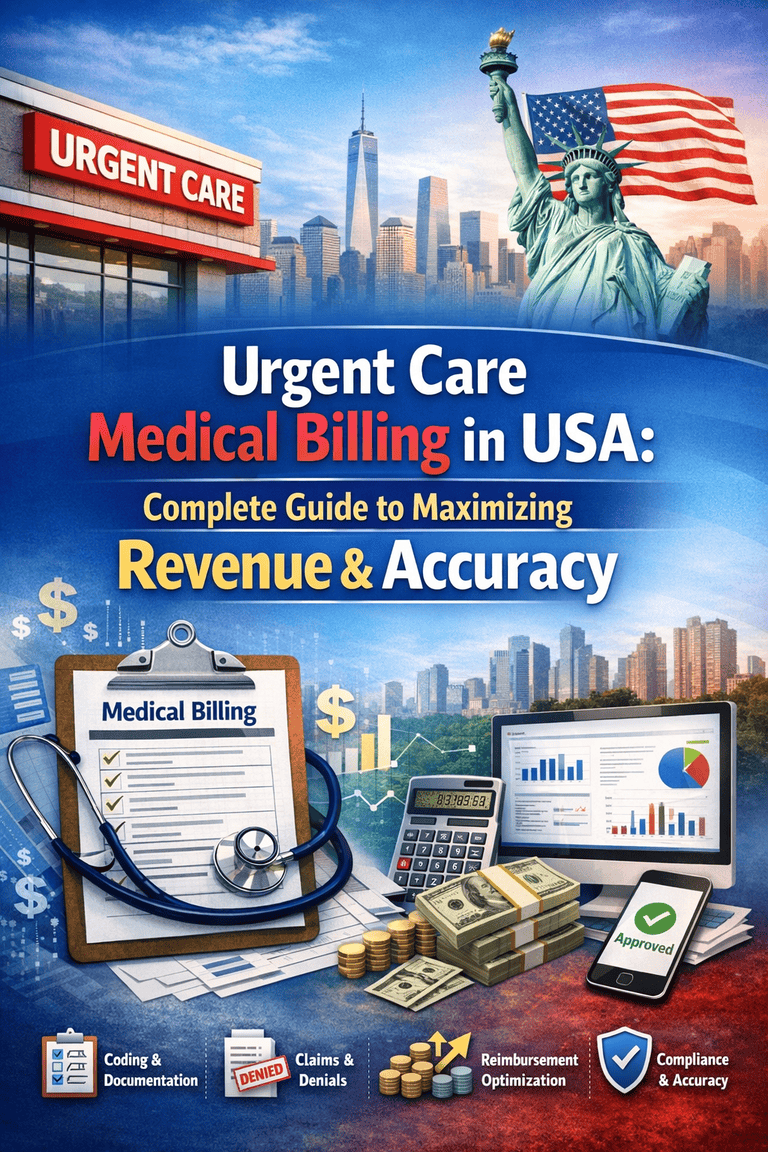
Urgent care centers have become an essential part of the healthcare system in the USA. They provide quick treatment for illnesses and injuries that require immediate attention but are not serious enough for an emergency room visit. While patient care moves quickly in these facilities, the administrative side can be much more challenging.
Accurate coding and billing for urgent care directly affects reimbursement, compliance, and the financial health of a practice. Even a small coding mistake or missing documentation can result in delayed payments, denied claims, or unnecessary audits.
This guide explains how urgent care billing works, common coding challenges, and best practices that help healthcare providers improve claim accuracy while maintaining compliance.
Why Urgent Care Billing Is Different
Unlike many specialty clinics, urgent care centers see patients with a wide variety of medical conditions every day. A single shift may include:
- Minor fractures
- Flu and respiratory infections
- Laceration repairs
- Allergic reactions
- Diagnostic testing
- Sports injuries
- Vaccinations
- Occupational health visits
Each visit requires proper documentation, accurate diagnosis coding, and the correct procedure codes. Since patient volume is high, billing teams must process claims quickly without sacrificing accuracy.
This is why many urgent care practices rely on experienced medical coding services to reduce coding errors and improve reimbursement rates.
The Basics of Coding and Billing for Urgent Care
The billing process starts long before a claim reaches the insurance payer.
A typical workflow includes:
- Patient registration
- Insurance verification
- Clinical documentation
- Medical coding
- Claim submission
- Payment posting
- Denial management
- Patient billing when applicable
Every stage influences whether a claim is paid correctly the first time.
If one step is missed, the entire reimbursement process may slow down.
Essential Coding Systems Used in Urgent Care
Several coding systems work together to create an accurate insurance claim.
ICD-10-CM Diagnosis Codes
Diagnosis codes explain why the patient received treatment.
Examples include:
- Influenza
- Ear infections
- Sprains
- Skin infections
- Urinary tract infections
The diagnosis must support the medical necessity of every procedure performed.
CPT Procedure Codes
Procedure codes identify the services provided during the visit.
These may include:
- Office evaluation and management
- Wound repair
- Splint application
- Laboratory testing
- X-rays
- Vaccinations
- Nebulizer treatments
Selecting the correct procedure code is essential for proper reimbursement.
HCPCS Codes
HCPCS codes are commonly used for:
- Medical supplies
- Certain medications
- Durable medical equipment
- Vaccines and injections
Using the wrong HCPCS code may lead to denied or underpaid claims.
Documentation Is the Foundation of Accurate Billing
Strong documentation supports every code submitted on an insurance claim.
Providers should document:
- Patient history
- Symptoms
- Physical examination findings
- Diagnostic results
- Medical decision-making
- Procedures performed
- Medications administered
- Follow-up recommendations
Incomplete documentation often creates coding uncertainty, increasing the risk of denials or compliance issues.
Professional medical billing services often review documentation before claim submission to improve first-pass claim acceptance.
Common Billing Challenges in Urgent Care
Urgent care centers face several unique reimbursement challenges.
Frequent Coding Errors
Incorrect diagnosis or procedure codes remain one of the leading causes of denied claims.
Examples include:
- Incorrect evaluation and management level
- Missing procedure codes
- Invalid diagnosis combinations
- Coding services not supported by documentation
Insurance Eligibility Issues
Patients frequently visit urgent care without prior appointments.
If insurance information is outdated or incorrect, claims may be rejected before processing begins.
Modifier Mistakes
Many urgent care claims require modifiers.
Incorrect modifier usage can result in:
- Duplicate claim denials
- Reduced reimbursement
- Delayed payments
Proper training helps coders understand when modifiers are necessary.
High Claim Volume
Urgent care centers often process hundreds of claims each week.
Without organized workflows, coding errors become more common during busy periods.
Best Practices to Improve Coding Accuracy
Improving coding accuracy requires consistent attention to detail.
Some proven strategies include:
- Educate providers on documentation requirements.
- Conduct routine coding audits.
- Verify insurance before treatment whenever possible.
- Review denied claims to identify recurring patterns.
- Update coding references regularly.
- Train staff on annual coding changes.
- Monitor payer-specific billing guidelines.
Continuous education helps practices remain compliant with changing healthcare regulations.
Reducing Claim Denials
Denied claims increase administrative workload and delay revenue.
Many denials can be prevented through better internal processes.
Common Prevention Strategies
- Verify patient demographics.
- Confirm active insurance coverage.
- Submit claims promptly.
- Match diagnosis codes with documented procedures.
- Review claims before submission.
- Correct rejected claims immediately.
Practices that monitor denial trends often discover recurring issues that can be fixed with staff training or workflow improvements.
The Role of Credentialing in Successful Billing
Before providers can receive reimbursement from many insurance companies, they must complete credentialing.
Credentialing confirms that healthcare professionals meet payer requirements.
Without proper credentialing:
- Claims may be denied.
- Payment delays may increase.
- Patients may face unexpected bills.
- Provider enrollment issues can interrupt cash flow.
Keeping provider information updated with insurance companies helps avoid unnecessary reimbursement delays.
Technology Makes Billing More Efficient
Modern healthcare software has significantly improved coding and billing accuracy.
Many urgent care centers now use:
- Electronic Health Records (EHR)
- Practice management software
- Automated claim scrubbing tools
- Real-time insurance verification
- Revenue analytics dashboards
- Electronic payment posting
These tools reduce manual errors while helping staff process claims more efficiently.
However, technology works best when combined with experienced coding professionals.
Why Revenue Cycle Management Matters
Billing is only one part of the financial process.
Effective revenue cycle management covers every stage of patient revenue, from appointment scheduling through final payment collection.
A well-managed revenue cycle helps practices:
- Improve cash flow
- Reduce denied claims
- Speed up reimbursements
- Increase billing accuracy
- Lower administrative costs
- Improve patient satisfaction
Regular performance reviews allow healthcare organizations to identify areas where billing processes can be strengthened.
Choosing Experienced Billing Support
Many urgent care centers choose to outsource administrative tasks because managing coding updates, payer requirements, and compliance internally can be time-consuming.
An experienced billing partner can assist with:
- Accurate claim submission
- Coding reviews
- Denial management
- Payment reconciliation
- Insurance follow-up
- Compliance monitoring
Organizations like 247 Medical Billing Services provide support across billing operations, including medical billing services, medical coding services, credentialing, and broader revenue cycle management solutions. The right support allows healthcare providers to spend more time focusing on patient care while maintaining efficient financial operations.
Final Thoughts
Accurate coding and billing for urgent care is far more than entering diagnosis and procedure codes. It requires complete documentation, coding expertise, payer knowledge, and efficient workflows that work together to support timely reimbursement.
As payer requirements continue to evolve across the USA, urgent care centers that invest in quality documentation, ongoing staff education, and strong billing practices are better positioned to reduce denials, improve cash flow, and remain compliant. Whether billing is handled internally or supported by experienced professionals, maintaining accuracy at every step is essential for long-term operational success.
Frequently Asked Questions
1. Why is coding and billing for urgent care more challenging than traditional primary care?
Urgent care centers treat a wide variety of conditions every day, requiring coders to accurately document different diagnoses, procedures, and payer requirements while processing a high volume of patient visits.
2. What causes most urgent care claim denials?
The most common reasons include incorrect diagnosis codes, coding errors, missing documentation, insurance eligibility problems, modifier mistakes, and incomplete patient information.
3. How often should urgent care coding be audited?
Most experts recommend conducting coding audits at least quarterly. Practices with high patient volume may benefit from monthly reviews to identify errors early and improve compliance.
4. How does documentation affect reimbursement?
Insurance companies rely on clinical documentation to verify medical necessity. Incomplete or inaccurate documentation can result in denied, delayed, or reduced payments.
5. Why is credentialing important for urgent care providers?
Credentialing allows healthcare providers to participate with insurance networks. Without completed credentialing, insurers may deny claims even when services are medically necessary.
6. Can outsourcing billing improve urgent care revenue?
Yes. Experienced billing professionals can help reduce coding errors, manage denials, improve claim accuracy, and streamline reimbursement, allowing providers to focus more on patient care.
7. What is the role of revenue cycle management in urgent care?
Revenue cycle management oversees the entire financial process, from patient registration and insurance verification to claim submission, payment collection, and denial resolution, helping practices maintain healthy cash flow and operational efficiency.

 Arabic
 French
 Spanish
 Portuguese
 Deutsch
 Turkish
 Dutch
Dutch
 Italiano
 Russian
 Romaian
 Portuguese (Brazil)
 Greek
Greek