Mental health providers across the USA are experiencing growing demand for counseling, psychiatry, therapy, and behavioral health services. While helping patients remains the top priority, managing insurance claims, coding updates, payment delays, and compliance requirements can quickly become overwhelming. Administrative work often takes valuable time away from patient care.
This is why many practices are choosing outsourced billing for mental health. Instead of handling every billing task in-house, providers work with experienced billing professionals who manage claims, payments, and insurance follow-ups. The result is often a smoother financial process, fewer billing errors, and more time for clinical care.
Whether you operate a solo therapy practice or a large behavioral health clinic, understanding how outsourced billing works can help you make informed business decisions.
Why Mental Health Billing Is More Complex Than Many Other Specialties
Mental health billing has unique challenges that require specialized knowledge. Unlike many medical specialties, behavioral health services often involve recurring appointments, varying session lengths, telehealth visits, and changing payer requirements.
Some common challenges include:
- Frequent insurance policy changes
- Authorization requirements for certain treatments
- Complex psychotherapy coding
- Telehealth billing regulations
- Documentation requirements
- Claim denials due to coding or eligibility issues
- Coordination with multiple insurance providers
Even a small documentation error can delay payments or result in denied claims, affecting the financial health of a practice.
What Is Outsourced Billing for Mental Health?
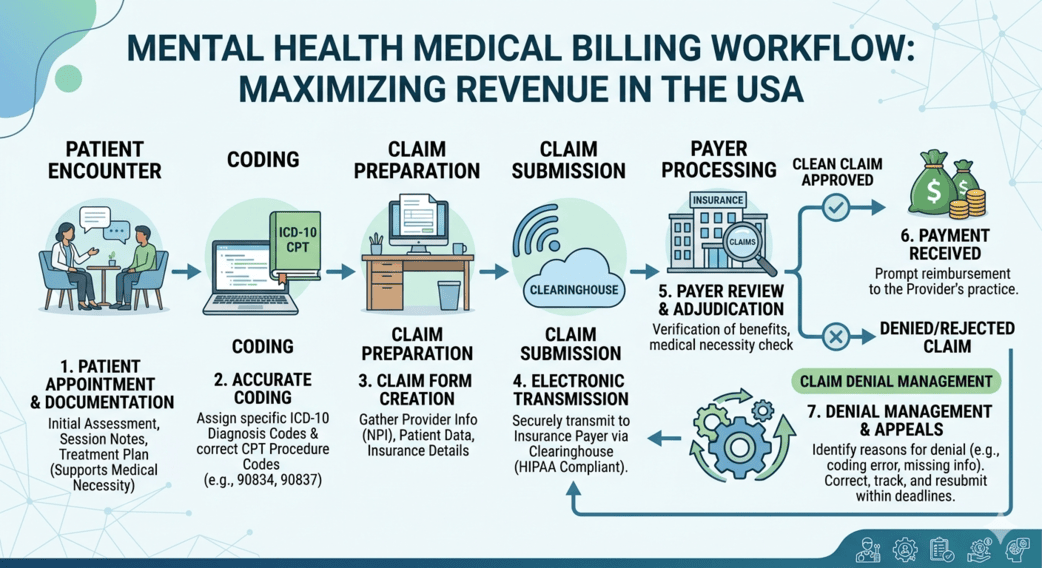
Outsourced billing for mental health means partnering with a specialized billing company that handles the financial side of your practice. Instead of hiring and managing a full in-house billing department, providers rely on experienced professionals to manage the billing process.
Typical responsibilities include:
- Insurance eligibility verification
- Claim preparation and submission
- Payment posting
- Denial management
- Appeals and resubmissions
- Patient billing support
- Accounts receivable follow-up
- Financial reporting
Many providers also benefit from integrated revenue cycle management, helping improve the entire payment process from patient registration to final reimbursement.
Benefits of Outsourcing Mental Health Billing
More Time for Patient Care
Administrative tasks consume a significant portion of a provider's day. Outsourcing allows therapists, psychiatrists, psychologists, and counselors to focus on treating patients instead of tracking unpaid claims.
This can also improve patient satisfaction because staff members spend less time handling billing issues and more time supporting patient needs.
Improved Claim Accuracy
Experienced billing professionals stay updated with payer policies and coding changes. They carefully review claims before submission, helping reduce common billing mistakes.
Accurate claims generally mean:
- Faster reimbursements
- Fewer rejected claims
- Lower denial rates
- Better cash flow
Specialized medical coding services also help ensure services are coded correctly according to current industry standards.
Faster Payment Collection
Delayed payments create financial stress for many practices. Billing experts monitor claims throughout the reimbursement process and quickly follow up when payments are delayed.
Consistent monitoring helps reduce outstanding accounts receivable and improves overall financial stability.
Better Compliance
Healthcare regulations continue to evolve. Professional billing teams stay informed about payer guidelines, coding updates, and documentation requirements.
This helps practices reduce compliance risks while maintaining accurate billing records.
Signs Your Practice May Benefit from Outsourcing
Not every practice experiences the same challenges, but certain warning signs often indicate it's time to consider outsourcing.
You may benefit if you notice:
- Increasing claim denials
- Slow insurance reimbursements
- Growing accounts receivable
- Staff overwhelmed by administrative work
- Difficulty hiring experienced billing personnel
- Frequent billing corrections
- Limited visibility into financial performance
Addressing these issues early can prevent long-term revenue loss.
What Services Are Usually Included?
Most mental health billing providers offer comprehensive support beyond simple claim submission.
Common services include:
Insurance Verification
Confirming patient eligibility before appointments reduces claim rejections and unexpected billing issues.
Claim Submission
Claims are prepared, reviewed, and submitted according to payer requirements to improve first-pass acceptance rates.
Denial Management
Denied claims are analyzed, corrected, and resubmitted whenever appropriate. Understanding the reason behind each denial helps reduce similar issues in the future.
Payment Posting
Insurance payments and patient payments are accurately recorded, allowing providers to monitor collections and outstanding balances.
Accounts Receivable Follow-Up
Regular follow-up with insurance companies helps recover unpaid claims before they become difficult to collect.
Financial Reporting
Detailed reports provide valuable insights into:
- Collection performance
- Outstanding claims
- Denial trends
- Revenue patterns
- Payment timelines
These reports support better business planning and decision-making.
The Role of Credentialing in Successful Billing
Proper credentialing is often overlooked but plays an essential role in successful reimbursements.
If providers are not correctly enrolled with insurance companies, claims may be delayed or denied regardless of the quality of care provided.
Keeping provider information updated helps ensure:
- Faster payer approval
- Fewer enrollment-related denials
- Accurate reimbursement
- Continuous participation with insurance networks
Combining credentialing with billing services creates a more efficient administrative workflow.
Choosing the Right Billing Partner
Selecting the right billing company requires more than comparing prices. Experience, transparency, and industry knowledge are equally important.
Consider asking these questions:
Do They Specialize in Mental Health?
Behavioral health billing differs from other medical specialties. A company familiar with psychotherapy, psychiatry, counseling, and telehealth billing can better manage specialty-specific challenges.
Do They Offer Complete Revenue Support?
Look for providers offering both billing and revenue cycle management rather than claim submission alone.
How Do They Handle Denials?
An effective billing partner should actively investigate denied claims and implement strategies to reduce future denials.
Are Financial Reports Easy to Understand?
Clear reporting helps practice owners monitor financial performance without needing extensive billing expertise.
Can They Support Practice Growth?
As your practice expands, your billing partner should be able to scale services without disrupting operations.
Technology Continues to Improve Mental Health Billing
Modern billing systems use automation to simplify repetitive administrative work while maintaining accuracy.
Technology can assist with:
- Automated eligibility verification
- Electronic claim submission
- Real-time claim tracking
- Payment reconciliation
- Performance dashboards
- Secure patient billing
Although technology improves efficiency, experienced billing professionals remain essential for handling complex cases and insurance disputes.
Building a Strong Financial Foundation
A healthy practice depends on more than excellent patient care. Financial stability allows providers to invest in staff, technology, and expanded services for their communities.
Professional medical billing services support long-term practice growth by improving billing efficiency and reducing administrative burdens. Combined with accurate medical coding services, organized credentialing, and effective revenue cycle management, providers can create a more reliable reimbursement process.
Many healthcare organizations choose experienced partners such as 247 Medical Billing Services to strengthen operational efficiency while allowing clinicians to remain focused on delivering quality behavioral healthcare. The goal is not simply faster payments but building a sustainable financial system that supports both providers and the patients they serve.
Frequently Asked Questions
1. What is outsourced billing for mental health?
It is the process of hiring an external billing company to manage insurance claims, payment posting, denial management, and reimbursement tasks for mental health practices.
2. Is outsourcing billing suitable for small therapy practices?
Yes. Solo therapists, counselors, psychologists, and small behavioral health clinics often benefit from outsourcing because it reduces administrative workload without requiring additional in-house staff.
3. Does outsourced billing improve reimbursement rates?
While no company can guarantee higher payments, accurate claim submission, timely follow-ups, and effective denial management often improve collection performance and reduce payment delays.
4. Why is medical coding important in mental health billing?
Correct coding ensures services are billed accurately according to payer requirements. Proper coding reduces claim denials, supports compliance, and helps providers receive appropriate reimbursement.
5. How does credentialing affect insurance claims?
Credentialing verifies that healthcare providers are approved to participate with insurance networks. Without proper credentialing, claims may be rejected or significantly delayed.
6. What is revenue cycle management in mental health practices?
Revenue cycle management covers every financial step, including patient registration, insurance verification, claim submission, payment collection, denial management, and financial reporting to improve overall practice performance.
7. Can outsourced billing help reduce claim denials?
Yes. Experienced billing professionals review claims before submission, monitor payer requirements, correct billing errors, and follow up on denied claims, helping reduce denial rates over time.




 English
 Arabic
 French
 Spanish
 Portuguese
 Deutsch
 Dutch
Dutch
 Italiano
 Russian
 Romaian
 Portuguese (Brazil)
 Greek
Greek