Blockchain has evolved far beyond cryptocurrency. Today, organizations are tokenizing everything from financial instruments and real estate to gaming ecosystems, loyalty rewards, carbon credits, intellectual property, and supply chain assets. At the center of this transformation is token development—the process of creating blockchain-based digital assets that represent value, ownership, rights, or utility.
The global digital asset market has expanded rapidly over the past few years. Tokenization of real-world assets (RWAs) alone is projected by multiple industry analysts to reach trillions of dollars over the next decade. Financial institutions, technology companies, governments, and startups are increasingly viewing blockchain tokens as programmable assets capable of automating transactions, improving transparency, and enabling global participation.
Yet, a successful token is much more than code deployed on a blockchain. It requires careful planning, economic design, technical architecture, regulatory awareness, smart contract security, and long-term ecosystem development. A poorly designed token often fails regardless of how promising the underlying project appears.
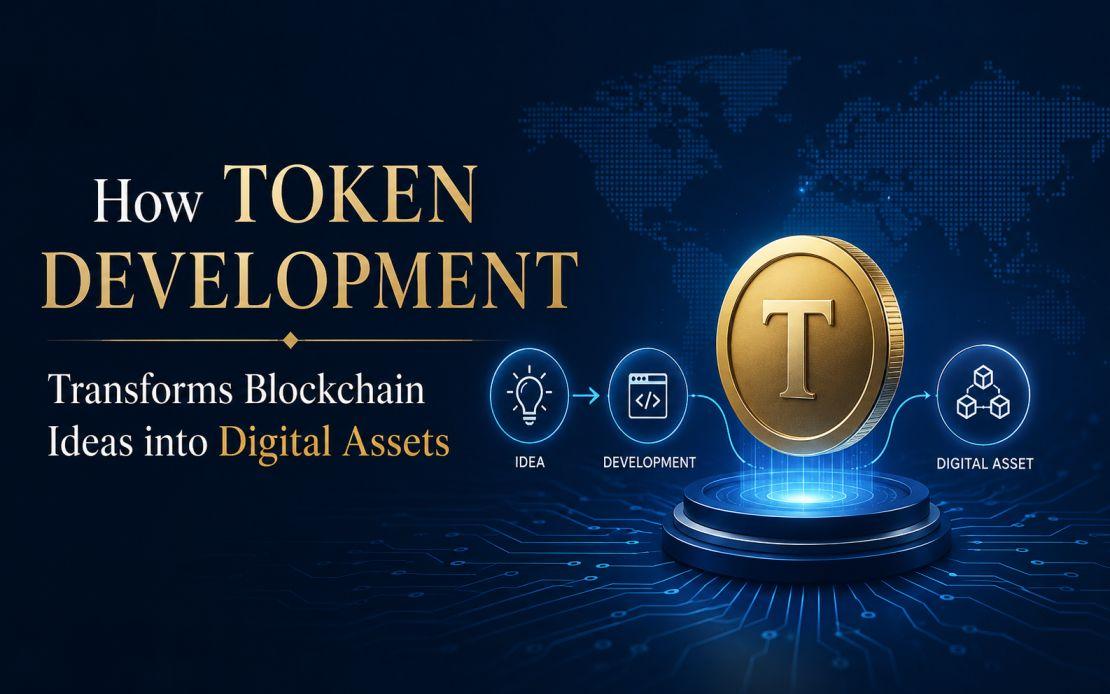
This article explores how token development converts blockchain concepts into functional digital assets, examines the technologies involved, highlights the importance of tokenomics and security, and explains why strategic planning plays an equally important role alongside technical execution.
Understanding Digital Assets in Blockchain
A digital asset is any blockchain-based representation of value that can be securely owned, transferred, or traded. Unlike traditional digital files that can be copied indefinitely, blockchain assets possess verifiable ownership recorded on decentralized ledgers.
Digital assets generally fall into several categories.
- Utility tokens
- Governance tokens
- Security tokens
- Stablecoins
- Asset-backed tokens
- Non-fungible tokens (NFTs)
- Real-world asset (RWA) tokens
Each category serves different purposes.
Utility tokens provide access to products or services within decentralized applications.
Governance tokens allow holders to vote on protocol upgrades and ecosystem decisions.
Security tokens represent regulated financial instruments such as equity or investment contracts.
Stablecoins maintain relatively stable values by linking to fiat currencies or other reserves.
NFTs represent unique ownership of digital or physical assets.
Asset-backed tokens digitize tangible assets such as commodities, artwork, or real estate.
Although these token categories differ significantly, they all rely on structured token development to function securely and efficiently.
From Concept to Token: The Development Journey
Creating a blockchain token involves considerably more than selecting a token standard and deploying a smart contract.
Professional token development begins with answering fundamental business questions.
What problem does the token solve?
Why should users hold it?
How does it generate value within the ecosystem?
Without clear answers, technical development rarely leads to sustainable adoption.
The development process typically follows several interconnected stages.
Defining the Business Model
Every successful token begins with a business objective rather than technology.
Some projects require fundraising through token sales.
Others focus on creating decentralized governance.
Gaming companies may introduce tokens for in-game economies, while enterprises tokenize real-world assets to improve liquidity.
The intended business model determines nearly every technical decision that follows.
Selecting the Right Blockchain
Choosing the appropriate blockchain is one of the most critical development decisions.
Ethereum remains the most established platform because of its mature developer ecosystem, extensive tooling, and widespread adoption.
BNB Chain offers lower transaction costs for consumer-focused applications.
Solana emphasizes high throughput and low latency, making it attractive for applications requiring significant transaction volumes.
Avalanche enables customizable blockchain environments suitable for enterprise deployments.
Polygon extends Ethereum while improving scalability through lower fees.
The blockchain selection influences scalability, interoperability, security, transaction costs, and user experience.
Choosing the Appropriate Token Standard
Blockchain networks provide standardized token frameworks that improve compatibility.
Common examples include:
- ERC-20 for fungible Ethereum tokens
- ERC-721 for NFTs
- ERC-1155 for multi-token applications
- BEP-20 on BNB Chain
- SPL tokens on Solana
These standards allow wallets, exchanges, and decentralized applications to interact with tokens without requiring custom integrations.
Smart Contracts: The Foundation of Every Token
Smart contracts automate token behavior through immutable blockchain code.
Rather than relying on centralized administrators, predefined rules execute automatically whenever specific conditions are met.
Smart contracts govern functions including:
- Token issuance
- Transfers
- Minting
- Burning
- Staking
- Vesting
- Governance
- Rewards distribution
Because blockchain transactions cannot easily be reversed, smart contract quality directly determines project reliability.
A single programming error may expose millions of dollars to attackers.
Several major blockchain exploits have demonstrated how vulnerable poorly written contracts can become. High-profile incidents involving bridges, lending platforms, and decentralized finance protocols have collectively resulted in billions of dollars in losses over recent years. Although token contracts are generally simpler than complex decentralized applications, they still require extensive testing and auditing before deployment.
Professional token development therefore emphasizes secure coding practices, peer reviews, automated testing, and independent security audits.
Designing Sustainable Tokenomics
Technology alone cannot create a successful digital asset.
Tokenomics determines whether users have meaningful reasons to acquire, use, and retain tokens over time.
Tokenomics includes:
- Total supply
- Circulating supply
- Distribution model
- Inflation schedule
- Vesting periods
- Reward mechanisms
- Burn strategies
- Treasury allocation
A balanced token economy aligns incentives among founders, investors, developers, partners, and community members.
Consider two hypothetical projects.
One releases 80% of tokens immediately to early investors.
Another introduces gradual vesting over four years while allocating meaningful portions toward ecosystem incentives and community development.
The second model generally reduces sudden selling pressure while encouraging long-term participation.
Poor tokenomics has contributed to the decline of numerous blockchain projects despite technically impressive products.
Successful ecosystems instead combine utility, scarcity, sustainable incentives, and transparent distribution.
Security Makes or Breaks Digital Assets
Security has become one of the defining characteristics of professional token development.
Modern blockchain ecosystems manage assets worth billions of dollars. Consequently, attackers continuously search for weaknesses.
Secure development involves several layers.
Smart Contract Auditing
Independent auditors review code for vulnerabilities before deployment.
Penetration Testing
Developers simulate attacks against blockchain infrastructure.
Automated Code Analysis
Static analysis tools identify known programming risks.
Bug Bounty Programs
Security researchers receive rewards for responsibly disclosing vulnerabilities.
Multi-signature Controls
Administrative permissions require approval from multiple authorized parties.
Continuous Monitoring
Projects monitor blockchain activity to identify suspicious behavior after launch.
Security is no longer viewed as a one-time event but as an ongoing operational process throughout the asset lifecycle.
Compliance Is Becoming a Core Development Requirement
Blockchain innovation increasingly intersects with regulatory expectations.
Depending on jurisdiction, token issuers may need to consider:
- Securities regulations
- Anti-money laundering (AML) requirements
- Know Your Customer (KYC) verification
- Consumer protection rules
- Data privacy regulations
- Tax reporting obligations
Token developers increasingly build compliance features directly into smart contracts.
Some asset-backed tokens include transfer restrictions, investor whitelisting, jurisdiction-based controls, and automated compliance verification.
These capabilities enable institutions to participate more confidently in blockchain ecosystems while meeting regulatory obligations.
Real-World Applications of Token Development
The versatility of blockchain tokens has expanded significantly across industries.
Real Estate
Property tokenization allows investors to purchase fractional ownership of commercial and residential assets.
Instead of purchasing an entire building, investors acquire blockchain tokens representing proportional ownership.
This model improves accessibility while increasing market liquidity.
Several regulated tokenization initiatives around the world now demonstrate how blockchain can simplify cross-border property investment.
Financial Services
Banks and fintech companies increasingly explore tokenized bonds, funds, equities, and money market instruments.
Programmable settlement reduces intermediaries while enabling faster transaction processing.
Asset tokenization also supports fractional investing, allowing smaller investors to access traditionally expensive financial products.
Gaming
Blockchain games use utility tokens to power virtual economies.
Players earn, trade, and spend digital assets across interconnected ecosystems.
Ownership remains with players rather than centralized gaming companies.
Supply Chain
Manufacturers tokenize products to improve traceability throughout production and distribution.
Every transaction creates an immutable blockchain record, increasing transparency while reducing fraud.
Healthcare
Medical institutions explore blockchain tokens to manage secure patient permissions, research incentives, and healthcare data sharing while maintaining privacy standards.
Interoperability Is Expanding Token Utility
The blockchain industry no longer revolves around isolated ecosystems.
Users increasingly expect assets to move seamlessly across multiple networks.
Cross-chain interoperability allows tokens to operate across Ethereum, Solana, Avalanche, Polygon, BNB Chain, and emerging blockchain infrastructures.
Modern token development therefore considers:
- Cross-chain bridges
- Wrapped assets
- Omnichain token standards
- Multi-chain wallet compatibility
- Cross-network governance
Projects that support multiple ecosystems generally reach larger user bases while reducing dependence on a single blockchain.
AI and Automation Are Changing Token Development
Artificial intelligence is beginning to influence blockchain development workflows.
Development teams increasingly use AI-assisted programming tools for code generation, vulnerability detection, documentation, and testing.
Analytics platforms leverage machine learning to identify abnormal wallet behavior, detect fraud, and improve governance insights.
Although AI cannot replace experienced blockchain engineers, it accelerates development while improving code quality when combined with human expertise.
As blockchain ecosystems mature, AI-powered monitoring and predictive analytics are expected to become standard components of token management.
Challenges That Projects Must Overcome
Despite its enormous potential, token development presents several challenges.
Scalability remains a concern for high-volume applications operating on congested networks.
Regulatory uncertainty varies significantly across jurisdictions.
Cybersecurity threats continue evolving as attackers discover new exploit techniques.
Market volatility affects investor confidence.
User education also remains essential because blockchain technologies introduce unfamiliar concepts such as private keys, wallets, gas fees, and decentralized governance.
Projects that address these challenges through thoughtful design, transparency, and continuous improvement typically establish stronger long-term ecosystems.
What Defines a Successful Token?
Successful digital assets share several characteristics regardless of industry.
They solve genuine business problems rather than existing solely for fundraising.
Their tokenomics create sustainable incentives instead of encouraging short-term speculation.
Their smart contracts undergo comprehensive security reviews.
Their blockchain infrastructure supports scalability and interoperability.
Their governance structures encourage community participation while maintaining operational stability.
Most importantly, successful tokens become integral components of functioning ecosystems rather than isolated digital assets with limited utility.
The Future of Token Development
Token development is becoming a cornerstone of the digital economy. As blockchain adoption expands beyond cryptocurrency into finance, healthcare, manufacturing, entertainment, logistics, and public infrastructure, digital assets will increasingly represent real economic activity rather than speculative investments.
Emerging technologies such as zero-knowledge proofs, account abstraction, decentralized identity, modular blockchains, and AI-enhanced development tools will continue improving security, usability, and scalability. At the same time, clearer regulatory frameworks are expected to encourage greater institutional participation, particularly in tokenized securities and real-world assets.
In the coming years, organizations are likely to view blockchain tokens not as standalone products but as programmable building blocks that enable automated business processes, transparent ownership, and global value exchange. Businesses that invest in thoughtful token design, secure smart contract development, sustainable tokenomics, and regulatory readiness will be better positioned to create digital assets with lasting utility.
Conclusion
Token development transforms blockchain concepts into functional digital assets by combining technical engineering, economic design, security, and strategic planning. A successful token is not defined solely by the blockchain it runs on or the smart contract that powers it. Its long-term value depends on solving a meaningful problem, creating balanced incentives, maintaining strong security standards, and supporting an ecosystem that encourages adoption and growth.
As blockchain technology becomes increasingly integrated into mainstream industries, token development will play a central role in enabling new business models, expanding access to investment opportunities, and digitizing ownership across the global economy. Organizations that approach token creation with a comprehensive, long-term perspective will be better equipped to build digital assets that remain relevant in an increasingly connected and tokenized world.
For businesses looking to bring their blockchain ideas to market, partnering with an experienced token development company can significantly reduce technical complexity and accelerate deployment. Blockchain App Factory provides end-to-end token development services, helping startups and enterprises design secure smart contracts, build sustainable token economies, and launch scalable digital assets across leading blockchain networks. By combining technical expertise with strategic guidance, businesses can confidently transform innovative blockchain concepts into successful digital assets that deliver long-term value.




 English
 Arabic
 Spanish
 Portuguese
 Deutsch
 Turkish
 Dutch
Dutch
 Italiano
 Russian
 Romaian
 Portuguese (Brazil)
 Greek
Greek