


Key Steps to Build an Effective AML and CFT Compliance Framework
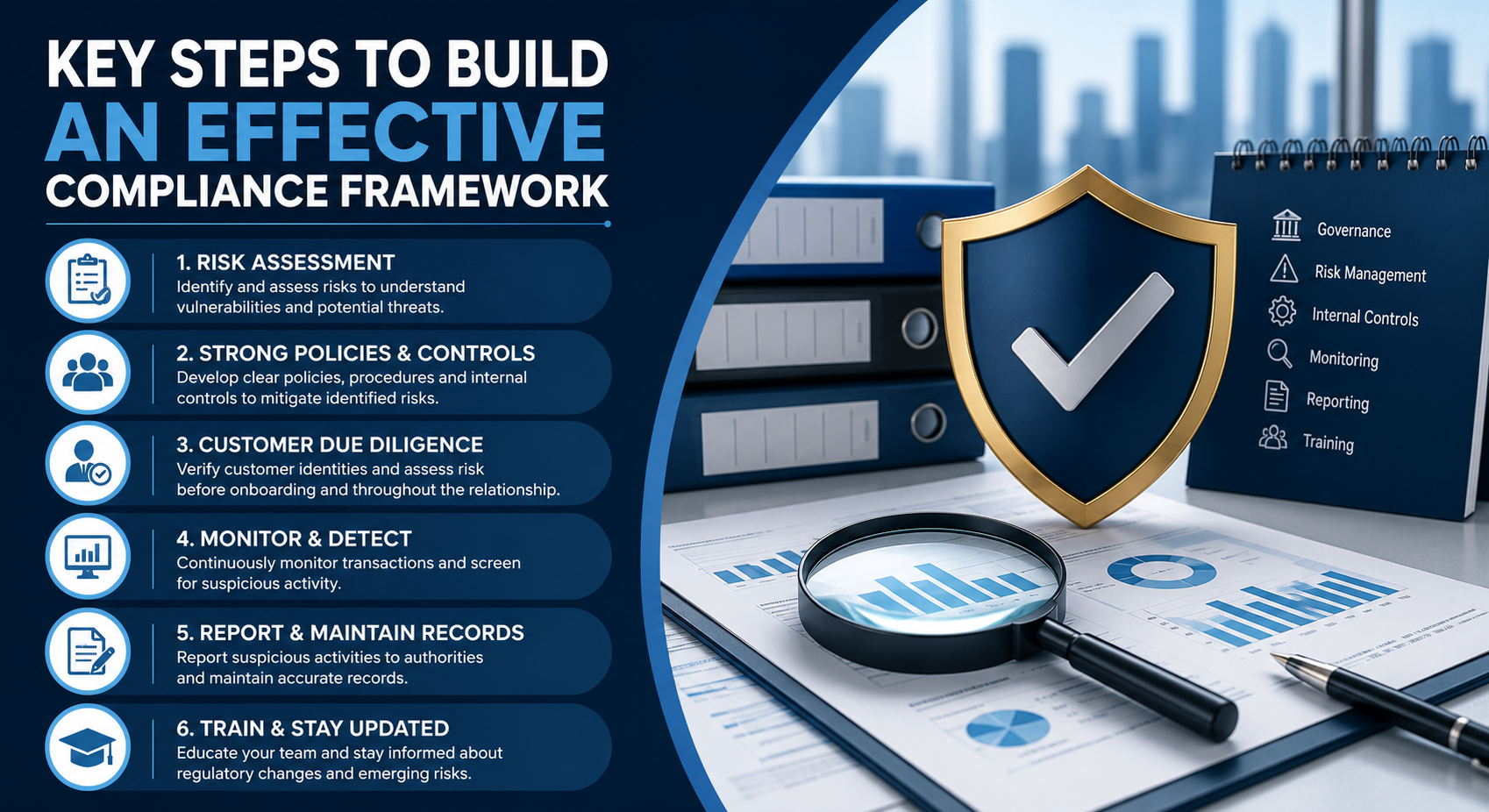
Financial crimes continue to evolve, creating significant risks for businesses across industries. Organizations that fail to establish strong compliance measures may face regulatory penalties, financial losses, and reputational damage. This is why implementing an effective Anti-Money Laundering (AML) and Counter Financing of Terrorism (CFT) compliance framework has become a critical business priority rather than just a regulatory requirement.
A well-designed compliance framework helps organizations identify, assess, monitor, and mitigate risks associated with money laundering and terrorist financing. It also demonstrates a company's commitment to ethical business practices while ensuring compliance with local and international regulations. Whether you operate in banking, financial services, real estate, insurance, or other regulated industries, building a structured AML and CFT compliance framework is essential for long-term success.
NOTE :- Organizations following AML / CFT regulations in Dubai had improved their internal controls and reduced exposure to money laundering risks. Proper documentation, customer due diligence, and continuous monitoring had strengthened regulatory compliance. M&M AL Menhali Auditing had supported businesses with tailored compliance services. Contact the experts today to stay compliant.
Understand Regulatory Requirements
The first step in developing an effective compliance framework is understanding the applicable AML and CFT regulations in your jurisdiction. Different countries have unique regulatory standards, reporting obligations, and customer verification requirements.
Organizations should stay updated with changes in national laws, regulatory guidance, and international recommendations. Understanding these obligations ensures that compliance policies align with legal expectations while minimizing regulatory risks.
Conduct a Comprehensive Risk Assessment
Every business faces different levels of money laundering and terrorist financing risks depending on its customers, products, services, and geographical operations. A comprehensive risk assessment helps organizations identify vulnerable areas before implementing appropriate controls.
The assessment should evaluate factors such as customer profiles, transaction types, delivery channels, business relationships, and high-risk jurisdictions. Regular reviews ensure that the organization adapts to emerging threats and evolving financial crime techniques.
Develop Clear AML and CFT Policies
Well-documented policies form the foundation of any successful compliance program. These policies should clearly explain the organization's approach to preventing money laundering and terrorist financing activities.
The documentation should define internal procedures, employee responsibilities, customer verification processes, reporting requirements, record-keeping practices, and escalation protocols. Policies should also be reviewed periodically to remain aligned with changing regulations and business operations.
Implement Strong Customer Due Diligence
Customer Due Diligence (CDD) is one of the most important components of an AML and CFT framework. Businesses must verify customer identities before establishing business relationships and continuously monitor customer activities throughout the relationship.
Enhanced Due Diligence (EDD) should be applied to customers classified as high risk. These may include politically exposed persons, customers from high-risk countries, or businesses operating in industries with increased financial crime exposure.
Accurate customer identification helps organizations detect suspicious activities early while reducing the likelihood of facilitating illegal financial transactions.
Establish Effective Transaction Monitoring
Transaction monitoring enables organizations to identify unusual financial activities that may indicate money laundering or terrorist financing. Manual monitoring alone is often insufficient due to the growing volume and complexity of financial transactions.
Automated monitoring systems can detect abnormal transaction patterns, unusual account behavior, rapid movement of funds, or transactions involving sanctioned entities. Alerts generated by these systems should be investigated promptly by trained compliance professionals.
Continuous monitoring strengthens an organization's ability to identify potential risks before they escalate into regulatory violations.
Maintain Accurate Record Keeping
Proper documentation plays a vital role in regulatory compliance. Businesses must maintain detailed records of customer information, identity verification documents, transaction histories, and suspicious activity investigations.
Accurate record keeping supports regulatory audits, internal investigations, and reporting obligations. It also provides evidence that the organization has implemented appropriate compliance measures when examined by regulatory authorities.
Retention periods should comply with applicable legal requirements while ensuring records remain secure and accessible when needed.
Provide Regular Employee Training
Employees serve as the first line of defense against financial crime. Even the most advanced compliance systems may fail if employees cannot recognize suspicious behavior or understand reporting procedures.
Regular AML and CFT training programs should educate staff on regulatory requirements, customer due diligence procedures, suspicious activity indicators, internal reporting channels, and emerging financial crime trends.
Training should be tailored according to employee roles, with additional specialized sessions provided for compliance officers, senior management, and customer-facing personnel. Ongoing education helps create a strong compliance culture across the organization.
Appoint Qualified Compliance Leadership
An effective AML and CFT compliance framework requires dedicated leadership. Organizations should appoint experienced compliance officers responsible for overseeing program implementation, monitoring regulatory developments, conducting internal reviews, and communicating with regulatory authorities.
Senior management should actively support compliance initiatives by allocating sufficient resources, approving policies, and promoting ethical business practices throughout the organization.
Leadership commitment demonstrates that compliance is an organizational priority rather than merely a regulatory obligation.
Conduct Independent Audits and Reviews
Regular independent audits help evaluate whether the compliance framework operates effectively. Internal or external auditors should assess policy implementation, customer due diligence processes, transaction monitoring effectiveness, employee awareness, and regulatory reporting practices.
Audit findings provide valuable insights into weaknesses that require corrective action. Periodic reviews also help organizations adapt their compliance programs to evolving regulations and changing business risks.
Continuous improvement ensures that compliance frameworks remain effective over time.
Leverage Technology for Compliance
Modern compliance programs increasingly rely on advanced technology to improve efficiency and accuracy. Artificial intelligence, machine learning, data analytics, and automated screening solutions can significantly strengthen AML and CFT controls.
Technology can assist with customer verification, sanctions screening, transaction monitoring, risk scoring, adverse media checks, and regulatory reporting. While technology enhances operational efficiency, human oversight remains essential for reviewing complex cases and making informed compliance decisions.
Organizations should select compliance solutions that align with their business size, regulatory obligations, and risk profile.
Foster a Culture of Compliance
An effective compliance framework extends beyond policies and technology. Organizations must create a culture where ethical conduct, transparency, and regulatory compliance are integrated into daily business operations.
Employees should feel confident reporting suspicious activities without fear of retaliation. Open communication, management support, and regular compliance awareness initiatives encourage accountability throughout the organization.
A strong compliance culture reduces organizational risk while strengthening trust among customers, regulators, and business partners.
Conclusion
Building an effective AML and CFT compliance framework requires a proactive and structured approach that combines regulatory knowledge, risk assessment, customer due diligence, transaction monitoring, employee training, and continuous improvement. As financial crimes become increasingly sophisticated, organizations must regularly review and strengthen their compliance programs to remain resilient against emerging threats.
For More Insightful Articles Related To This Topic, Feel Free To Visit: https://kontentz.xzero.co.uk/

 English
 Arabic
 French
 Portuguese
 Deutsch
 Turkish
 Dutch
Dutch
 Italiano
 Russian
 Romaian
 Portuguese (Brazil)
 Greek
Greek