


Upneeq vs Blepharoplasty: Which Is Better for Droopy Eyelids?
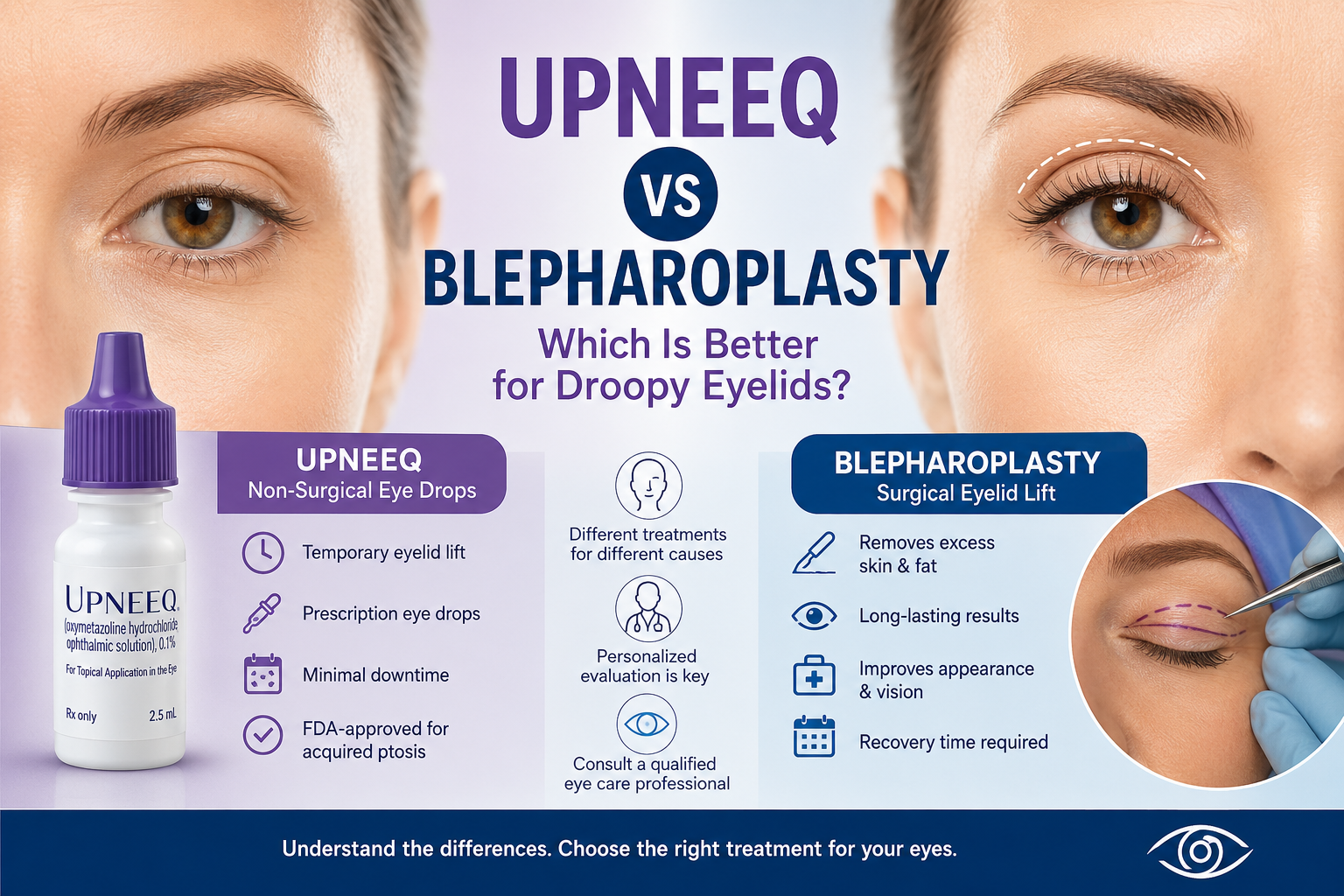
Drooping upper eyelids, medically known as ptosis, can affect both appearance and vision. While some people experience mild upper eyelid drooping due to aging, others develop acquired ptosis from weakened eyelid muscles or underlying medical conditions. Selecting the right droopy eyelid treatment depends on identifying the cause rather than simply choosing between surgery and non-surgical options.
Two commonly discussed ptosis treatment options are Upneeq®, a prescription eye drop approved by the U.S. Food and Drug Administration (FDA) for acquired blepharoptosis in adults, and blepharoplasty, a surgical procedure that removes excess eyelid skin and reshapes surrounding tissues when appropriate. Although both can improve the appearance of the upper eyelids, they work in fundamentally different ways and are designed for different clinical situations.
This guide compares Upneeq vs blepharoplasty, explaining how each treatment works, who may benefit from each option, recovery expectations, and factors healthcare professionals consider when recommending the most appropriate approach.
What Is Upneeq?
Upneeq (oxymetazoline hydrochloride ophthalmic solution 0.1%) is an FDA-approved prescription medication used to treat acquired ptosis in adults. Unlike surgery, it provides a non-surgical eyelid lift by stimulating Müller's muscle, a small muscle that helps raise the upper eyelid.
The eye drop is typically applied once daily as directed by a qualified healthcare provider. Many patients notice improvement in eyelid elevation shortly after application, although results vary depending on the individual and the severity of the condition.
Because the medication temporarily stimulates the eyelid muscle, it is considered a temporary eyelid lift rather than a permanent correction. It does not remove excess skin, tighten connective tissue, or repair weakened eyelid muscles.
Patients interested in learning whether they are candidates for Upneeq services should first undergo a comprehensive eye evaluation to determine whether their eyelid drooping is caused by acquired ptosis or another condition.
Advantages of Upneeq
-
Non-invasive treatment
-
No incisions or anesthesia
-
Minimal downtime
-
FDA-approved for acquired blepharoptosis in adults
-
Suitable for selected patients seeking an eyelid lift without surgery
Limitations
-
Results are temporary
-
Prescription required
-
Does not remove excess eyelid skin
-
Not intended for severe ptosis or significant structural eyelid changes
What Is Blepharoplasty?
Blepharoplasty is a surgical procedure performed to improve the appearance or function of the eyelids. Unlike Upneeq, surgery permanently reshapes eyelid tissues by removing excess skin and, when necessary, repositioning fat or tightening supporting structures.
Upper blepharoplasty is commonly recommended for patients with heavy, sagging eyelids caused by excess skin, a condition known as dermatochalasis. In some cases, blepharoplasty may also be combined with ptosis repair when weakened eyelid muscles contribute to the drooping.
Depending on the patient's needs, the procedure may be performed for cosmetic enhancement or to improve vision when excess eyelid tissue obstructs the upper visual field.
Benefits of Blepharoplasty
-
Long-lasting improvement
-
Removes excess upper eyelid skin
-
May improve vision in patients with functional obstruction
-
Creates a more refreshed eyelid appearance
-
Can address significant age-related eyelid changes
Considerations
-
Surgical procedure requiring recovery
-
Temporary swelling and bruising are expected
-
Incision care is necessary during healing
-
As with any surgery, potential risks should be discussed with the treating surgeon
Eyelid Lift Surgery vs Upneeq: Key Differences
Although both treatments aim to improve upper eyelid appearance, they are designed for different causes of eyelid drooping.
|
Feature |
Upneeq |
Blepharoplasty |
|
Treatment type |
Prescription eye drops |
Surgical procedure |
|
Best for |
Mild acquired ptosis |
Excess eyelid skin and selected cases of ptosis |
|
Invasiveness |
Non-surgical |
Surgical |
|
Downtime |
Minimal |
Several days to a few weeks, depending on recovery |
|
Results |
Temporary |
Long-lasting |
|
Removes excess skin |
No |
Yes |
|
Prescription required |
Yes |
Surgical consultation required |
|
FDA-approved |
Yes, for acquired blepharoptosis in adults |
Surgical procedure performed according to accepted clinical standards |
Which Treatment Is Better?
When comparing Upneeq vs blepharoplasty, there is no universal "better" option. The appropriate treatment depends on the underlying cause of upper eyelid drooping, the patient's goals, and the findings of a comprehensive examination.
In general:
-
Upneeq may be appropriate for adults with mild acquired ptosis who prefer an eyelid surgery alternative and are seeking temporary improvement without surgery.
-
Blepharoplasty is often recommended when excess eyelid skin is the primary concern or when long-term structural correction is appropriate.
-
Patients with significant levator muscle dysfunction may require ptosis repair, which differs from cosmetic blepharoplasty and should be evaluated by an ophthalmologist or oculoplastic surgeon.
Because ptosis and excess eyelid skin can occur together, some individuals may benefit from a combination of treatments based on a physician's assessment.
Recovery and Safety Considerations
Recovery is one of the biggest differences between eyelid lift surgery vs Upneeq.
Because Upneeq is a prescription eye drop, most patients can resume normal daily activities immediately after use. Some individuals may experience temporary eye irritation, redness, dryness, blurred vision, or discomfort. Patients should use the medication exactly as prescribed and inform their healthcare provider about existing eye conditions or other medications before starting treatment.
Blepharoplasty, on the other hand, requires a healing period. Swelling, bruising, and mild discomfort are common during the first one to two weeks, although recovery varies by individual and the extent of the procedure. Following postoperative instructions_including proper wound care, avoiding strenuous activities, and attending follow-up appointments_helps support healing and reduce the risk of complications.
Like all medical treatments, both options have potential risks and benefits. A thorough consultation with a qualified healthcare professional is essential before deciding on treatment.
Who Is a Good Candidate?
The most appropriate treatment depends on the underlying cause of the eyelid drooping rather than appearance alone.
Upneeq may be appropriate for adults who:
-
Have mild upper eyelid ptosis caused by acquired blepharoptosis.
-
Prefer a non-surgical eyelid lift.
-
Want temporary improvement without surgery.
-
Have realistic expectations about treatment outcomes.
Blepharoplasty may be more appropriate for individuals who:
-
Have significant excess upper eyelid skin.
-
Experience visual obstruction due to heavy eyelids.
-
Desire a long-lasting structural correction.
-
Are healthy enough to undergo surgery after medical evaluation.
A comprehensive eye examination allows healthcare providers to determine whether eyelid drooping is caused by muscle weakness, excess skin, or another medical condition. This evaluation is critical because treatment recommendations differ depending on the diagnosis.
Common Misconceptions
"Upneeq can replace surgery."
Not always. Upneeq temporarily elevates the upper eyelid in appropriately selected adults with acquired ptosis, but it does not remove loose skin or permanently change eyelid anatomy.
"Blepharoplasty treats every type of ptosis."
No. Cosmetic blepharoplasty primarily removes excess eyelid skin. Patients with true ptosis caused by levator muscle dysfunction may require a separate ptosis repair procedure, either alone or in combination with blepharoplasty.
"Every drooping eyelid is caused by aging."
While aging is a common factor, upper eyelid drooping may also result from nerve disorders, muscle diseases, previous eye surgery, trauma, or congenital conditions. A professional evaluation is important to identify the underlying cause.
Supporting Eye Health
Although nutritional supplements cannot treat ptosis or replace prescription medications or surgery, maintaining overall eye health is an important part of healthy aging. Individuals concerned about long-term wellness may discuss evidence-based nutritional support with their healthcare provider. Medical-grade supplements formulated for general eye and healthy aging support, when recommended by a clinician, may complement an overall wellness plan but should not be viewed as treatments for drooping eyelids.
Frequently Asked Questions
1. Is Upneeq a permanent solution for droopy eyelids?
No. Upneeq provides a temporary lift by stimulating Müller's muscle. Continued use is generally required to maintain its effect.
2. Is blepharoplasty permanent?
Blepharoplasty offers long-lasting improvement by removing excess tissue, but it does not stop the natural aging process. Eyelids continue to age over time.
3. Can Upneeq improve vision?
In some adults with acquired ptosis, raising the upper eyelid may improve the superior visual field. However, results vary, and patients should be evaluated by a qualified healthcare professional.
4. Can Upneeq and blepharoplasty be used together?
Yes. Depending on the diagnosis, a physician may recommend Upneeq before or after surgery in selected cases. Treatment plans are individualized based on the patient's anatomy and clinical needs.
5. Which treatment is better for excess eyelid skin?
When excess skin is the primary cause of heavy eyelids, blepharoplasty is generally more appropriate because Upneeq does not remove or tighten loose skin.
Conclusion
When comparing Upneeq vs blepharoplasty, the right choice depends on the underlying cause of eyelid drooping, the severity of the condition, and the patient's treatment goals. Upneeq offers a convenient, non-surgical option for selected adults with acquired ptosis who want temporary improvement without downtime. Blepharoplasty provides a long-lasting surgical solution for excess eyelid skin and may also be combined with ptosis repair when clinically indicated.
Rather than viewing one treatment as universally superior, healthcare professionals evaluate eyelid anatomy, muscle function, vision, and overall eye health to determine the most appropriate approach. A comprehensive examination by an ophthalmologist, oculoplastic surgeon, or other qualified provider remains the best first step toward choosing a safe and effective treatment plan.

 Arabic
 French
 Spanish
 Portuguese
 Deutsch
 Turkish
 Dutch
Dutch
 Italiano
 Russian
 Romaian
 Portuguese (Brazil)
 Greek
Greek