


The Hidden Cost of Slow Data Pipelines and How ETL Process Optimization Solves It
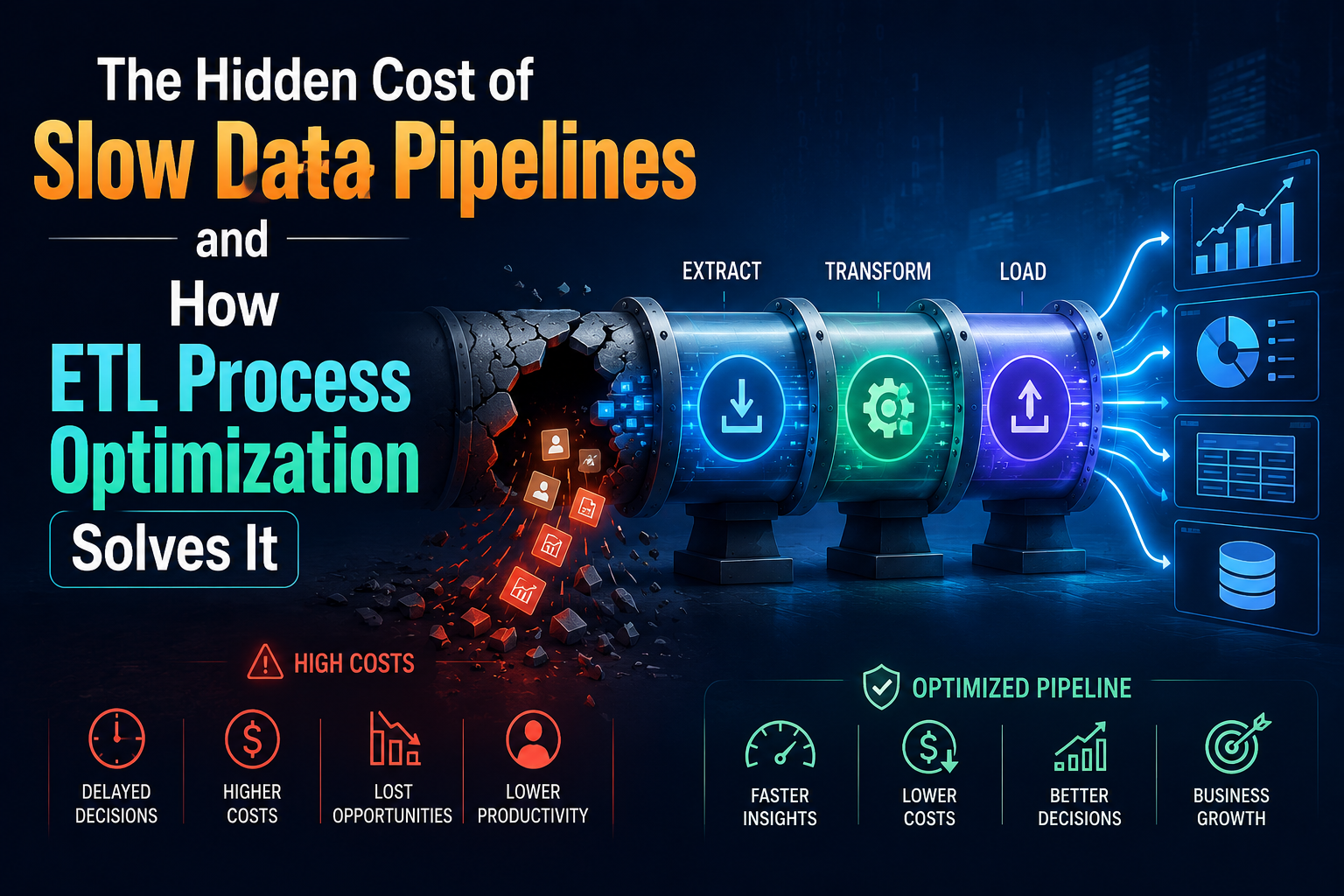
Data drives almost every business decision today. Whether it's customer insights, sales reporting, financial forecasting, or operational analytics, organizations depend on accurate and timely information. However, many businesses overlook a critical problem—the hidden cost of slow data pipelines.
When data takes too long to move from one system to another, teams make decisions using outdated information. Reports are delayed, customer experiences suffer, and employees spend valuable hours waiting for data instead of acting on it. Over time, these delays lead to reduced productivity, higher infrastructure costs, and missed business opportunities.
This is where ETL Process Optimization becomes essential. By improving how data moves through every stage of processing, businesses can reduce bottlenecks, improve performance, and create faster, more reliable workflows.
Why Slow Data Pipelines Are More Expensive Than You Think
Many organizations only notice data pipeline problems after they begin affecting daily operations. A report that takes hours instead of minutes may seem like a minor inconvenience, but the cumulative impact is significant.
Slow pipelines often result in:
-
Delayed business reports
-
Poor customer experiences
-
Increased cloud computing costs
-
Inefficient resource utilization
-
Missed sales opportunities
-
Lower employee productivity
Imagine a sales team waiting for updated customer data before contacting new leads. Even a short delay can result in lost opportunities if competitors respond first.
Rather than treating slow pipelines as an IT issue, businesses should recognize them as a company-wide efficiency challenge.
Understanding the Role of Extract, Transform, and Load
Every modern data workflow relies on Extract, Transform, and Load.
The process begins by extracting data from multiple sources such as CRM platforms, databases, applications, APIs, and spreadsheets.
Next, the data is transformed into a standardized format by removing duplicates, correcting inconsistencies, and preparing it for analysis.
Finally, the processed data is loaded into a destination such as a data warehouse, analytics platform, or reporting system.
When any of these stages become inefficient, the entire pipeline slows down, affecting every team that relies on business data.
Common Causes of Poor Pipeline Performance
Data pipelines rarely become slow for a single reason. Instead, several small inefficiencies combine to create significant performance issues.
Processing Too Much Unnecessary Data
Many pipelines process complete datasets even when only a small portion has changed. This consumes unnecessary computing resources and increases execution time.
Poor Data Quality
Duplicate records, inconsistent formatting, and incomplete datasets require additional processing before analysis can begin.
Outdated Workflows
Older ETL architectures may not scale effectively as businesses collect larger volumes of information.
Lack of Monitoring
Without continuous monitoring, failures often go unnoticed until reports or dashboards stop updating.
Inefficient Infrastructure
Limited computing resources, slow storage systems, or poorly configured cloud environments can reduce overall pipeline performance.
How ETL Process Optimization Solves These Challenges

Instead of simply making pipelines faster, ETL Process Optimization improves the entire data workflow.
Optimized pipelines process only relevant information, eliminate unnecessary tasks, and automate repetitive operations. This reduces processing time while improving accuracy and reliability.
Businesses also benefit from:
-
Faster report generation
-
Improved decision-making
-
Lower infrastructure costs
-
Better data consistency
-
Reduced manual intervention
-
Greater scalability
As organizations continue adopting AI-powered analytics and automation, optimized ETL processes become even more valuable.
Effective pipeline optimization techniques
Several proven pipeline optimization techniques can dramatically improve workflow performance.
Process Incremental Data
Rather than processing complete datasets every time, incremental processing updates only new or modified records.
This reduces execution time and lowers infrastructure costs.
Automate Repetitive Tasks
Automation eliminates manual intervention for scheduling, validation, and monitoring.
Modern workflow automation ensures pipelines continue operating with minimal supervision.
Optimize Data Transformations
Complex transformations should be simplified wherever possible.
Removing unnecessary calculations and combining related operations reduces processing overhead.
Monitor Pipeline Health Continuously
Real-time monitoring allows teams to detect failures before they affect business operations.
Performance dashboards also help identify recurring bottlenecks.
Scale Infrastructure Dynamically
Cloud-based environments allow businesses to increase computing resources during peak workloads and reduce them during quieter periods.
This improves efficiency while controlling operational costs.
Essential etl best practices
Following strong etl best practices ensures pipelines remain efficient as businesses grow.
Design for Scalability
Build workflows that can handle increasing data volumes without requiring complete redesigns.
Validate Data Early
Identifying errors during the extraction stage prevents poor-quality information from affecting downstream systems.
Document Every Workflow
Clear documentation makes troubleshooting easier while simplifying future improvements.
Reduce Data Duplication
Removing duplicate records improves processing speed and increases reporting accuracy.
Review Performance Regularly
Optimization should not be treated as a one-time project.
Regular reviews help organizations adapt to changing workloads and evolving business requirements.
Why Modern Businesses Need Smarter Data Workflows
Business environments are becoming increasingly data-driven.
Marketing teams monitor campaign performance in real time.
Sales departments analyze customer behavior daily.
Finance teams require accurate reporting for forecasting.
Executives rely on live dashboards for strategic decisions.
Without ETL Process Optimization, these teams risk making decisions based on delayed or incomplete information.
Organizations that invest in smarter data workflows gain faster insights, improve operational efficiency, and respond more quickly to changing market conditions.
Solutions that automate data extraction and preparation can further simplify these workflows. For example, platforms like ExtractMails help businesses collect structured data from emails, reducing manual work before information enters ETL pipelines.
Conclusion
Slow data pipelines affect much more than reporting speed. They increase operational costs, reduce productivity, and delay important business decisions.
By investing in ETL Process Optimization, organizations can create faster, more reliable, and scalable workflows that support long-term growth.
Implementing effective pipeline optimization techniques, following proven etl best practices, and improving every stage of Extract, Transform, and Load enables businesses to unlock greater value from their data while reducing unnecessary complexity.
As data volumes continue to grow, organizations that optimize their ETL processes today will be better prepared for tomorrow's analytical and operational demands.
Frequently Asked Questions
1. What is ETL Process Optimization?
ETL Process Optimization improves the efficiency, speed, and reliability of data extraction, transformation, and loading workflows while reducing operational costs.
2. Why are slow data pipelines a business problem?
Slow pipelines delay reporting, reduce productivity, increase infrastructure costs, and prevent teams from making timely business decisions.
3. What are some effective pipeline optimization techniques?
Common techniques include incremental data processing, workflow automation, real-time monitoring, optimized transformations, and scalable cloud infrastructure.
4. Why are etl best practices important?
Following etl best practices improves data quality, system reliability, scalability, and long-term maintenance while reducing pipeline failures.
5. What does Extract, Transform, and Load mean?
Extract, Transform, and Load is the process of collecting data from various sources, preparing it for analysis, and loading it into a destination such as a data warehouse or analytics platform.

 English
 Arabic
 French
 Spanish
 Portuguese
 Deutsch
 Turkish
 Dutch
Dutch
 Italiano
 Romaian
 Portuguese (Brazil)
 Greek
Greek