


How Does a Cardiac Modular OT With Laminar Airflow Improve Surgical Precision?
Introduction
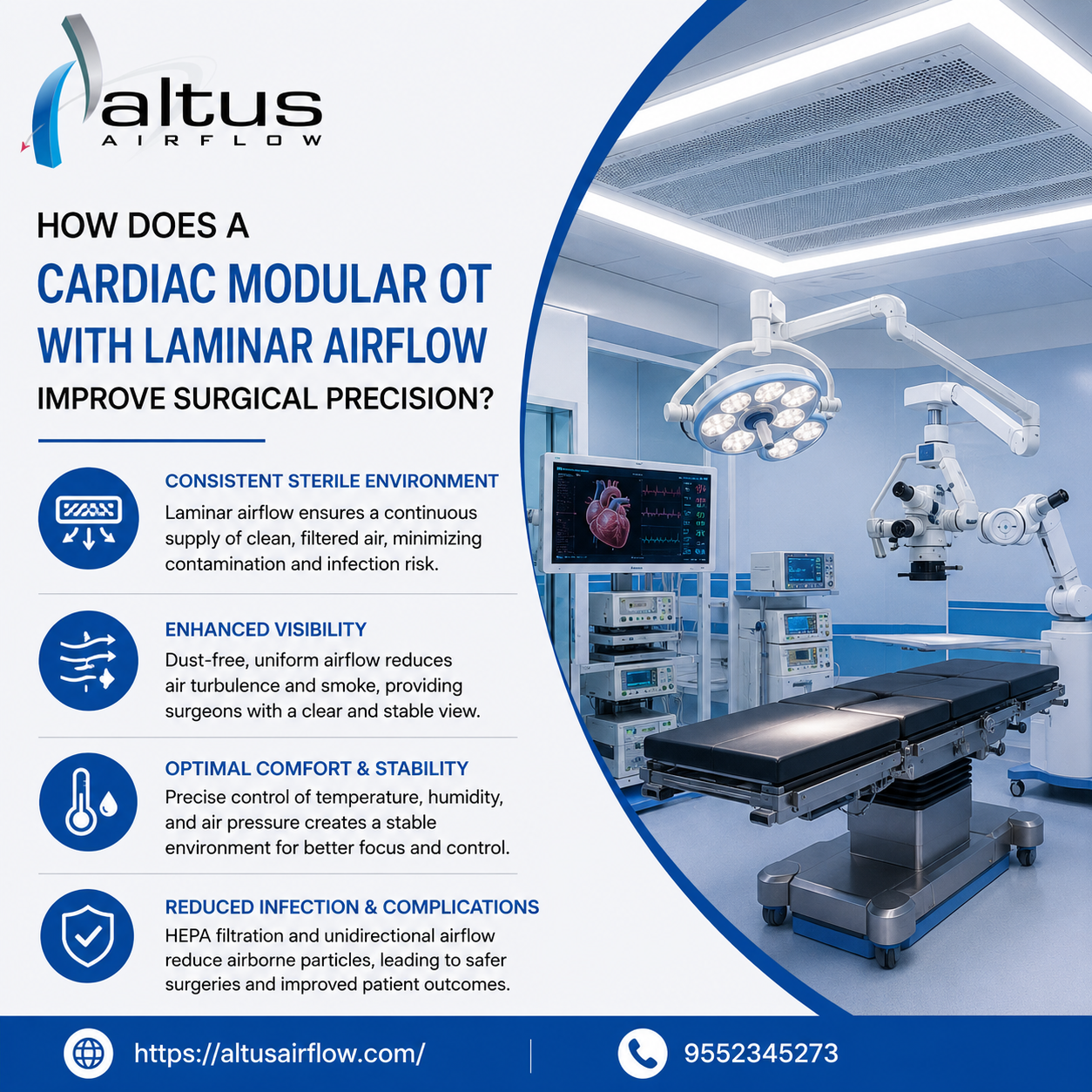
Cardiac surgery demands exceptional accuracy because even the smallest error can significantly affect patient outcomes. To support surgeons in performing highly complex cardiovascular procedures, hospitals require an operating environment that minimizes contamination, maintains stable environmental conditions, and accommodates advanced surgical technologies. A Cardiac Modular OT With Laminar Airflow is specifically designed to provide these advantages by integrating modular construction, cleanroom engineering, HEPA filtration, advanced HVAC systems, and controlled airflow. Companies such as Altus Airflow develop specialized modular cardiac operation theatres that help hospitals create safe, efficient, and highly controlled surgical environments where precision becomes easier to achieve.
Unlike conventional operation theatres, cardiac modular OTs are engineered to maintain consistent temperature, humidity, air quality, and sterility throughout lengthy procedures. These controlled conditions allow surgeons to concentrate entirely on delicate cardiac interventions without unnecessary environmental distractions.
This article explains how a cardiac modular OT with laminar airflow contributes to greater surgical precision and improved patient safety.
Importance of Surgical Precision in Cardiac Procedures
Cardiac surgeries involve delicate structures such as:
-
Heart valves
-
Coronary arteries
-
Major blood vessels
-
Cardiac muscles
Even minimal inaccuracies can influence surgical success, making precision essential.
Understanding a Cardiac Modular OT With Laminar Airflow
A Cardiac Modular OT With Laminar Airflow combines modular infrastructure with advanced environmental control technologies.
Major features include:
-
Laminar airflow systems
-
HEPA filtration
-
HVAC integration
-
Modular wall systems
-
Medical gas pipeline systems
These features support high-quality surgical performance.
What Is Laminar Airflow?
Laminar airflow is a controlled air distribution system that delivers filtered air uniformly across the operating area.
The system helps:
-
Maintain clean air
-
Control airborne particles
-
Reduce contamination
Stable airflow creates a safer surgical environment.
Maintaining a Sterile Surgical Field
Sterility directly affects surgical precision.
Laminar airflow continuously supplies clean air to the operating field, helping reduce airborne contaminants that may interfere with surgery.
A cleaner environment allows surgeons to focus entirely on the procedure.
Reduction of Airborne Contaminants
Airborne particles can introduce infection risks during surgery.
Laminar airflow works together with HEPA filters to reduce:
-
Dust particles
-
Microorganisms
-
Airborne contaminants
Cleaner air supports safer procedures.
Role of HEPA Filtration
HEPA filters remove extremely fine airborne particles from the operating theatre.
Benefits include:
-
Improved air quality
-
Reduced contamination
-
Better environmental stability
High-quality filtration enhances surgical conditions.
Stable Temperature Control
Cardiac procedures often require long operating hours.
Advanced HVAC systems maintain:
-
Consistent room temperature
-
Comfortable working conditions
-
Equipment stability
Stable temperatures improve concentration for surgical teams.
Controlled Humidity Levels
Humidity influences both equipment performance and surgical comfort.
Proper humidity management helps:
-
Protect sensitive equipment
-
Improve staff comfort
-
Maintain environmental stability
Balanced humidity contributes to better surgical accuracy.
Enhanced Surgeon Concentration
A controlled operating environment minimizes unnecessary distractions.
Benefits include:
-
Better visibility
-
Improved focus
-
Reduced fatigue
Enhanced concentration supports precision throughout lengthy procedures.
Improved Lighting Conditions
Modern modular cardiac OTs use advanced LED surgical lighting.
Advantages include:
-
Shadow-free illumination
-
Uniform light distribution
-
Reduced heat generation
Clear visibility supports accurate surgical techniques.
Ergonomic Operating Theatre Design
Proper layout planning improves workflow.
Well-designed theatres provide:
-
Easy equipment access
-
Efficient staff movement
-
Organized workstations
Ergonomic environments reduce procedural interruptions.
Advanced Equipment Integration
Modern cardiac surgery relies on sophisticated technologies.
Modular operation theatres accommodate:
-
Surgical microscopes
-
Robotic systems
-
Imaging equipment
-
Patient monitoring systems
Proper integration supports precision-based procedures.
Reliable Medical Gas Pipeline Systems
Continuous medical gas supply is essential during cardiac surgery.
Integrated systems provide:
-
Oxygen
-
Medical air
-
Vacuum
Reliable infrastructure supports uninterrupted operations.
Reduced Infection Risk
Lower infection rates contribute to improved recovery and better surgical outcomes.
Contamination control systems help reduce:
-
Surgical site infections
-
Airborne microorganisms
-
Environmental contamination
Safer environments improve patient care.
Support for Minimally Invasive Procedures
Many modern cardiac procedures use minimally invasive techniques.
Controlled operating environments improve:
-
Instrument accuracy
-
Surgical visualization
-
Procedure efficiency
Modular OTs support these advanced techniques.
Compatibility with Robotic Cardiac Surgery
Robotic surgery requires precise environmental control.
Modular theatres support:
-
Robotic equipment
-
Digital imaging
-
Advanced monitoring systems
Organized infrastructure improves robotic performance.
Consistent Airflow Around the Surgical Field
Uniform airflow reduces turbulence near the operating table.
This helps:
-
Maintain sterility
-
Prevent particle movement
-
Protect open surgical sites
Stable airflow supports delicate procedures.
Efficient Surgical Workflow
Well-organized operating theatres improve coordination.
Benefits include:
-
Faster equipment access
-
Better communication
-
Reduced delays
Efficient workflows contribute to improved precision.
Compliance with Healthcare Standards
Modern cardiac modular OTs are designed according to healthcare quality requirements.
Compliance includes:
-
Air quality standards
-
Environmental control
-
Infection prevention
-
Safety protocols
Meeting standards improves overall surgical quality.
Long-Term Operational Reliability
High-quality modular operation theatres provide dependable performance.
Their systems are designed for:
-
Consistent operation
-
Easy maintenance
-
Future upgrades
Reliable infrastructure supports long-term surgical excellence.
Why Specialized Engineering Matters
A professionally engineered Cardiac Modular OT With Laminar Airflow integrates cleanroom technology, modular construction, advanced airflow systems, HVAC engineering, HEPA filtration, ergonomic planning, and digital infrastructure to create an environment where surgeons can perform highly complex procedures with greater precision and confidence.
Conclusion
A cardiac modular OT with laminar airflow significantly improves surgical precision by maintaining sterile conditions, controlling airborne contamination, supporting stable temperature and humidity, integrating advanced surgical technologies, and optimizing workflow. These environmental improvements allow surgeons to focus on complex cardiovascular procedures while reducing infection risks and enhancing patient safety.
Altus Airflow delivers advanced modular cardiac operation theatre solutions that combine cleanroom engineering, HVAC systems, laminar airflow, HEPA filtration, and customized healthcare infrastructure. Through innovative engineering expertise and high-quality execution, Altus Airflow helps hospitals establish future-ready cardiac surgical environments designed to support precision, efficiency, and clinical excellence.
FAQs
1. How does a Cardiac Modular OT With Laminar Airflow improve surgical precision?
A Cardiac Modular OT With Laminar Airflow improves surgical precision by maintaining sterile airflow, reducing airborne contaminants, supporting HEPA filtration, controlling temperature and humidity, improving lighting conditions, integrating advanced equipment, and creating a stable operating environment.
2. Why is laminar airflow important in cardiac surgery?
Laminar airflow delivers clean filtered air that reduces contamination around the surgical field.
3. Do HEPA filters improve surgical safety?
Yes. HEPA filters remove airborne particles and help maintain cleaner operating conditions.
4. How does HVAC support surgical precision?
HVAC systems regulate temperature, humidity, ventilation, and air quality throughout surgery.
5. Can robotic cardiac surgery be performed in these operation theatres?
Yes. Modular cardiac OTs support robotic systems and advanced surgical technologies.
Read Our Previous Blog --------------->Can robotic cardiac surgery be performed in a Cardiac Modular Operation Theatre?

 English
 Arabic
 French
 Portuguese
 Deutsch
 Turkish
 Dutch
Dutch
 Italiano
 Russian
 Romaian
 Portuguese (Brazil)
 Greek
Greek