


Frozen Food Market Advances Through Efficient Freezing Technologies
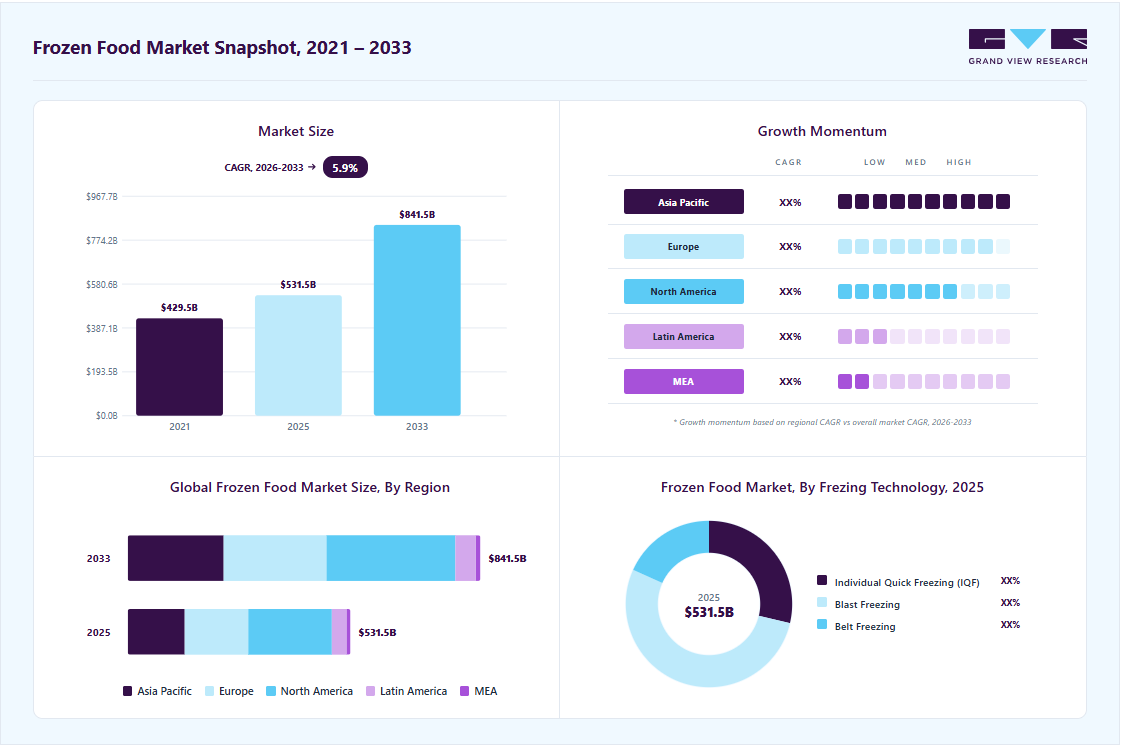
The frozen food market is witnessing steady growth as consumers increasingly seek convenient, long-lasting, and ready-to-use food products that fit modern lifestyles. The global frozen food market size was valued at USD 531.5 billion in 2025 and is projected to grow from USD 561.5 billion in 2026 to USD 841.5 billion by 2033, at a CAGR of 5.9% from 2026 to 2033. The market in North America dominated with a revenue share of 37.5% in 2025. The increasing popularity of shelf-stable foods among consumers on a global level is expected to boost industry growth over the next few years.
Another major factor supporting market expansion is the growing demand for convenient meal solutions, improved cold chain infrastructure, and advancements in food preservation technologies. Manufacturers are introducing innovative frozen food products with enhanced quality, nutrition, and longer shelf life to meet evolving consumer preferences. Expanding retail distribution networks, foodservice demand, and technological improvements in freezing processes continue to strengthen market growth.
Key Market Trends & Insights
• Regional analysis indicates that North America dominated the frozen food market, accounting for the largest revenue share of 37.5% in 2025. The region's leadership is supported by strong consumer demand for convenience foods, advanced cold chain infrastructure, high retail penetration, and widespread availability of frozen food products. Furthermore, Asia Pacific is expected to register the highest CAGR from 2026 to 2033, driven by rapid urbanization, changing consumer lifestyles, increasing disposable incomes, and expanding food retail networks.
• Based on product, the frozen desserts segment held the largest market share of 23.2% in 2025. The segment continues to grow due to strong consumer demand for premium frozen desserts, innovative flavors, and convenient ready-to-eat options.
• Based on freezing technology, the blast freezing segment held the largest market share of 53.0% in 2025. Blast freezing technology remains widely adopted because it rapidly preserves food quality, texture, nutritional value, and shelf life while supporting large-scale commercial food production.
• Based on distribution channel, the foodservice segment held the largest market share of 70.0% in 2025. Restaurants, hotels, catering services, and institutional food providers continue driving demand for frozen food products due to operational efficiency, product consistency, and reduced food waste.
• By country, the U.S. held the largest market share in 2025. The country's leadership is supported by high consumer spending on convenience foods, an established frozen food industry, advanced distribution infrastructure, and continuous product innovation.
Key Companies & Market Share Insights
The frozen food market is highly competitive, with leading companies focusing on product innovation, sustainability, portfolio expansion, and distribution network development. Companies continue investing in healthier frozen food offerings, premium product categories, environmentally responsible packaging, and advanced manufacturing technologies to strengthen their market position.
• Nestlé S.A. is one of the world's largest food and beverage companies, operating more than 2,000 brands across 188 countries with approximately 270,000 employees. The company offers products across Powdered and Liquid Beverages, PetCare, Nutrition and Health Science, Prepared Dishes and Cooking Aids, Milk Products and Ice Creams, Confectionery, and Water. Nestlé also aims to reduce its carbon footprint by 50% by the end of 2030.
• General Mills, Inc. is a leading producer of packaged consumer foods with a strong portfolio including Cheerios, Pillsbury, Betty Crocker, Nature Valley, Old El Paso, Blue Buffalo, and Häagen-Dazs. The company continues expanding its presence across packaged foods, frozen products, snacks, cereals, and foodservice markets through continuous product innovation and brand development.
Leading manufacturers are increasingly investing in premium frozen meals, healthier product formulations, sustainable packaging, and expanded retail and foodservice partnerships to meet evolving consumer demand. These strategic initiatives are expected to strengthen competition and support long-term market expansion.
With growing demand for convenient food products, expanding cold chain infrastructure, advancements in freezing technologies, and increasing consumer preference for shelf-stable foods, the frozen food market is expected to experience sustained growth through 2033. Companies focusing on product innovation, sustainability, premium offerings, and efficient distribution networks are well positioned to capitalize on future market opportunities.
Key Frozen Food Companies:
· Unilever PLC
· Nestlé S.A.
· General Mills, Inc.
· Nomad Foods Ltd.
· Tyson Foods Inc.
· Conagra Brands Inc.
· Wawona Frozen Foods
· Bellisio Parent, LLC
· The Kellogg Company
· The Kraft Heinz Company
Grand View Research offers
· Focused market intelligence reports on specific geographies or high-growth segments.
· Extended forecast timelines for long-term planning.
· Competitor Benchmarking and Supply Chain Analysis
· Inclusion of regulatory and policy assessments.
· Inclusion of custom data models, KPIs, or applications unique to your business
· Specific high-impact Data Decks and Tables to support effective decision making
· And much more…
Looking for a report customized to your requirements? Explore our Custom Research Offering

 English
 Arabic
 French
 Spanish
 Portuguese
 Deutsch
 Turkish
 Italiano
 Russian
 Romaian
 Portuguese (Brazil)
 Greek
Greek