


AI Automation Observability: How to Monitor Intelligent Workflows
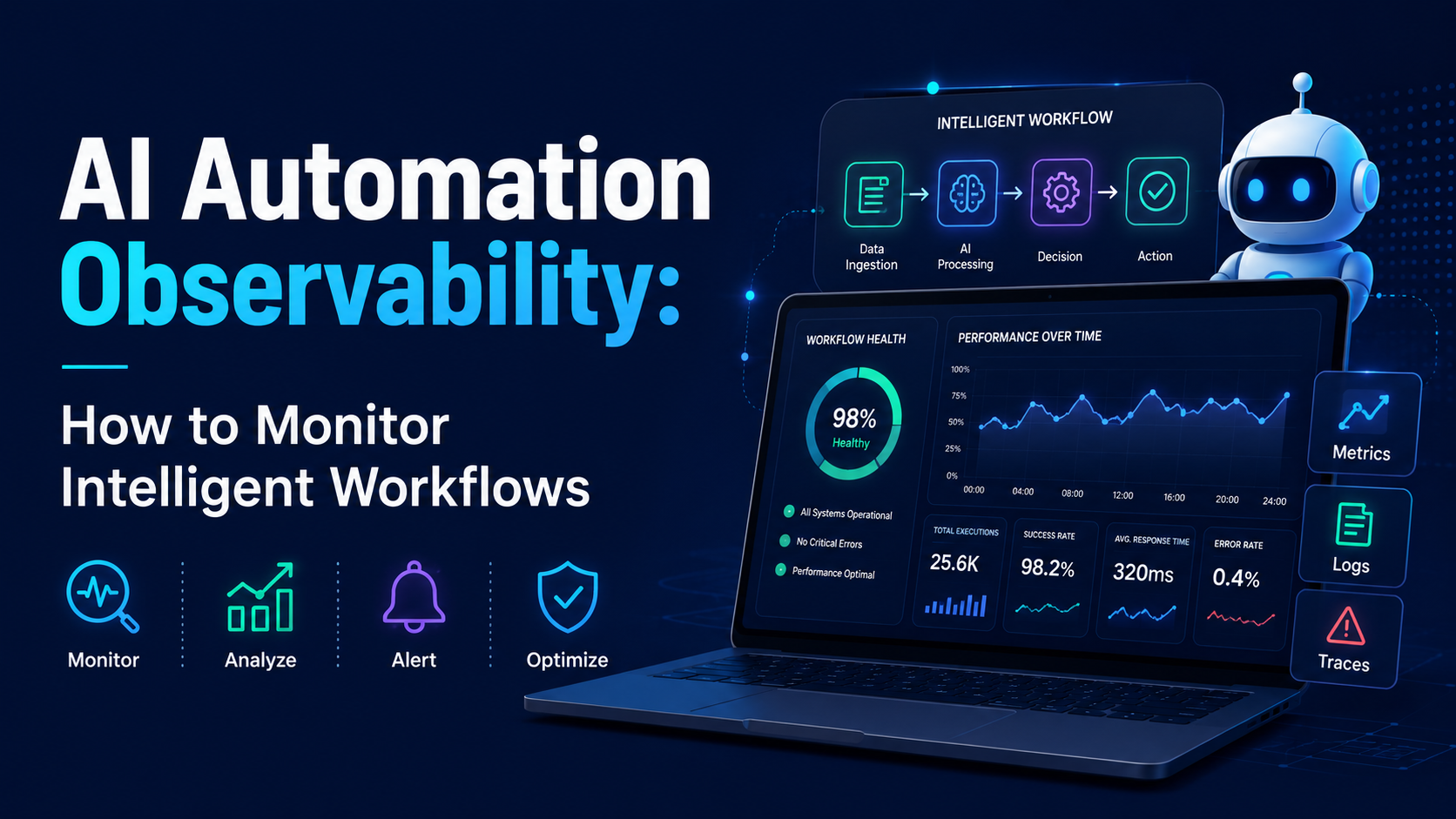
AI automation is transforming the way businesses operate. Organizations are using AI agents, intelligent workflows, generative AI, and automated decision-making systems to streamline processes, reduce manual work, and improve productivity.
However, as AI-powered automation becomes more complex, simply deploying an automated workflow is no longer enough. Businesses need to understand what their AI systems are doing, why a workflow produced a particular result, how often failures occur, and where human intervention is required.
This is where AI automation observability becomes important.
AI automation observability provides businesses with visibility into intelligent workflows, AI agents, models, integrations, decisions, and outcomes. It helps teams monitor automation performance, identify failures, detect unexpected behavior, improve reliability, and maintain greater control over AI-driven processes.
In this guide, we will explain what AI automation observability is, why it matters, what should be monitored, key metrics, implementation best practices, challenges, and the future of monitoring intelligent workflows.
What Is AI Automation Observability?
AI automation observability is the practice of monitoring, analyzing, and understanding the behavior and performance of AI-powered workflows and automation systems.
Traditional application monitoring generally focuses on metrics such as:
- Server performance
- API response time
- Application errors
- Database performance
- Infrastructure availability
AI-powered workflows require additional visibility because their behavior can depend on data, prompts, models, tools, external systems, and AI-generated decisions.
For example, an AI-powered customer support workflow may operate like this:
Customer Email → AI Intent Detection → Customer Data Retrieval → Knowledge Base Search → AI Response Generation → CRM Update → Customer Notification
If the workflow fails, a traditional monitoring system may only tell you that an API request failed.
AI automation observability can help answer deeper questions:
- Which step failed?
- What information did the AI receive?
- Which model was used?
- What tools did the AI agent call?
- How long did each step take?
- Was the response accurate?
- Did the AI use the correct knowledge source?
- Was human intervention required?
- How much did the workflow cost?
This additional visibility is essential for reliable AI automation.
Why AI Automation Observability Matters
AI workflows are different from traditional deterministic software.
A traditional application may follow:
Input → Rule → Output
An intelligent workflow can behave more like:
Input → AI Interpretation → Reasoning → Tool Selection → Data Retrieval → Action → Evaluation → Output
Each stage can introduce new failure points.
Without proper observability, businesses may not know why automation is becoming unreliable or why an AI agent is producing inconsistent results.
Key benefits include:
- Improved workflow reliability
- Faster issue detection
- Better AI performance
- Reduced operational costs
- Improved security
- Greater transparency
- Easier debugging
- Better compliance
- Continuous optimization
What Should You Monitor in AI Workflows?
Effective observability requires monitoring more than just system uptime.
1. Workflow Performance
Track the overall performance of automated workflows.
Important metrics include:
- Workflow execution time
- Completion rate
- Failure rate
- Retry rate
- Queue time
- Step-level latency
- Throughput
For example, if an invoice-processing workflow normally takes 30 seconds but suddenly takes five minutes, observability tools can help identify the bottleneck.
2. AI Agent Performance
When AI agents are part of a workflow, monitor how they behave during execution.
Useful metrics include:
- Task completion rate
- Tool usage
- Agent response time
- Number of steps
- Failed actions
- Escalation rate
- Repeated actions
- Agent success rate
This helps teams determine whether an AI agent is efficiently completing its assigned tasks.
3. Model Performance
AI models can produce different outputs depending on inputs, prompts, context, and model versions.
Businesses should monitor:
- Model response time
- Token usage
- Output quality
- Error rate
- Model version
- Response consistency
- Hallucination indicators
Tracking model performance helps organizations identify changes in AI behavior after model or prompt updates.
4. Prompt and Context Monitoring
Prompts are an important part of AI-powered workflows.
A small change in a prompt can sometimes produce significantly different results.
Observability systems can track:
- Prompt versions
- Prompt execution
- Context length
- Input data
- Output data
- Prompt failures
- Response quality
This allows development teams to compare workflow behavior before and after prompt changes.
5. Tool and API Calls
AI agents frequently interact with external tools and business systems.
For example:
AI Agent → CRM API → Customer Database → Payment System → Email Service
Each integration can become a potential point of failure.
Monitor:
- API response time
- API errors
- Authentication failures
- Timeout events
- Tool execution success
- Retry frequency
This makes it easier to determine whether an issue originates from the AI model or an external system.
6. Data Quality
AI automation is only as reliable as the information it receives.
Monitor data-related issues such as:
- Missing information
- Incorrect values
- Duplicate records
- Invalid formats
- Outdated information
- Incomplete context
For example, if an AI sales agent receives incorrect customer information from a CRM, the AI may generate an incorrect response even if the model itself is functioning properly.
7. AI Workflow Costs
AI automation can generate costs through:
- Model usage
- API calls
- Cloud infrastructure
- Data processing
- External tools
Observability helps organizations track the cost of individual workflows.
For example:
Customer Support Workflow → $0.04 per interaction
Sales Qualification Workflow → $0.12 per lead
This information can help businesses identify expensive workflows and optimize their architecture.
8. Human Intervention
Human oversight remains important for many AI-powered processes.
Observability should track:
- Human approval rate
- Escalation frequency
- Manual corrections
- Human override actions
- Time to intervention
A high human intervention rate may indicate that an AI workflow requires better prompts, improved data, additional rules, or a different model.
Important AI Automation Observability Metrics
Businesses should define a set of KPIs to measure intelligent workflow performance.
| Metric | What It Measures |
|---|---|
| Workflow Success Rate | Percentage of workflows completed successfully |
| Failure Rate | Number of failed executions |
| Latency | Time required to complete tasks |
| AI Accuracy | Quality of AI-generated outcomes |
| Escalation Rate | Workflows requiring human intervention |
| Tool Success Rate | Successful external tool/API calls |
| Token Usage | AI model consumption |
| Cost per Workflow | Average automation cost |
| Retry Rate | Frequency of repeated executions |
| Hallucination Rate | Potentially incorrect AI outputs |
| Task Completion Rate | Percentage of successfully completed AI tasks |
Monitoring these metrics provides a clearer picture of both technical and business performance.
AI Automation Observability vs Traditional Monitoring
Traditional monitoring and AI observability serve different purposes.
| Traditional Monitoring | AI Automation Observability |
| Infrastructure health | AI workflow health |
| Server metrics | Agent execution metrics |
| API errors | Tool and agent errors |
| Application logs | AI reasoning and workflow traces |
| Request latency | AI and workflow latency |
| System availability | Task completion |
| Error monitoring | AI output quality |
| Infrastructure cost | AI model and workflow cost |
Traditional monitoring is still essential, but AI-powered systems require additional visibility into workflow behavior and AI outcomes.
Distributed Tracing for Intelligent Workflows
AI automation workflows often involve multiple systems.
Consider this example:
User Request → AI Agent → LLM → Knowledge Base → CRM → Payment API → Email Service
If the final workflow fails, developers need to know where the problem occurred.
Distributed tracing allows teams to follow the complete execution path.
A trace may show:
Step 1: User request received
Step 2: AI agent initialized
Step 3: LLM response generated
Step 4: Knowledge base queried
Step 5: CRM API called
Step 6: Payment API failed
Step 7: Workflow escalated to human
This makes troubleshooting much faster.
AI Agent Observability
AI agents require specialized monitoring because they can dynamically decide what actions to perform.
For example, an AI sales agent might:
- Read a lead inquiry.
- Analyze customer intent.
- Search CRM records.
- Research available products.
- Calculate pricing.
- Generate an email.
- Schedule a meeting.
Observability allows businesses to track each step.
Important agent metrics include:
- Agent goal completion
- Tool selection
- Tool execution
- Number of reasoning steps
- Failed actions
- Repeated actions
- Escalations
- Response quality
- Execution cost
This helps organizations understand whether their AI agents are operating efficiently.
Monitoring AI Hallucinations
One of the biggest challenges with generative AI is hallucination.
An AI model may produce information that appears accurate but is actually incorrect.
For business-critical workflows, teams should monitor:
- Unsupported claims
- Incorrect information
- Missing citations
- Unexpected responses
- Low-confidence outputs
Businesses can reduce these risks by combining:
- Retrieval-augmented generation
- Trusted knowledge bases
- Structured outputs
- Validation rules
- Human approval
- Automated evaluation
Observability can then measure whether these safeguards are working effectively.
AI Workflow Security Monitoring
AI automation systems may access sensitive business information.
For example:
AI Agent → CRM → Customer Data → Financial System
Security observability should monitor:
- Unauthorized access
- Suspicious API calls
- Data leakage
- Permission violations
- Authentication failures
- Unexpected tool usage
- Sensitive data exposure
Role-based access control and least-privilege principles should be applied to AI agents and automation workflows.
AI Automation Observability for Different Industries
Finance
Monitor:
- Invoice processing
- Payment workflows
- Fraud detection
- Financial document processing
Healthcare
Monitor:
- Patient communication workflows
- Document processing
- Administrative automation
- Data access
Retail
Monitor:
- Customer support
- Order processing
- Inventory workflows
- Personalized recommendations
SaaS
Monitor:
- Customer onboarding
- Support automation
- Lead qualification
- Product workflows
Manufacturing
Monitor:
- Supply chain automation
- Procurement workflows
- Quality processes
- Maintenance workflows
How to Implement AI Automation Observability
Step 1: Map the Complete Workflow
Document every component involved in the automation.
For example:
Input → AI Agent → Model → Tool → API → Database → Output
Step 2: Define Key Metrics
Identify the metrics that matter for your business.
For example:
- Completion rate
- Accuracy
- Cost
- Latency
- Escalation rate
Step 3: Implement Structured Logging
Capture relevant execution information in a consistent format.
Logs should help teams understand:
- What happened
- When it happened
- Which component was involved
- Whether the action succeeded
- What caused the failure
Step 4: Add Distributed Tracing
Track the complete execution path across AI models, APIs, databases, and external applications.
Step 5: Create Dashboards
Build dashboards that show real-time workflow performance.
A useful dashboard may include:
- Active workflows
- Failed workflows
- Average latency
- AI costs
- Agent performance
- API failures
- Human escalations
Step 6: Configure Alerts
Set alerts for important events.
Examples include:
- Workflow failure rate exceeds threshold
- AI costs increase unexpectedly
- API response time becomes too high
- Agent repeatedly performs the same action
- Sensitive data access is detected
Step 7: Continuously Evaluate AI Outputs
Technical monitoring alone is not enough.
Organizations should also evaluate whether AI-generated outputs are accurate, relevant, safe, and aligned with business requirements.
Best Practices for AI Automation Observability
Use End-to-End Tracing
Monitor the complete workflow instead of individual components in isolation.
Track Business Outcomes
Do not focus only on technical metrics. Measure whether automation actually improves business performance.
Monitor Costs
Track AI model and infrastructure usage to prevent unexpected expenses.
Keep Humans in the Loop
Use human approval for high-risk decisions.
Version Prompts and Models
Maintain visibility into which model and prompt version generated each result.
Protect Sensitive Data
Avoid exposing confidential information through logs and monitoring systems.
Continuously Improve
Use observability data to identify bottlenecks and optimize workflows.
Common Challenges
AI automation observability can introduce several challenges.
Complex Architectures
Modern workflows can involve multiple models, agents, APIs, databases, and SaaS applications.
Difficult AI Evaluation
Unlike traditional software, AI outputs are not always binary. Quality may require contextual evaluation.
Data Privacy
Logs and traces can contain sensitive information and must be protected.
Cost Management
Detailed monitoring itself can generate additional storage and processing costs.
Rapidly Changing AI Systems
Models, prompts, tools, and workflows can change frequently, making consistent monitoring more challenging.
The Role of AI Automation Agencies
Implementing observability requires both AI and software engineering expertise.
An experienced AI automation agency in USA can help businesses design observable workflows, implement monitoring systems, integrate AI agents with business applications, and establish performance metrics.
Organizations working with an AI development company in USA can also build customized AI solutions with observability features integrated directly into the architecture.
For businesses that require custom enterprise applications, APIs, dashboards, and system integrations, a reliable Software Development Company in Dallas can help build the technical infrastructure required to monitor intelligent workflows effectively.
Future of AI Automation Observability
As AI agents become more autonomous, observability will become increasingly important.
Future observability systems are likely to focus on:
- Autonomous AI agent monitoring
- Real-time workflow evaluation
- AI quality scoring
- Automated anomaly detection
- Predictive failure detection
- Cost optimization
- Security monitoring
- Agent behavior analysis
- Automated workflow optimization
AI systems may eventually be capable of detecting their own performance problems and recommending workflow improvements.
For example:
Monitor → Detect Issue → Identify Root Cause → Recommend Fix → Test → Deploy Improvement
This could create a continuous optimization loop for intelligent business automation.
Conclusion
AI automation can significantly improve business productivity, but intelligent workflows must be monitored to remain reliable, secure, cost-effective, and aligned with business objectives.
AI automation observability provides the visibility businesses need to understand how AI agents, models, APIs, tools, and workflows behave in real-world environments.
By monitoring workflow performance, AI outputs, agent behavior, costs, data quality, security, and human intervention, organizations can identify problems faster and continuously improve their automation systems.
As businesses move toward increasingly autonomous AI workflows, observability should not be treated as an optional feature. It should be considered a core component of any reliable AI automation architecture.
The combination of AI automation + observability + human oversight can help organizations build intelligent workflows that are not only powerful but also measurable, explainable, and operationally reliable.
Frequently Asked Questions
What is AI automation observability?
AI automation observability is the practice of monitoring AI-powered workflows, agents, models, integrations, outputs, costs, and business outcomes to understand system behavior and identify problems.
Why is observability important for AI agents?
AI agents can dynamically select tools, perform multiple actions, and produce variable outputs. Observability helps businesses understand agent behavior, detect failures, monitor costs, and improve reliability.
What metrics should businesses monitor?
Important metrics include workflow success rate, failure rate, latency, AI accuracy, token usage, cost per workflow, tool success rate, escalation rate, and task completion rate.
How is AI observability different from traditional monitoring?
Traditional monitoring primarily focuses on infrastructure and application health. AI observability additionally monitors model behavior, prompts, agent actions, AI outputs, workflow execution, and business outcomes.
Can AI automation observability reduce operational costs?
Yes. By identifying inefficient workflows, excessive model usage, repeated agent actions, and unnecessary API calls, observability can help businesses optimize AI infrastructure and reduce automation costs.
Should AI workflows always be fully autonomous?
Not necessarily. High-risk or business-critical processes may require human approval. A human-in-the-loop approach can provide additional control while still allowing AI to automate repetitive tasks.
How can businesses implement AI automation observability?
Businesses should map their workflows, define important metrics, implement structured logging and distributed tracing, monitor AI outputs, create dashboards, configure alerts, and continuously evaluate workflow performance.

 English
 Arabic
 French
 Spanish
 Portuguese
 Deutsch
 Dutch
Dutch
 Italiano
 Russian
 Romaian
 Portuguese (Brazil)
 Greek
Greek