


SOC Services Companies in India: Safer Healthcare Security
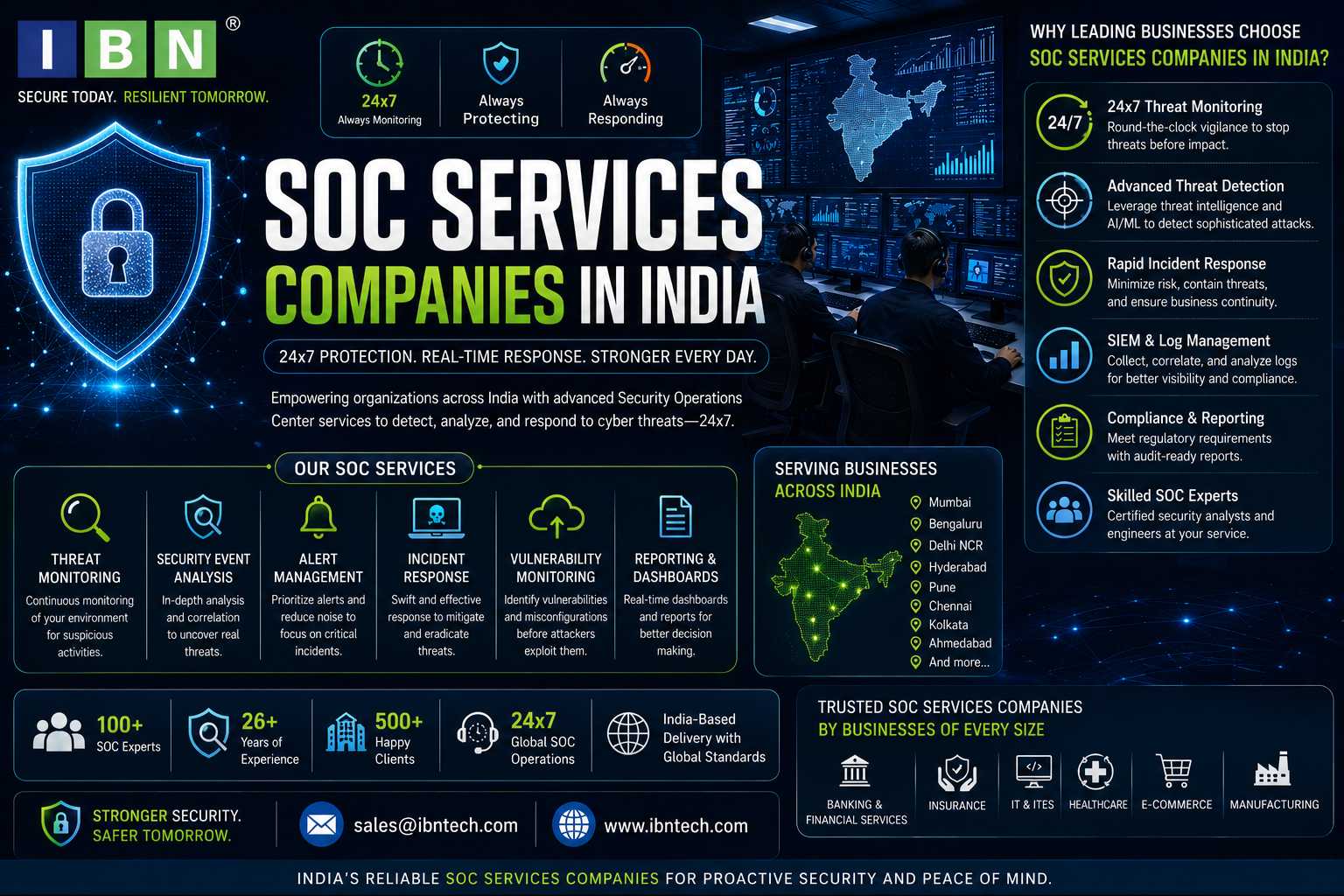
SOC Services Companies in India: What Healthcare Organizations Should Expect
A hospital or healthtech company can have strong clinical systems and still face cybersecurity gaps between those systems. Patient portals, endpoints, cloud platforms, administrative applications, connected infrastructure, and third-party integrations all create potential security exposure. For healthcare organizations evaluating soc services companies in india, the priority should be finding a security partner that understands continuous monitoring as part of patient-data protection and operational resilience.
The healthcare SOC decision is different from a general IT security purchase. Security leaders must consider sensitive information, business continuity, access management, compliance, legacy environments, and the potential operational consequences of an incident.
What Do SOC Services Companies in India Provide to Healthcare?
SOC services companies provide centralized security operations that monitor systems, analyze security events, detect suspicious behavior, and support incident response. For healthcare organizations, a managed SOC can provide an additional security layer across the technology environments supporting clinical, administrative, and digital health operations.
A SOC does not replace preventive controls. Instead, it connects security visibility, detection, investigation, and response.
Why Healthcare Needs Continuous Security Visibility
Healthcare organizations manage information that requires careful protection. Patient records, diagnostic information, insurance details, employee information, financial data, and operational records may exist across different systems.
At the same time, healthcare organizations increasingly depend on digital workflows.
A hospital may rely on connected applications for scheduling, administration, patient engagement, billing, diagnostics, and other functions. A healthtech business may operate cloud applications and APIs that connect patients, providers, and partners.
This creates a broad technology environment where a security event in one area may have implications elsewhere.
Continuous monitoring helps security teams identify suspicious activity sooner and investigate relationships between events instead of reviewing every system in isolation.
The Problem With Tool-Heavy Security
Healthcare organizations may already have endpoint protection, firewalls, identity controls, vulnerability management, and other security technologies.
However, these controls generate information that needs to be interpreted.
For example, an unusual account login may not be suspicious on its own. If it occurs alongside unusual endpoint behavior and an unexpected connection, the combined pattern may deserve investigation.
A SOC creates an operational function around this information.
The goal is not simply to increase the number of alerts reaching the IT team. It is to provide better context around the alerts that matter.
What Makes a Healthcare SOC Different?
Healthcare organizations should assess a SOC provider according to the environment it needs to protect.
The monitoring scope should account for relevant endpoints, networks, cloud environments, security devices, applications, and other important systems.
The provider should also have a clear approach to incident escalation. Healthcare teams need to know who investigates an event, who receives an escalation, what information is shared, and how security decisions interact with operational priorities.
Compliance is another consideration.
A healthcare SOC should support the organization's broader security governance instead of operating separately from risk assessments, vulnerability management, access controls, and compliance activities.
IBN Technologies' healthcare offering includes 24/7 SOC and SIEM monitoring, VAPT services, and cybersecurity and compliance capabilities for healthcare organizations.
From Security Events to Action
A managed SOC begins with collecting relevant security information.
SIEM capabilities can centralize and correlate logs and events, helping security analysts identify patterns across different systems.
The SOC then investigates meaningful alerts. Threat intelligence can provide additional context, while threat hunting can help identify suspicious activity that may not have triggered a straightforward alert.
When a potential incident is confirmed, the response process becomes critical. The security team can investigate, communicate findings, and support appropriate containment or remediation activities according to the agreed operating model.
Managed Detection and Response can further support healthcare security with threat hunting, incident response, behavioral analysis, forensic investigation, reporting, and threat containment.
How soc services companies in india Can Support Healthcare Security
Healthcare leaders should expect a SOC engagement to address four connected areas:
- Visibility across relevant technology environments
- Continuous monitoring and meaningful alert analysis
- Investigation and incident-response support
- Reporting that supports security governance and compliance
The exact scope should be determined by the organization's technology architecture, risk profile, regulatory obligations, and operational priorities.
The Value of a Healthcare-Focused Monitoring Model
A managed SOC can reduce the pressure placed on healthcare IT teams that already have multiple responsibilities.
Instead of expecting infrastructure staff to continuously investigate security alerts, the organization can establish a dedicated monitoring function through an external security operation.
This can also improve consistency. Security events can follow documented investigation and escalation processes rather than being handled differently depending on who happens to be available.
Another benefit is visibility across distributed environments. For healthcare groups operating multiple facilities or digital services, centralized monitoring can make security operations more coordinated.
The model can also support growth. As new applications, cloud services, endpoints, or locations are introduced, monitoring requirements can be reviewed and expanded.
Healthcare Use Case: A Multi-Site Hospital Group
Imagine an Indian healthcare group operating hospitals, clinics, and diagnostic facilities across different locations.
Each site uses a combination of clinical applications, employee endpoints, network infrastructure, administrative systems, and external services. The central security team wants visibility across these environments, but local IT teams remain responsible for day-to-day technology operations.
A managed SOC can establish a centralized monitoring layer.
Security events from relevant systems are collected and analyzed. The SOC investigates unusual activity and escalates meaningful incidents to the appropriate healthcare IT and security stakeholders.
This approach allows the organization to create a more consistent security operation across locations while retaining internal ownership of business and clinical decisions.
Healthcare SOC Checklist
Healthcare organizations evaluating a SOC provider should consider:
- Coverage of critical clinical and administrative systems
- Endpoint and network monitoring
- Cloud security visibility
- Security-device monitoring
- SIEM and event-correlation capabilities
- Threat intelligence support
- Threat hunting requirements
- Incident escalation procedures
- Reporting and governance requirements
- Compliance monitoring needs
- Integration with internal IT and security teams
- Ability to scale as digital healthcare services expand
Compliance and Healthcare Security
Healthcare cybersecurity should be connected to the organization's compliance framework.
IBN Technologies' healthcare and cybersecurity services identify ISO 9001:2015, ISO 27001:2022, SOC 2 Type II, and HIPAA among its stated certifications and compliance credentials.
Its cybersecurity compliance services also cover security audits, continuous compliance monitoring, gap and risk analysis, and support for multiple regulatory and security frameworks.
Organizations should still determine which requirements apply to their specific operations. A certification or managed security service does not by itself make a healthcare organization compliant.
Instead, continuous monitoring can contribute evidence and operational support within a broader governance program covering policies, access controls, risk management, vulnerability assessment, incident response, and data protection.
Patient Trust Depends on Operational Resilience
Cybersecurity in healthcare ultimately protects more than information. It supports the reliability of the digital systems that clinicians, administrators, partners, and patients depend on.
That is why the choice of SOC provider should be based on operational fit rather than a generic list of security features. Healthcare organizations need monitoring that understands their technology environment, escalation requirements, compliance context, and business priorities.
For hospitals, clinics, diagnostic providers, and healthtech businesses, soc services companies in india can provide a structured way to strengthen continuous security monitoring while complementing existing cybersecurity controls. The strongest approach connects SOC operations with SIEM, threat intelligence, incident response, vulnerability management, and compliance so that security becomes an ongoing operational capability rather than a reactive activity.
Contact Us:
020-711-79586
IBN Technologies Ltd.
E-mail: - sales@ibntech.com

 English
 Arabic
 French
 Spanish
 Portuguese
 Deutsch
 Dutch
Dutch
 Italiano
 Russian
 Romaian
 Portuguese (Brazil)
 Greek
Greek