


SOC Provider Companies in India: Secure Healthcare Protection
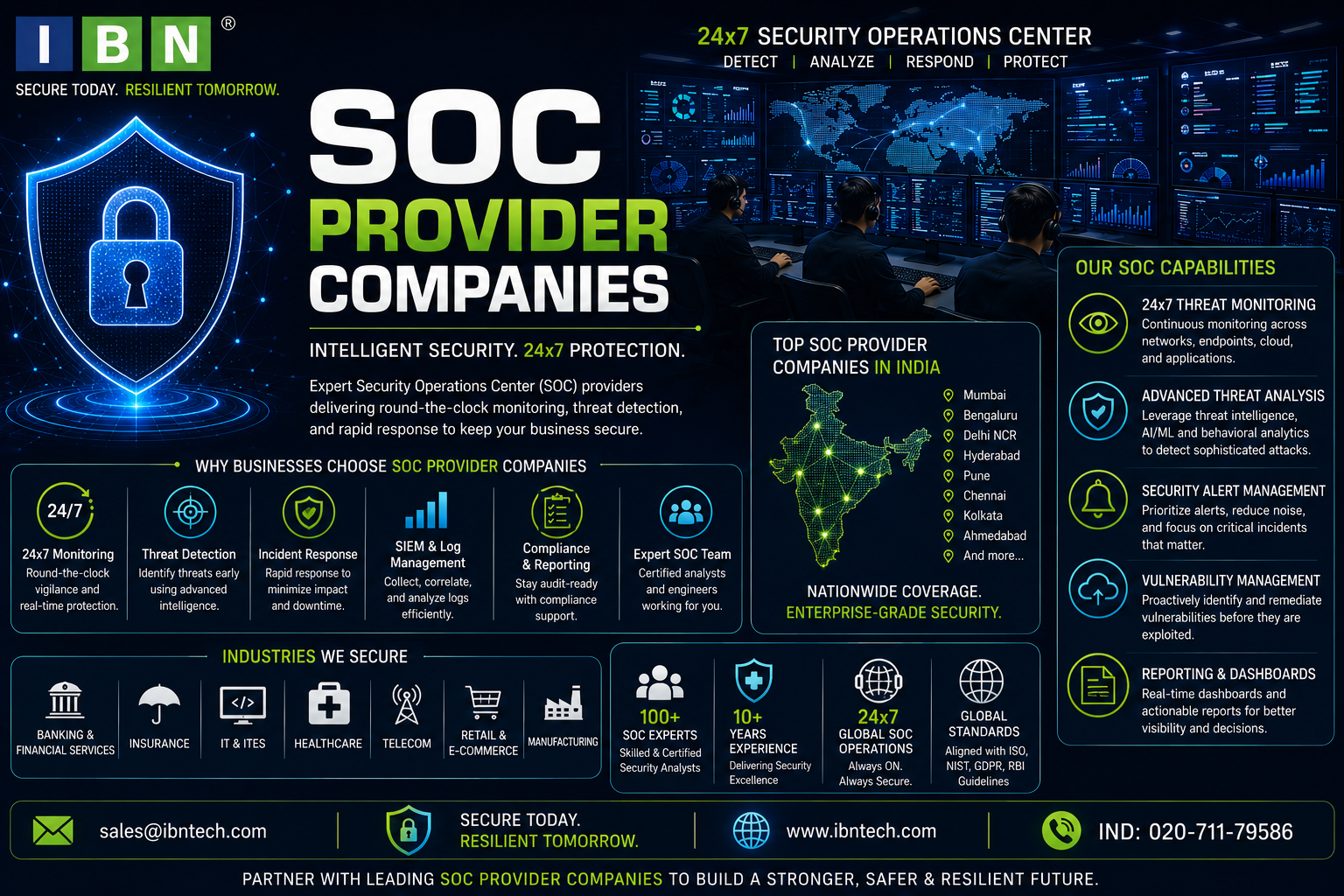
Why Healthcare Organizations Need Smarter SOC Provider Companies
Hospitals, clinics, healthtech businesses, diagnostic providers, and pharmaceutical organizations increasingly depend on digital systems to deliver services. Electronic health records, connected applications, digital patient journeys, remote services, and data-sharing ecosystems create convenience but also expand the security environment.
For healthcare leaders, soc provider companies can provide an important layer of continuous security oversight. Instead of treating cybersecurity as an occasional technical review, organizations can use a managed Security Operations Center to monitor activity, identify suspicious behavior, investigate incidents, and support coordinated response.
The objective is not simply to generate more alerts. It is to protect sensitive information and maintain the availability of systems that healthcare operations depend on.
What Does Healthcare SOC Monitoring Do?
Healthcare SOC monitoring continuously observes security events across relevant IT environments to identify activity that may indicate a cyber threat. Security analysts investigate suspicious events, prioritize incidents, and escalate them according to defined response procedures.
For healthcare organizations, this approach matters because a security incident can affect more than information confidentiality. Disrupted applications, unavailable records, compromised accounts, or interrupted digital services can also interfere with everyday operations.
Why the Indian Healthcare Environment Needs Stronger Security Operations
India's healthcare ecosystem is becoming increasingly digital and interconnected. Healthcare organizations can operate across hospitals, clinics, laboratories, pharmacies, healthtech applications, cloud environments, and third-party platforms.
Healthcare data is also unusually diverse. It can include clinical records, prescriptions, laboratory information, radiological images, patient identifiers, and other sensitive information.
That environment makes continuous visibility more valuable than relying solely on perimeter controls or periodic security assessments.
Where Traditional Healthcare Security Approaches Struggle
Many healthcare organizations operate a mixture of modern cloud services, legacy applications, specialized medical systems, endpoints, third-party platforms, and connected infrastructure.
Security teams may therefore face three simultaneous problems: too much data, too little context, and limited specialist capacity.
Endpoint protection may detect suspicious activity. A firewall may block malicious traffic. Vulnerability assessments may identify weaknesses. But these controls operate within specific security domains.
A SOC brings another layer: ongoing correlation and investigation of security events. It can help connect individual signals into a broader incident picture and provide an escalation mechanism when activity requires deeper investigation.
How to Evaluate a Healthcare SOC Provider
Healthcare leaders should evaluate providers according to the realities of clinical and operational environments rather than generic enterprise checklists.
The first question is visibility. Can the provider monitor the organization's important technology environments and security events?
The next is response. What happens when an alert is considered significant? Who investigates it? Who is contacted? How quickly can the healthcare organization take action?
Governance is equally important. Security monitoring should generate evidence and reporting that security, compliance, technology, and executive stakeholders can understand.
IBN Technologies provides Managed SOC and SIEM services with continuous monitoring, threat detection, incident response, scalable security capabilities, and compliance-oriented reporting. Its healthcare cybersecurity services include SOC and SIEM monitoring alongside VAPT, vCISO, and MDR capabilities.
What Healthcare SOC Provider Companies Should Cover
A healthcare-focused security operations model should account for:
- Patient and organizational data environments
- Identity and privileged access activity
- Endpoints used by clinical and administrative personnel
- Cloud infrastructure and applications
- Security events from relevant network infrastructure
- Suspicious account behavior
- Malware and ransomware indicators
- Vulnerability and exposure information
- Incident escalation and response workflows
- Audit and compliance reporting requirements
The exact monitoring scope should be determined by the organization's architecture, risk assessment, contractual obligations, and applicable regulations.
A Healthcare Use Case: Protecting a Multi-Site Provider
Imagine an Indian healthcare organization operating hospitals and outpatient facilities across several locations. Patient and administrative systems are distributed across sites, while staff use shared applications and cloud services.
An isolated security approach at each facility can make centralized visibility difficult. An incident involving a compromised account could appear insignificant at one location while becoming more serious when viewed alongside activity elsewhere.
A centralized SOC model can provide a common monitoring and investigation function. Suspicious events can be correlated, investigated, and escalated to the organization's designated security and technology teams.
The model is especially useful when the healthcare organization wants continuous security operations without creating a separate SOC capability for every location.
Benefits Healthcare Leaders Should Expect
Continuous visibility: Security teams gain an ongoing mechanism for observing relevant security events rather than depending only on periodic checks.
Improved incident context: Analysts can investigate events and help distinguish routine activity from potentially significant threats.
Operational support: Defined escalation paths can help clinical and technology teams respond more systematically when security incidents occur.
Compliance support: Consistent monitoring and reporting can contribute to evidence and governance processes.
Security scalability: A managed service can adapt as facilities, applications, users, and digital services expand.
IBN Technologies also combines SOC capabilities with VAPT, MDR, vCISO, Microsoft Security, and cybersecurity maturity and risk assessment services, allowing organizations to address monitoring alongside assessment, response, governance, and security improvement.
Healthcare SOC Readiness Checklist
- Identify systems containing or processing sensitive health and personal information.
- Document critical applications whose disruption could affect healthcare operations.
- Map privileged users, service accounts, remote access, and third-party access.
- Define which security events require immediate escalation.
- Establish contacts for security, IT, compliance, and operational leadership.
- Review how logs and security evidence are collected and retained.
- Test incident-response procedures instead of relying only on written policies.
- Connect vulnerability assessment findings with ongoing monitoring priorities.
- Review provider reporting for executive, technical, and audit audiences.
- Reassess monitoring coverage whenever new digital health services or applications are introduced.
Compliance Context for Indian Healthcare
Compliance requirements should be mapped to the organization's specific role, services, data flows, contracts, and jurisdictions.
Healthcare organizations should consider applicable Indian privacy, cybersecurity, digital-health, contractual, and sector-specific requirements when designing security operations. Monitoring, logging, incident response, access controls, and evidence management should support the organization's overall compliance framework.
For organizations serving international patients or customers, additional requirements may also apply depending on the nature and location of the data being processed.
The right soc provider companies should therefore be evaluated as security operations partners rather than simple monitoring vendors. Healthcare leaders should look for continuous visibility, meaningful investigation, disciplined escalation, compliance-aware reporting, and the ability to work alongside existing clinical and technology environments. IBN Technologies' healthcare cybersecurity portfolio combines SOC and SIEM monitoring with VAPT, MDR, vCISO, and broader security capabilities, providing a foundation for organizations seeking a more structured approach to healthcare cyber resilience.
Contact Us:
020-711-79586
IBN Technologies Ltd.
E-mail: - sales@ibntech.com

 English
 Arabic
 French
 Spanish
 Portuguese
 Deutsch
 Turkish
 Dutch
Dutch
 Russian
 Romaian
 Portuguese (Brazil)
 Greek
Greek