


Managed SOC Providers in India: Stronger Healthcare Security
Why Healthcare Organizations Need a Different SOC Strategy
Healthcare security is not simply an IT problem. Hospitals, clinics, healthtech companies, and other providers rely on digital systems for patient records, clinical workflows, communication, billing, scheduling, and connected services. A security incident can therefore affect both sensitive information and day-to-day operations.
For organizations evaluating managed soc providers, the healthcare question is more specific: can the security operation continuously protect sensitive environments while supporting privacy, compliance, and operational continuity?
In India, this matters as healthcare organizations expand digital services while continuing to manage legacy technologies and complex third-party ecosystems. A suitable managed SOC can provide continuous security monitoring while fitting into an organization's existing technology and governance model.
What Is Healthcare SOC Monitoring?
Healthcare SOC monitoring is the continuous observation and analysis of security activity across systems that support healthcare operations. It helps identify suspicious behavior, investigate potential threats, and coordinate an appropriate response.
The objective is not merely to generate alerts. Effective healthcare SOC monitoring connects security telemetry with investigation, response, reporting, and the privacy requirements surrounding sensitive healthcare information.
Why Healthcare Environments Are Hard to Monitor
Healthcare organizations often have a broader technology footprint than a conventional office environment.
Electronic health record systems, practice-management platforms, endpoints, cloud services, networks, security devices, and third-party connections may all form part of the operational environment.
Availability is also critical. Security controls cannot be designed in isolation from clinical and administrative workflows. An investigation or remediation action must consider whether a system supports patient-facing or revenue-critical activity.
Healthcare organizations may also operate with legacy systems that cannot always be modernized quickly. That makes visibility and compensating security controls particularly important.
A managed SOC can help create a consistent monitoring function across this complex environment.
Where Traditional Security Approaches Struggle
A small internal security function may have strong technical knowledge but still lack continuous coverage.
Another organization may own several security tools but have difficulty correlating their alerts. Healthcare teams can also face competing priorities, including audits, access management, vulnerability remediation, infrastructure issues, and incident investigations.
Simply adding another security product does not necessarily solve the operational problem.
A managed SOC addresses the people-and-process layer around security technology by providing continuous monitoring, investigation, threat detection, incident response, and security expertise.
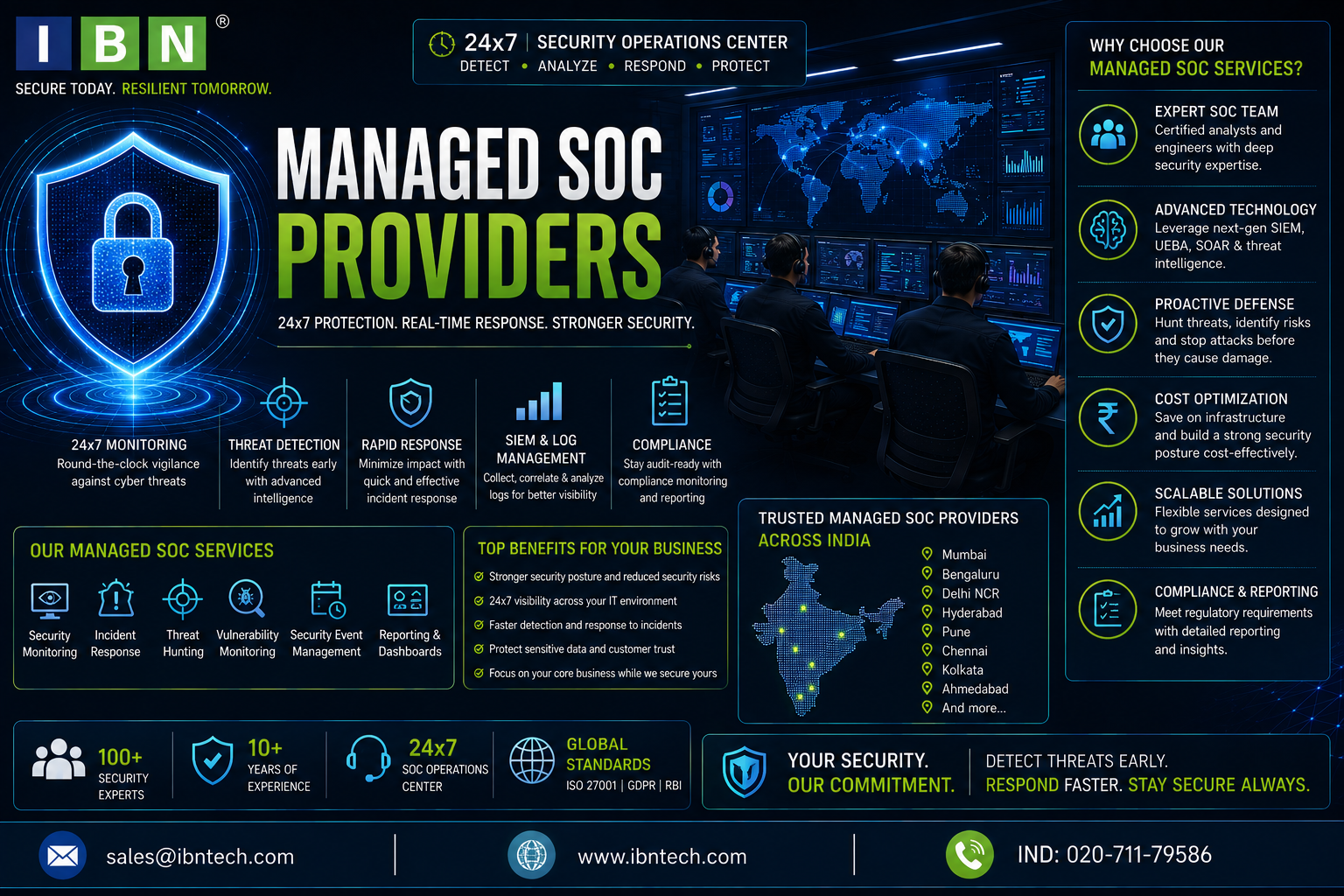
IBN Technologies' Managed SOC and SIEM services include round-the-clock monitoring, threat detection, incident response, threat intelligence, security-device monitoring, vulnerability management, and compliance-driven reporting.
How a Healthcare-Focused Managed SOC Should Operate
A suitable service starts by understanding which healthcare systems are critical and which security events require immediate attention.
Security information can then be centralized through SIEM capabilities, allowing events from relevant systems and security controls to be correlated.
Security analysts can investigate suspicious patterns and determine whether they represent a genuine security concern.
For more proactive protection, Managed Detection and Response can add threat hunting and human-led containment and remediation. IBN Technologies offers MDR as part of its cybersecurity services, alongside managed SOC and SIEM capabilities.
The objective is to create a repeatable security workflow that supports healthcare operations rather than operating separately from them.
The Healthcare SOC Evaluation Checklist
Healthcare executives and security managers should assess providers against these areas:
- Ability to monitor critical healthcare technology continuously
- Understanding of sensitive healthcare information and privacy requirements
- SIEM-based log collection and security-event correlation
- Defined incident investigation and escalation procedures
- Threat intelligence and proactive threat hunting capabilities
- Monitoring of endpoints, networks, firewalls, cloud assets, and other relevant security devices
- Human expertise alongside automated detection
- Audit-ready security reporting
- Support for applicable healthcare compliance requirements
- Clear responsibilities between the provider, IT team, security leadership, and business stakeholders
The provider should also demonstrate how its SOC fits into the healthcare organization's existing security architecture rather than treating monitoring as a standalone service.
The Business Benefits for Healthcare Leaders
A managed SOC can help healthcare organizations establish security coverage without making continuous internal staffing the only path to round-the-clock monitoring.
For CIOs and CTOs, this can mean greater visibility into security activity across a distributed technology environment.
For CISOs and security managers, it can provide additional analyst capacity for investigation, threat hunting, and response.
Compliance teams can benefit from structured security evidence and reporting. A centralized monitoring model can make it easier to maintain consistent security records and investigate incidents when evidence is required.
The broader business benefit is resilience. Security operations become an ongoing function rather than an activity that begins only after a major incident.
A Healthcare Use Case
Imagine a multi-location healthcare provider using an EHR environment alongside cloud applications, endpoints, network infrastructure, and practice-management systems.
An unusual login pattern appears alongside other anomalous activity.
Without centralized monitoring, individual alerts may remain separated across different systems. With a managed SOC, relevant events can be brought together for investigation, allowing security analysts to assess the wider context.
If the activity indicates a genuine threat, the response process can involve appropriate internal stakeholders and remediation actions while maintaining an evidence trail for later review.
The value is not that every alert becomes an emergency. It is that suspicious activity receives structured attention before it becomes an unmanaged operational problem.
Compliance Must Be Designed Into the SOC
Healthcare organizations should avoid treating compliance as a separate documentation exercise.
India's data-protection environment, contractual requirements, sector expectations, and international obligations can create overlapping responsibilities. Organizations dealing with international healthcare information may also have obligations such as HIPAA, depending on their role and the data involved.
IBN Technologies' cybersecurity and compliance services address frameworks and requirements including DPDPA, ISO 27001, HIPAA, SOC 2, PCI DSS, GDPR, RBI, SEBI, and IRDAI, where applicable.
A managed SOC can support compliance through continuous monitoring, centralized security information, incident documentation, and audit-oriented reporting.
However, compliance depends on the organization's complete control environment, policies, contracts, governance, and implementation—not on SOC monitoring alone.
Security Practices Healthcare Organizations Should Prioritize
Healthcare organizations should keep the operating model focused on practical security fundamentals:
- Know which systems contain or access sensitive healthcare information
- Prioritize monitoring around critical clinical and business systems
- Establish clear incident severity and escalation criteria
- Integrate security monitoring with existing infrastructure where practical
- Review security logs and alerts continuously rather than periodically
- Maintain documented incident-response procedures
- Connect security monitoring with vulnerability and risk-management activities
- Preserve appropriate evidence for investigations and audits
- Review third-party and cloud dependencies as part of the security picture
- Reassess monitoring coverage as healthcare technology changes
A broader cybersecurity program can also combine SOC monitoring with services such as VAPT, cybersecurity maturity and risk assessment, compliance management, and managed detection and response.
For healthcare organizations, choosing managed soc providers should ultimately be about more than 24/7 alert monitoring. The right partner should understand sensitive data, operational continuity, healthcare technology, incident response, and compliance expectations. For Indian hospitals, clinics, and healthtech businesses, a managed SOC can become a practical security layer that strengthens visibility and response while supporting a broader, compliance-focused cybersecurity strategy.
Contact Us:
020-711-79586
IBN Technologies Ltd.
E-mail: - sales@ibntech.com

 English
 Arabic
 French
 Spanish
 Portuguese
 Deutsch
 Turkish
 Dutch
Dutch
 Italiano
 Romaian
 Portuguese (Brazil)
 Greek
Greek