


Managed SIEM Providers in India: Safer Healthcare Security
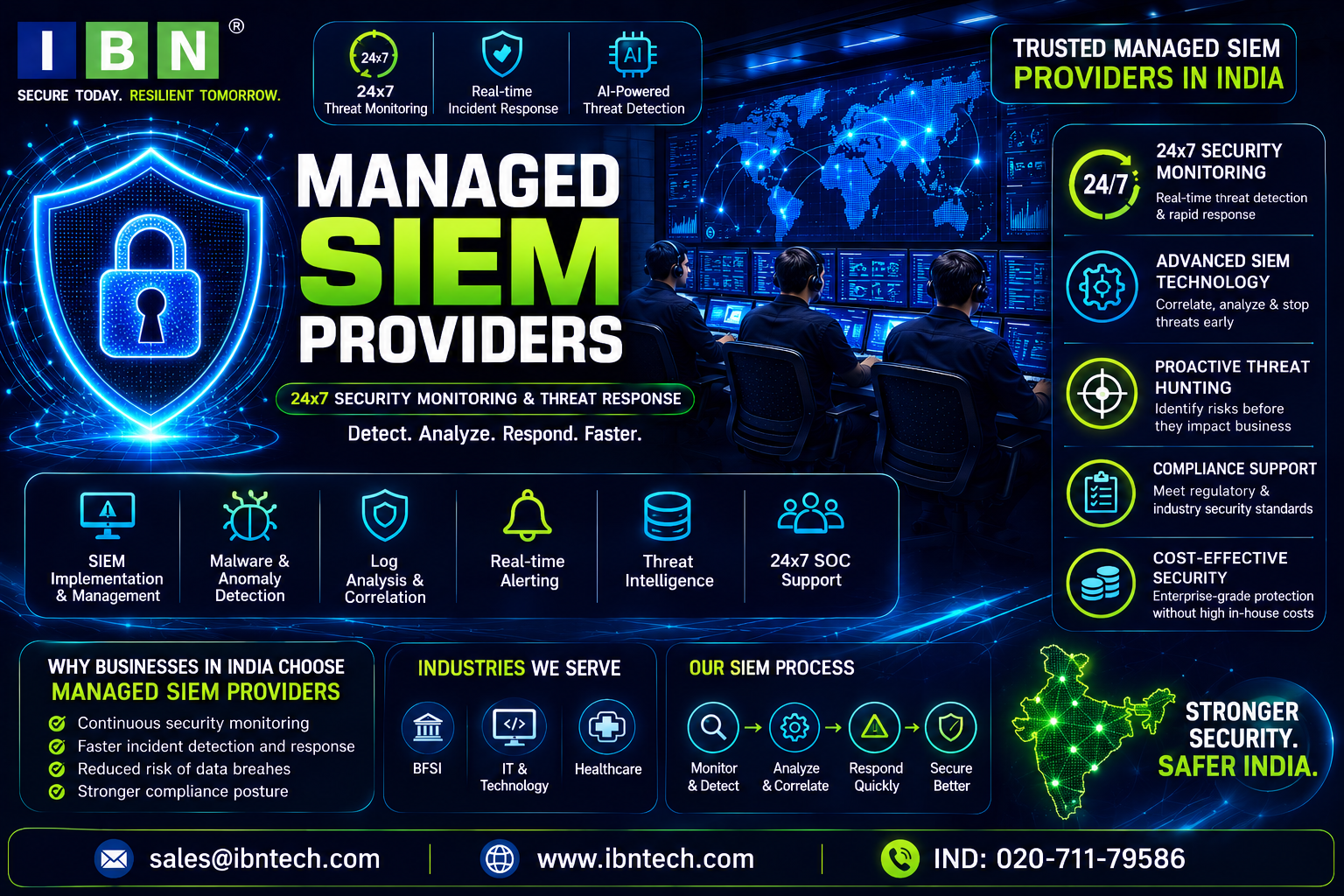
Why Healthcare Organizations Need Managed SIEM
Healthcare organizations generate and process highly sensitive information while depending on technology for clinical, administrative, and financial operations. Electronic health records, practice-management platforms, cloud applications, endpoints, networks, and connected systems all create security events that can be difficult to monitor independently.
For healthcare leaders evaluating managed siem providers, the central question is not simply whether a SIEM can collect logs. It is whether the organization can turn security information into timely visibility, investigation, response, and compliance evidence.
A managed SIEM can provide that operational layer by centralizing relevant security information and supporting continuous monitoring through security professionals.
What Is Healthcare SIEM Monitoring?
Healthcare SIEM monitoring is the continuous collection, analysis, and correlation of security information from systems used by a healthcare organization. It helps security teams identify unusual activity, investigate potential incidents, and support appropriate response.
For healthcare providers, the value of SIEM is especially connected to context. A suspicious authentication event, endpoint anomaly, or unusual network activity may become more significant when considered alongside other events involving the same user, system, or application.
This makes centralized security visibility important for organizations managing sensitive information and operationally important technology.
Why Indian Healthcare Organizations Need Better Visibility
Indian hospitals, clinics, healthtech businesses, and other healthcare organizations are adopting increasingly digital operating models.
At the same time, many healthcare environments must continue supporting existing applications, legacy systems, third-party services, and geographically distributed operations.
Security teams therefore face a visibility problem as much as a technology problem.
An organization may have endpoint security, firewalls, cloud controls, identity systems, and other protective technologies, yet still struggle to understand what is happening across the complete environment.
A managed SIEM can bring relevant security information together so that events can be reviewed as part of a wider picture.
The Risk of Treating Logs as a Compliance Exercise
Collecting logs is not the same as monitoring them effectively.
Healthcare organizations may retain substantial amounts of security information without having enough time or expertise to analyze it continuously. Important events can become buried within routine activity.
This is particularly challenging when IT teams are also responsible for application availability, infrastructure support, user access, system upgrades, and day-to-day healthcare technology operations.
An outsourced SIEM service can provide additional operational capacity without requiring the healthcare organization to build every component of a dedicated security monitoring function internally.
What Healthcare Leaders Should Expect From a Managed SIEM
A healthcare-focused evaluation should begin with data visibility.
The provider should understand which systems are important, what security information they generate, and which events should receive priority.
IBN Technologies' Managed SIEM and SOC services include cloud-based log management and real-time threat correlation, alongside continuous monitoring, threat detection, incident response, threat intelligence, and security-device monitoring.
The service can support cloud and on-premise environments, allowing organizations to build monitoring around their existing technology landscape.
For more proactive defense, IBN Technologies also provides Managed Detection and Response, combining AI-assisted threat hunting with human-led containment and remediation.
This combination can help healthcare security teams move from passive log collection toward active security operations.
What Makes a Healthcare SIEM Strategy Effective?
Healthcare organizations should evaluate a managed SIEM according to the risks and workflows of their environment.
A useful service should provide visibility without creating unnecessary operational complexity. It should also support security investigations without ignoring the importance of system availability and healthcare operations.
The provider should be able to explain how it handles alert prioritization, investigation, escalation, reporting, and integration with existing technologies.
Security leaders should also establish clear boundaries between the provider and internal teams. The managed service can support detection and investigation, but organizational leadership still needs ownership of risk decisions, policies, business priorities, and regulatory responsibilities.
Benefits for Healthcare CIOs and CISOs
The most immediate benefit of managed SIEM is centralized security visibility.
Instead of reviewing separate security consoles, teams can work from correlated information that provides greater context around suspicious activity.
Another benefit is operational consistency. Monitoring and investigation can follow defined procedures instead of depending entirely on whether an internal employee is available at a particular moment.
Healthcare organizations can also gain additional security expertise without making recruitment and retention the only way to expand monitoring capability.
For leadership teams, structured reporting can make security activity easier to communicate to executives, compliance stakeholders, and other decision-makers.
A Healthcare Use Case
Consider a healthcare organization operating across several locations.
Its environment includes patient-management applications, cloud services, employee endpoints, network security controls, and systems supporting administrative functions.
An employee account begins showing unusual access behavior. Separately, an endpoint associated with the same user generates another security event.
If these events are reviewed independently, each may appear relatively minor. Centralized SIEM monitoring can provide the context needed to connect related activity and determine whether further investigation is warranted.
A security analyst can review the broader event pattern, escalate the incident according to defined procedures, and coordinate with the healthcare organization's internal stakeholders.
This approach helps the organization respond based on evidence rather than isolated alerts.
Healthcare SIEM Evaluation Checklist
Before engaging a provider, healthcare security teams should confirm that:
- Critical healthcare applications and infrastructure can be monitored
- Relevant cloud and on-premise systems are supported
- Security events can be centrally collected and correlated
- Monitoring responsibilities are clearly defined
- High-priority incidents have documented escalation paths
- Analysts are available to investigate meaningful alerts
- Existing security technologies can be integrated
- Threat intelligence and proactive threat hunting are available where required
- Security and compliance reporting is provided
- Data-handling and privacy expectations are clearly addressed
- The service can adapt as healthcare technology changes
The organization should also establish which events require immediate attention and which can be handled through routine investigation.
Compliance and Healthcare Data Protection
Healthcare security has a strong compliance dimension because organizations may handle sensitive patient and personal information.
IBN Technologies' managed SIEM and SOC services identify HIPAA, GDPR, PCI-DSS, and ISO 27001 among supported compliance frameworks. Its healthcare practice also identifies ISO 27001:2022, SOC 2 Type II, and HIPAA within its stated certifications and compliance credentials.
For Indian organizations, the broader regulatory environment can also involve requirements such as DPDPA, CERT-In, and other applicable obligations depending on the organization's activities and data.
A SIEM can support compliance by providing centralized security information, monitoring, reporting, and evidence. It does not, however, replace a complete compliance program.
Healthcare organizations still need appropriate governance, policies, access controls, risk assessments, contractual safeguards, incident procedures, and other controls required by their obligations.
Building a Stronger Healthcare Security Operation
The most effective healthcare SIEM strategy begins with knowing what needs protection.
Organizations should identify critical systems, sensitive information, important users, external dependencies, and security events that could indicate compromise. Monitoring should then be aligned with those priorities rather than attempting to treat every log equally.
Regular review is equally important. As healthcare applications move to the cloud, new connected services are introduced, or business processes change, SIEM coverage should be reassessed.
This keeps security monitoring aligned with the actual technology environment rather than the environment as it existed when the SIEM was first deployed.
For healthcare organizations assessing managed siem providers, the right partner should offer more than centralized log collection. It should provide a practical combination of monitoring, correlation, threat detection, investigation, response support, security expertise, and compliance-oriented reporting. For Indian healthcare providers, that operating model can strengthen visibility across complex digital environments while helping security and IT leaders protect sensitive information and maintain greater confidence in their security posture.
Contact Us:
020-711-79586
IBN Technologies Ltd.
E-mail: - sales@ibntech.com

 English
 Arabic
 French
 Spanish
 Portuguese
 Deutsch
 Turkish
 Dutch
Dutch
 Russian
 Romaian
 Portuguese (Brazil)
 Greek
Greek