


Steel Rebar Producers Adapt to Changing Construction and Supply Trends
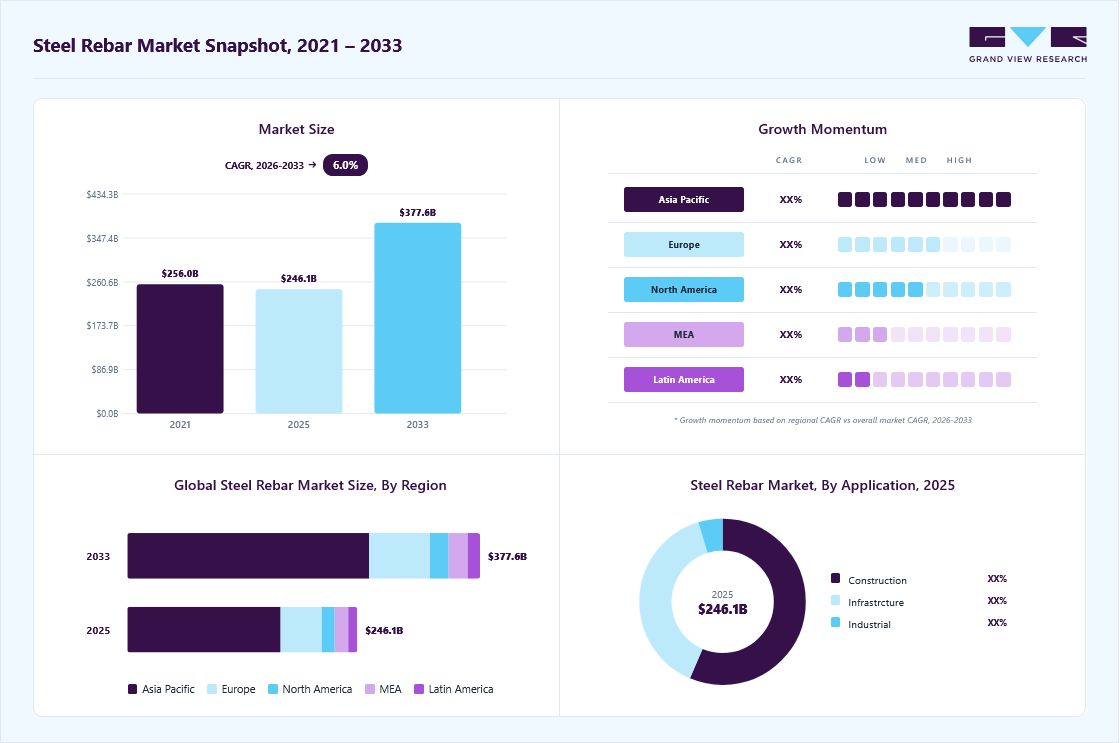
The steel rebar market is entering a sustained growth phase as infrastructure development, construction activity, urbanization, and industrial expansion continue to generate demand for reinforcing steel. The market size was valued at USD 246.1 billion in 2025 and is projected to increase from USD 250.9 billion in 2026 to USD 377.6 billion by 2033, registering a CAGR of 6.0% from 2026 to 2033. Steel rebar plays an essential role in reinforced concrete structures by improving tensile strength, structural integrity, and durability across infrastructure, residential, commercial, and industrial applications.
Asia Pacific remains the dominant regional market, accounting for 66.7% of revenue in 2025. The region is also identified as the fastest-growing regional market, with a CAGR of 6.4% from 2026 to 2033. Rapid urbanization, population growth, housing development, transportation projects, industrial corridors, and government-led infrastructure programs are supporting long-term rebar consumption across countries including China, India, Indonesia, and Vietnam.
Current Market Dynamic & Pricing (August 2026)
Steel rebar prices strengthened during 2026 amid geopolitical tensions, higher energy expenses, and disruptions affecting trade routes. Increased freight charges, marine insurance premiums, and fuel costs contributed to higher logistics expenses, while elevated oil, natural gas, and electricity prices affected the economics of energy-intensive steel production.
China's rebar prices remained approximately within the USD 460-480 per ton range during the first quarter of 2026. Despite relatively weak real estate activity, prices strengthened as controlled steel production, declining inventories, rising raw material costs, and tighter market availability supported the market. Disruptions to steel operations and exports in the Middle East also contributed to tighter regional supply conditions.
China's Slowdown
China remains the largest consumer and producer of steel rebar, but its market is transitioning from rapid expansion toward a more stable growth phase. The focus is increasingly shifting toward high-quality infrastructure, urban redevelopment, environmental compliance, production rationalization, and capacity controls. These changes are influencing long steel supply dynamics while reducing the dependence of future growth on rapid real estate expansion.
India's Turnaround
India represents an important source of steel demand as infrastructure investment, housing development, highways, railways, smart cities, and industrial corridors support consumption. The country reported a ~10.7% year-on-year increase in crude steel production to 168.4 million tons for FY 2025-26. Rising upstream steel availability supports the consumption of long steel products such as rebar. Capacity expansion by major producers is also expected to strengthen the supply of construction-grade steel.
Key Market Segmentations
By application, construction held the largest share, accounting for 56.3% of the market in 2025. Rebar is extensively used in foundations, columns, slabs, and structural frameworks, making construction a core source of demand. Meanwhile, the infrastructure segment is expected to register the highest CAGR, supported by investments in highways, railways, bridges, ports, energy systems, urban connectivity, and smart city projects. The market is segmented into infrastructure, construction, and industrial applications.
Competitive Landscape
The steel rebar market features major producers competing through capacity expansion, product development, operational efficiency, and decarbonization initiatives. Key companies profiled include ArcelorMittal, Jiangsu Shagang Group, JSW Steel, Nippon Steel Corporation, NLMK, Nucor, POSCO Holdings Inc., Steel Authority of India Limited (SAIL), Steel Dynamics, Inc., and Tata Steel. Recent investments in long steel capacity, rebar production, electric arc furnaces, and low-carbon steel technologies demonstrate the industry's focus on meeting construction demand while improving production efficiency and environmental performance.
Overall, infrastructure spending, construction growth, urbanization, and investments in transportation and industrial facilities are expected to keep steel rebar demand on an upward trajectory. With the market projected to reach USD 377.6 billion by 2033, manufacturers are likely to focus increasingly on capacity expansion, high-strength products, efficient production, and lower-carbon steelmaking to capture emerging opportunities.
Key Steel Rebar Companies:
· ArcelorMittal
· Jiangsu Shagang Group
· JSW Steel
· Nippon Steel Corporation
Explore our dedicated business services:
· Brainshare Consulting – End-to-end business consulting services including Opportunity assessment, GTM support, Competitive intelligence, and Consumer Analytics.
· Custom Research – Get a market intelligence report tailored to your specific requirements and aligned with your business goals.
· Consumer Insights – Capture real, evolving consumer sentiment and behavior to help you make data driven strategies.
· Horizon Databooks – Access the world’s largest portal of Market Reports & Statistics
· Investment Insights – Make investment decisions with data driven insights, powered by domain and technology
· Signal (Pricing Intelligence) - Commodity price intelligence to drives strategic advantage.
About us:
Grand View Research, a market research and consulting company, provides syndicated research reports, customized research reports, and consulting services. Grand View Research database is used by the world's renowned academic institutions and Fortune 500 companies to understand the global and regional business environment. Our database features thousands of statistics and in-depth analysis on 46 industries in 25 major countries worldwide.

 English
 Arabic
 French
 Spanish
 Portuguese
 Deutsch
 Turkish
 Dutch
Dutch
 Italiano
 Russian
 Portuguese (Brazil)
 Greek
Greek