


Managed SOC Service Providers: Stronger Healthcare Security in India
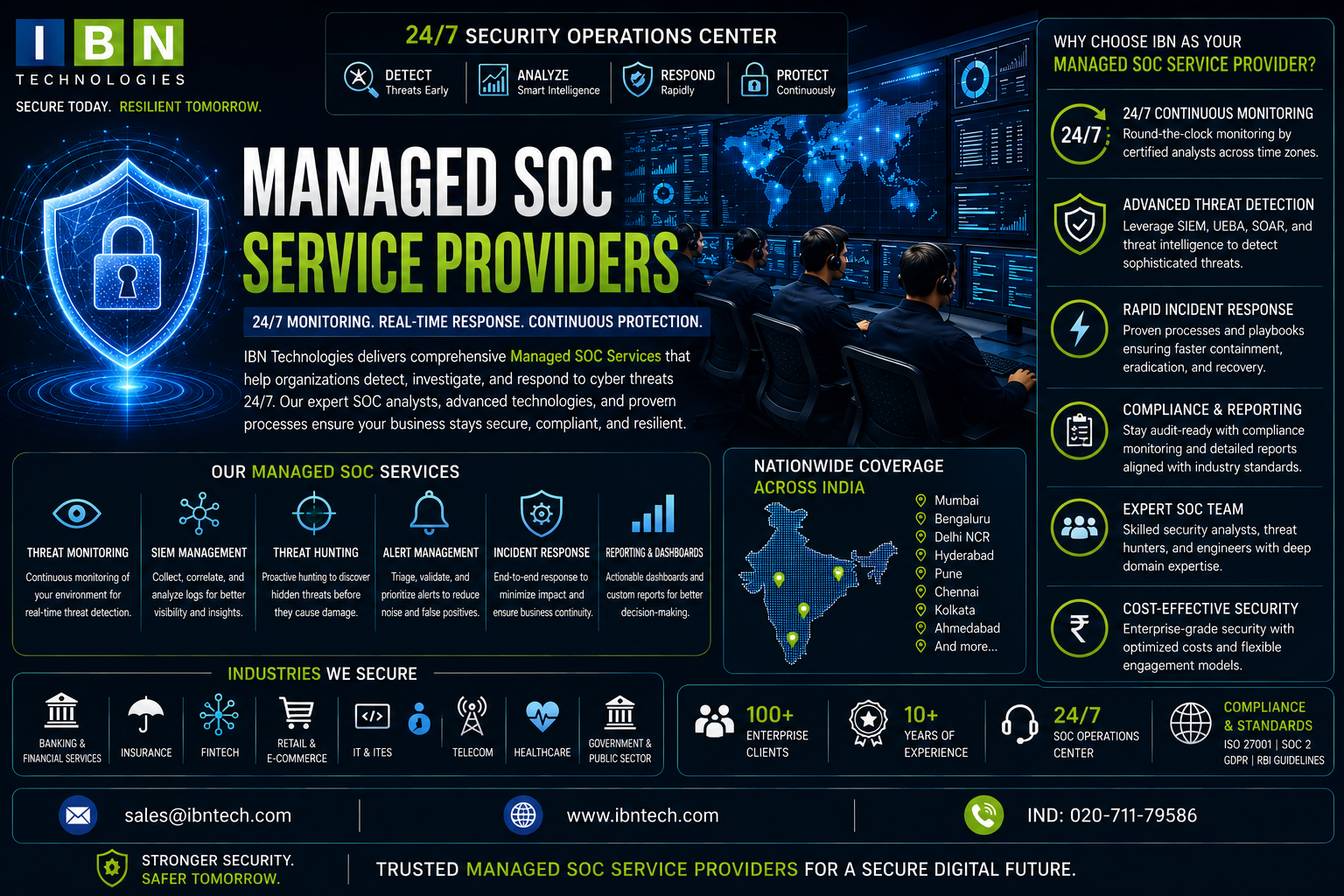
Why managed soc service providers matter for healthcare
Managed soc service providers help healthcare organizations maintain continuous security monitoring and coordinated threat response across digital environments. A managed SOC combines security monitoring, threat analysis, incident investigation, and response support so that security operations do not depend entirely on an internal team being available at a particular time.
For hospitals, clinics, healthtech companies, and other healthcare organizations, this matters because digital systems support both administrative and patient-facing activities.
A security incident can affect sensitive information, applications, user accounts, connected systems, and operational continuity at the same time.
Healthcare cybersecurity is also an operational issue
Healthcare organizations face a different risk profile from many conventional businesses.
Patient information requires strong protection. At the same time, clinical and administrative systems need to remain available for authorized users.
Threats such as ransomware, phishing, credential compromise, unauthorized access, and exploitation of legacy technology can therefore create security and operational concerns simultaneously.
IBN Technologies identifies healthcare cybersecurity challenges including data-breach risks involving protected health information, HIPAA compliance complexity, ransomware threats, and legacy-system vulnerabilities.
This environment makes continuous monitoring increasingly important.
Why healthcare teams can struggle with security coverage
Healthcare IT environments can be complex.
A single organization may operate electronic health applications, patient portals, financial systems, employee devices, cloud platforms, medical technology, legacy applications, and third-party services.
These systems may produce security events continuously.
Internal security teams must determine which events require investigation and which represent normal activity. They may also have to support IT operations, access management, vulnerability remediation, compliance requests, and incident response.
That workload can make continuous security coverage difficult.
A managed SOC can provide additional operational capacity without requiring the healthcare organization to build every SOC function internally.
What healthcare organizations should expect
A capable healthcare SOC should provide more than an alert dashboard.
The service should establish a repeatable process for observing security activity, identifying suspicious behavior, investigating relevant events, escalating incidents, and documenting actions.
IBN Technologies' SOC and SIEM services include continuous monitoring, threat intelligence, incident response, compliance-oriented reporting, security-device monitoring, and vulnerability management.
Its healthcare-focused cybersecurity offering also includes 24/7 SOC and SIEM monitoring and VAPT services.
For healthcare leaders, the central question should be whether the provider can translate security signals into meaningful action.
Healthcare SOC services and patient-data protection
Healthcare SOC services can support patient-data protection by providing continuous visibility into security events involving relevant systems.
For example, an unusual login to a system containing sensitive information may not automatically indicate a breach. However, when combined with abnormal device activity, suspicious authentication patterns, or other indicators, it may deserve immediate investigation.
A SOC can help establish the process for identifying these relationships.
This does not replace access controls, encryption, secure configuration, vulnerability management, backups, or employee awareness. Instead, it adds an operational layer for detecting and responding to potential security incidents.
Choosing a provider: the healthcare perspective
Healthcare organizations should evaluate providers according to their own technology and compliance environment.
|
Evaluation area |
Healthcare leadership should assess |
|
Sensitive systems |
Can the provider monitor systems relevant to patient and business information? |
|
Continuous coverage |
Is security monitoring designed to operate around the clock? |
|
Incident handling |
Are investigation and escalation procedures clearly defined? |
|
Vulnerability management |
Can monitoring be complemented by vulnerability assessment? |
|
Compliance |
Can reporting support applicable governance and audit requirements? |
|
Third parties |
Can the organization account for external access and connected services? |
|
Legacy technology |
Can security monitoring accommodate older systems where appropriate? |
|
Reporting |
Can security information be communicated to both technical and executive stakeholders? |
This approach helps healthcare leaders evaluate a provider based on operational requirements instead of marketing terminology.
How managed SOC operations can strengthen healthcare resilience
One important benefit is continuity of security oversight.
Healthcare organizations may operate at all hours, but internal security staffing may not provide identical coverage throughout the day and night.
A managed SOC can provide a dedicated monitoring function that remains active beyond normal business schedules.
Another benefit is access to security expertise. Healthcare organizations do not necessarily need to recruit a large internal SOC team to obtain specialist monitoring and investigation capabilities.
A managed model can also support scalability as applications, users, locations, and cloud services change.
A healthcare use case
Imagine a growing Indian healthtech organization that operates a patient portal and supporting administrative systems.
Employees access internal applications remotely, while external service providers connect to selected systems.
An employee account begins generating authentication activity that differs from its normal pattern. Around the same period, another endpoint produces a security alert.
Rather than treating each event separately, a SOC can investigate the relationship between the signals.
If the activity indicates a credible threat, the incident can be escalated according to the organization's established response process.
This type of coordinated investigation can be particularly valuable when healthcare organizations have limited internal security resources but cannot afford gaps in security oversight.
Healthcare security checklist
Healthcare leaders considering a managed SOC should make sure they:
- Identify critical clinical and administrative systems
- Map systems containing sensitive information
- Review privileged and third-party access
- Establish incident severity definitions
- Document escalation contacts
- Define provider and internal-team responsibilities
- Review monitoring coverage as systems change
- Combine security monitoring with vulnerability assessment
- Maintain appropriate incident records
- Test response procedures periodically
- Include cybersecurity within business-continuity planning
A managed SOC should strengthen the existing security program rather than become its only security control.
Compliance should be considered from the beginning
Healthcare organizations often operate under multiple security and privacy expectations depending on their services, customers, jurisdictions, and information flows.
IBN Technologies' healthcare and pharmaceutical offering identifies ISO 9001:2015, ISO 27001:2022, SOC 2 Type II, and HIPAA within its certifications and compliance information.
Its healthcare cybersecurity offering also addresses HIPAA-related requirements, PHI protection, ransomware risk, and legacy-system vulnerabilities.
For Indian organizations, applicable privacy and regulatory obligations should be assessed according to the organization's role and data-processing activities. The Digital Personal Data Protection Act, 2023 is also relevant to organizations covered by its provisions.
A managed SOC does not itself establish regulatory compliance. However, monitoring, incident records, security reporting, and defined response procedures can support a broader compliance and governance program.
Building a sustainable healthcare security model
The best managed SOC relationship should fit naturally into the healthcare organization's existing IT, security, compliance, and operational structure.
Healthcare leaders should therefore assess more than technology.
They should examine the provider's monitoring approach, incident-handling process, reporting model, integration capabilities, vulnerability-management options, and ability to work with internal stakeholders.
For Indian healthcare organizations, managed soc service providers can offer a practical way to strengthen continuous security operations without requiring every organization to build a full SOC internally. With sensitive information, connected applications, and operationally important systems requiring protection, a managed SOC can provide the ongoing visibility, investigation, escalation, and response support needed to build a more resilient healthcare security program.
Contact Us:
020-711-79586
IBN Technologies Ltd.
E-mail: - sales@ibntech.com

 English
 Arabic
 French
 Spanish
 Portuguese
 Deutsch
 Turkish
 Dutch
Dutch
 Italiano
 Russian
 Portuguese (Brazil)
 Greek
Greek