


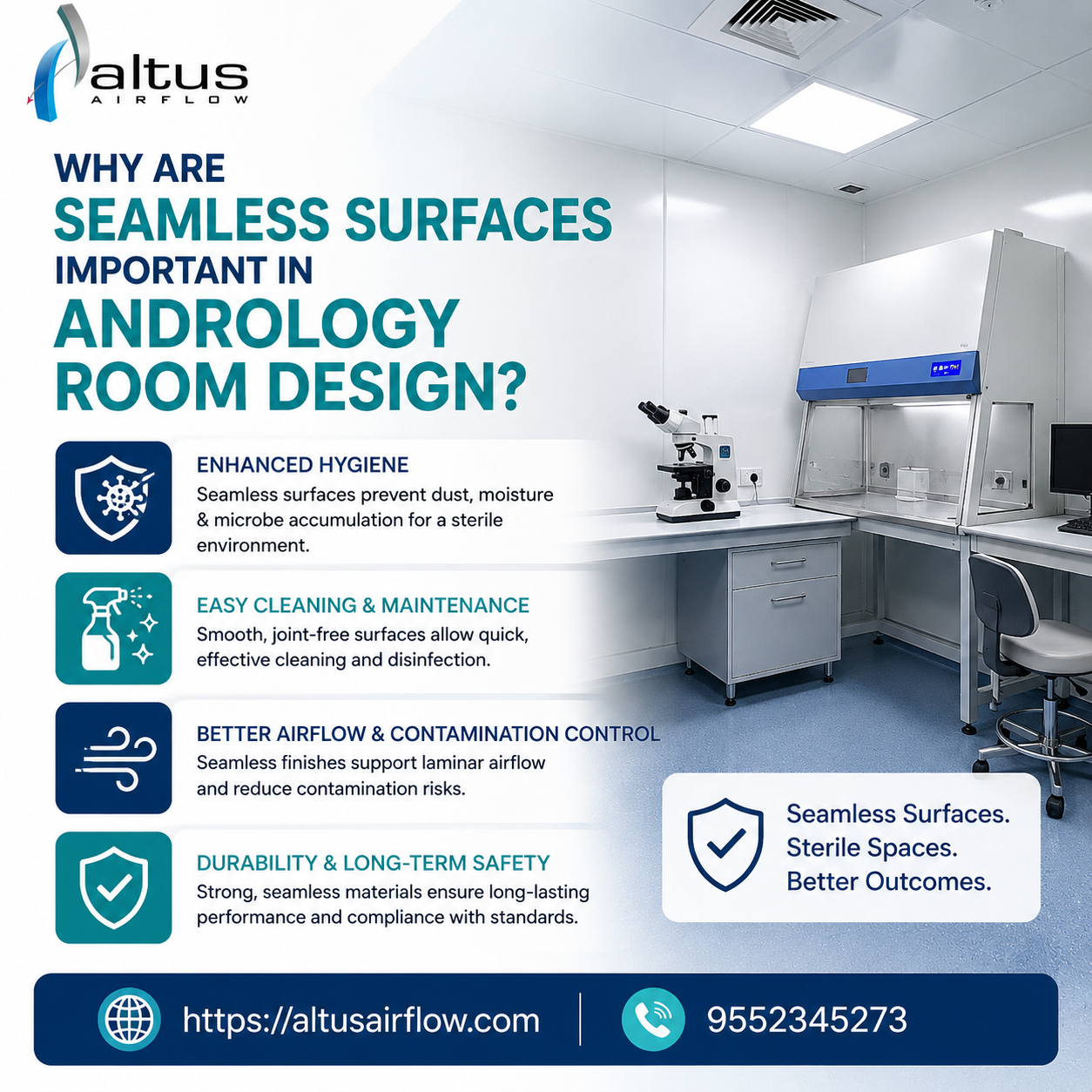
Why Are Seamless Surfaces Important in Andrology Room Design?
Introduction
Andrology Room Design requires careful attention to hygiene, contamination control, workflow, environmental stability, and easy maintenance. Altus Airflow provides specialized healthcare infrastructure solutions that can incorporate seamless wall, ceiling, and flooring systems into controlled laboratory environments. Seamless surfaces are particularly important because they reduce unnecessary joints, gaps, and difficult-to-clean areas where dust, particles, microorganisms, or laboratory residues could accumulate.
Andrology rooms are specialized spaces used for activities such as semen sample collection, handling, preparation, examination, and related laboratory procedures. Since these activities require controlled and hygienic conditions, the room's interior materials should support established cleaning and infection-control procedures.
Traditional construction materials may contain multiple joints, porous areas, uneven transitions, or exposed gaps. These characteristics can make cleaning more difficult and may increase maintenance requirements. Seamless healthcare-grade surfaces provide a smoother and more coordinated interior environment.
This article explains why seamless surfaces are important, where they can be used, how they support hygiene and maintenance, and what factors should be considered when selecting them for an andrology room.
What Are Seamless Surfaces?
Seamless surfaces are interior surfaces designed with minimal visible joints, gaps, or discontinuities.
They can be incorporated into:
- Walls
- Ceilings
- Floors
- Corners
- Door interfaces
- Service areas
- Work surfaces
The objective is to create surfaces that are smooth, durable, cleanable, and suitable for the intended laboratory environment.
A truly seamless system depends on the materials, installation method, joint treatment, sealants, and detailing used throughout the room.
Why Hygiene Matters in Andrology Rooms
Andrology laboratories require controlled handling of biological samples and laboratory materials. Maintaining a clean environment is therefore an important part of facility operation.
Interior surfaces should support routine cleaning and disinfection procedures.
Poorly detailed surfaces can create:
- Difficult-to-clean joints
- Dust accumulation points
- Moisture traps
- Damaged edges
- Areas requiring frequent repair
Seamless construction can reduce some of these challenges by providing smoother transitions.
Reduced Dust and Particle Accumulation
Joints and gaps can collect dust and airborne particles over time.
In a controlled laboratory environment, minimizing unnecessary ledges and openings can simplify routine housekeeping.
Smooth wall and ceiling systems can make it easier for cleaning personnel to wipe surfaces thoroughly.
However, surface design should always work together with appropriate HVAC, filtration, cleaning protocols, and laboratory procedures.
Easier Cleaning
One of the major advantages of seamless surfaces is easier cleaning.
A smooth surface allows cleaning personnel to work across larger areas without having to navigate numerous joints.
Suitable surfaces can support:
- Regular wiping
- Disinfection
- Spill cleanup
- Routine housekeeping
- Periodic deep cleaning
The selected material should be compatible with the cleaning and disinfecting agents used by the facility.
Improved Contamination Control
Contamination control depends on several factors rather than one building component.
These can include:
- HVAC systems
- HEPA filtration
- Airflow management
- Personnel practices
- Cleaning procedures
- Equipment hygiene
- Interior materials
Seamless surfaces contribute by reducing locations where contaminants could potentially accumulate.
They should therefore be considered as part of an overall contamination-control strategy.
Seamless Wall Systems
Walls are among the most important surfaces in an andrology room.
Healthcare-grade modular wall panels can provide smooth, durable surfaces with controlled joints.
Important characteristics may include:
- Smooth finish
- Easy cleaning
- Moisture resistance
- Chemical resistance
- Durable coating
- Proper joint sealing
Wall systems should be installed accurately to minimize gaps and uneven transitions.
Seamless Flooring
Flooring receives significant attention because it is exposed to frequent foot traffic, cleaning, equipment movement, and occasional spills.
Suitable flooring can include healthcare-grade sheet flooring or other systems designed for controlled environments.
Important characteristics may include:
- Minimal joints
- Chemical resistance
- Easy cleaning
- Durability
- Slip resistance
- Appropriate static-control properties where required
Flooring should be properly bonded and detailed at wall transitions.
Coved Floor-to-Wall Transitions
A coved transition extends the flooring material partially up the wall rather than creating a sharp 90-degree corner.
This design can help reduce difficult-to-clean corners.
Potential benefits include:
- Easier cleaning
- Reduced dirt accumulation
- Improved surface continuity
- Better maintenance
The cove should be properly installed and sealed to prevent gaps or lifting.
Seamless Ceiling Systems
Ceilings can also contribute to a hygienic room environment.
A modular ceiling system may provide smooth, cleanable surfaces while accommodating:
- HEPA filtration
- Lighting
- Air distribution
- Inspection access
- Sensors
- Other services
Ceiling panels should be properly aligned and sealed according to the design requirements.
Sealed Joints and Connections
Seamless construction does not necessarily mean that a room has absolutely no joints. Modular systems naturally require connections between panels and components.
The important factor is how those joints are designed and sealed.
Appropriate joint treatment can help provide:
- Smooth transitions
- Reduced gaps
- Easier cleaning
- Better environmental separation
- Improved appearance
Sealants should be compatible with the surrounding materials and cleaning chemicals.
Chemical Resistance
Andrology rooms may require regular use of cleaning and disinfecting chemicals.
Surface materials should therefore be selected for compatibility with the facility's cleaning program.
Chemical-resistant surfaces can help reduce:
- Discoloration
- Surface degradation
- Cracking
- Premature replacement
The manufacturer should provide appropriate material information for the cleaning agents intended for use.
Moisture Resistance
Moisture can contribute to deterioration if it enters joints, substrates, or wall systems.
Seamless and properly sealed surfaces can help reduce opportunities for moisture penetration.
This is particularly relevant in areas that undergo frequent cleaning.
Material selection should consider the room's environmental conditions and cleaning practices.
Durability and Long-Term Performance
Andrology rooms may operate continuously and require frequent cleaning.
Interior materials should therefore be durable enough to withstand routine use.
Quality surfaces can help reduce the frequency of:
- Repairs
- Repainting
- Joint replacement
- Surface restoration
Durability should be evaluated together with installation quality and maintenance requirements.
Supporting Laboratory Workflow
Interior design should not only focus on appearance.
Smooth, well-coordinated surfaces can support laboratory workflow by making routine cleaning and housekeeping more efficient.
An appropriately designed room can provide clear separation between:
- Sample collection
- Sample handling
- Laboratory work
- Storage
- Cleaning areas
Surface selection should complement the functional zoning of the facility.
Integration With HVAC Systems
Seamless surfaces should be coordinated with HVAC and airflow infrastructure.
Walls and ceilings need appropriate openings for:
- Air supply
- Return air
- HEPA modules
- Sensors
- Access panels
Poorly sealed penetrations can affect the performance of a controlled environment.
Therefore, HVAC and interior systems should be coordinated during the design stage.
Integration With HEPA Filtration
Where HEPA filtration is required, filter modules may be incorporated into the ceiling or air-handling system.
The surrounding ceiling should be properly detailed to accommodate:
- Filter housings
- Sealing
- Access
- Air distribution
HEPA filter integrity and airflow performance should be tested after installation according to the project requirements.
Door and Frame Integration
Doors can create interfaces between walls, floors, and ceilings.
Specialized laboratory doors should be designed with surfaces that are easy to clean and appropriate for the intended room conditions.
Door frames should be properly sealed and aligned with adjacent modular panels.
This helps maintain surface continuity and reduces difficult-to-clean gaps.
Electrical and Utility Penetrations
Andrology rooms require electrical outlets, data points, lighting, and other utilities.
Every penetration through a wall or ceiling should be properly planned and sealed.
Poorly detailed penetrations can create:
- Gaps
- Dust collection points
- Cleaning difficulties
- Maintenance problems
Service locations should therefore be finalized before wall and ceiling fabrication.
Easy Maintenance
Seamless interiors can make maintenance more predictable.
If surfaces are durable and properly installed, routine maintenance may primarily involve:
- Cleaning
- Inspection
- Joint checks
- Sealant inspection
- Damage assessment
Maintenance teams should regularly inspect areas exposed to equipment movement or frequent cleaning.
Visual Inspection
Smooth surfaces also make visible defects easier to identify.
Maintenance personnel can inspect for:
- Cracks
- Scratches
- Damaged joints
- Sealant deterioration
- Surface discoloration
- Flooring damage
Early identification can prevent minor defects from becoming larger maintenance problems.
Supporting Good Laboratory Practices
Seamless interiors should complement established laboratory procedures.
They do not replace:
- Proper hand hygiene
- Cleaning protocols
- Equipment sterilization
- Personnel controls
- Waste management
- HVAC maintenance
- Environmental monitoring
Instead, they provide a physical environment that can make these practices easier to implement.
Material Selection Considerations
When selecting materials for an andrology room, project teams should evaluate:
- Surface smoothness
- Cleanability
- Chemical resistance
- Moisture resistance
- Durability
- Fire performance
- Joint detailing
- Maintenance requirements
Material selection should be based on the actual application and facility specifications.
Importance of Professional Installation
Even high-quality materials can perform poorly if installation is inadequate.
Professional installation should focus on:
- Accurate alignment
- Proper joint treatment
- Correct adhesive application
- Sealing
- Corner detailing
- Floor-to-wall transitions
- Service penetrations
Installation quality directly influences the long-term performance of the room.
Inspection and Commissioning
After installation, the completed room should be inspected before routine use.
Inspection may include:
- Surface condition
- Joint sealing
- Floor installation
- Ceiling alignment
- Door interfaces
- Utility penetrations
- HVAC operation
- Environmental conditions
Any defects should be corrected before final handover.
Future Maintenance and Upgrades
A well-designed seamless interior can also make future modifications easier when planned appropriately.
Additional equipment or services may require new penetrations, so modifications should be carefully sealed and finished to maintain the integrity of the room.
Maintenance documentation can help future teams understand the installed materials and approved cleaning procedures.
Why Professional Andrology Room Planning Matters?
An andrology room is not simply a conventional laboratory with specialized equipment. Its walls, ceilings, flooring, HVAC, filtration, lighting, utilities, equipment, and workflow need to be coordinated.
Professional planning helps ensure that seamless surfaces are integrated correctly with other systems while considering cleaning requirements, maintenance access, contamination control, and operational needs.
Conclusion
Seamless surfaces are important in Andrology Room Design because they can support easier cleaning, reduce difficult-to-maintain joints, minimize potential dust and particle accumulation points, improve moisture and chemical resistance, and contribute to a controlled laboratory environment. Seamless walls, ceilings, flooring, sealed joints, coved floor-to-wall transitions, and properly detailed service penetrations can work together to create a durable and hygienic interior.
Altus Airflow provides specialized healthcare infrastructure solutions for controlled laboratory environments, including modular interiors, HVAC systems, HEPA filtration, airflow management, and coordinated room infrastructure. Altus Airflow focuses on integrating cleanable surfaces and technical systems to support functional, maintainable, and well-planned andrology facilities.
FAQs
1. Why are seamless surfaces important in Andrology Room Design?
Andrology Room Design uses seamless surfaces to support easier cleaning, reduce dirt-collecting joints, improve surface continuity, and support contamination-control practices.
2. Are seamless floors suitable for andrology rooms?
Yes. Suitable healthcare-grade flooring can provide smooth, durable, cleanable surfaces with properly sealed joints and transitions.
3. Why are coved floor-to-wall joints useful?
Coved transitions reduce sharp corners and can make floor and wall surfaces easier to clean.
4. Can seamless wall panels support contamination control?
Yes. Smooth, properly sealed wall panels can reduce difficult-to-clean areas and support routine cleaning procedures.
5. Are seamless surfaces chemical resistant?
Suitable materials can be selected for compatibility with the cleaning and disinfecting chemicals used by the facility.
Read Our Previous Blog --------------->What quality control measures are followed by Modular Cardiac OT Manufacturers?

 English
 Arabic
 French
 Spanish
 Portuguese
 Deutsch
 Dutch
Dutch
 Italiano
 Russian
 Romaian
 Portuguese (Brazil)
 Greek
Greek