


Premium Display Technology Opens New Growth Opportunities for Television Brands
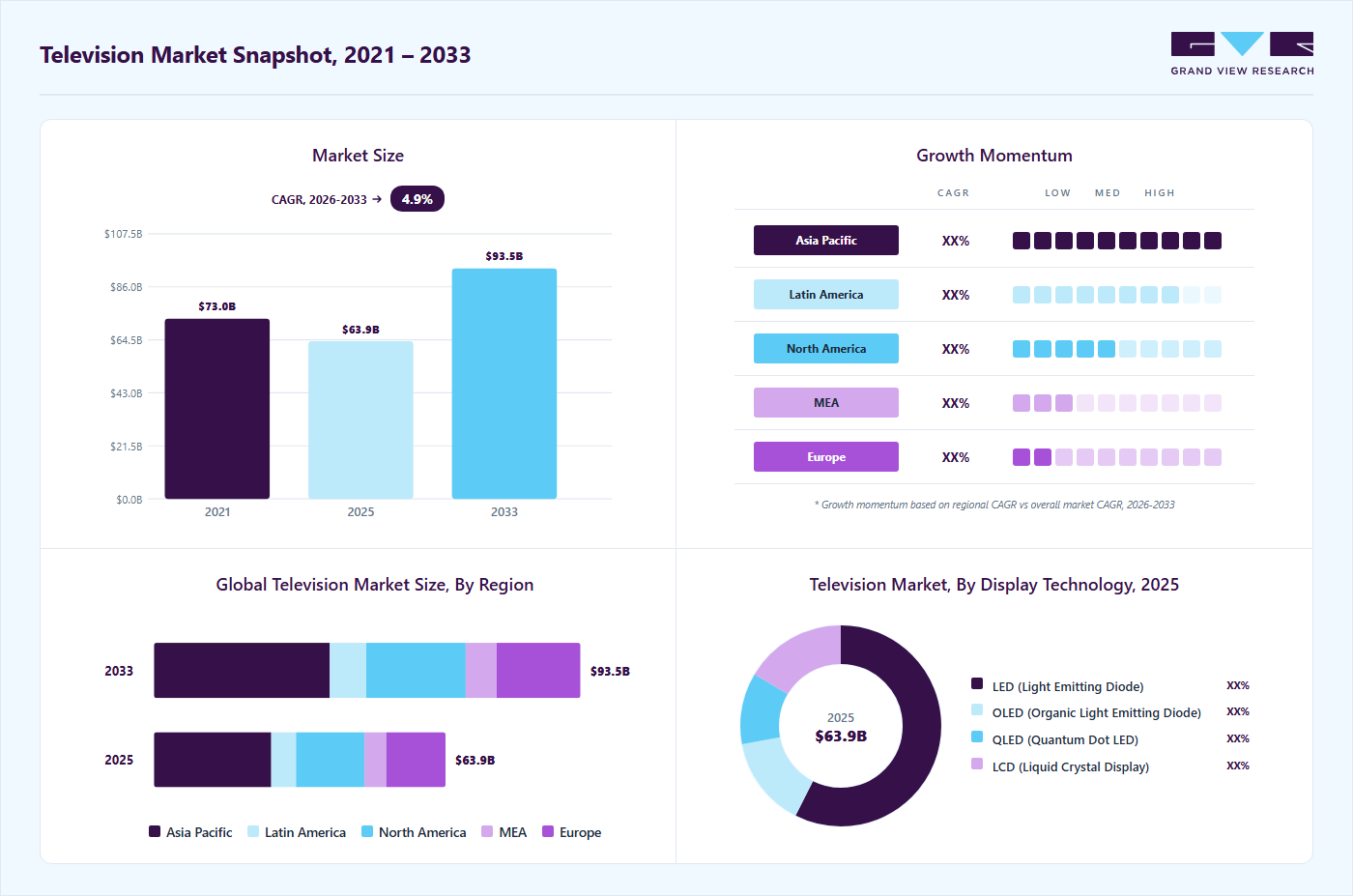
The television market is evolving beyond traditional broadcasting as consumers increasingly prioritize smart connectivity, larger screens, streaming access, and advanced display experiences. The market was valued at USD 63.9 billion in 2025 and is projected to reach USD 66.8 billion in 2026 and USD 93.5 billion by 2033, expanding at a CAGR of 4.9% from 2026 to 2033. Asia Pacific remained the leading regional market with a 40.2% revenue share in 2025.
Market Trends & Global Statistics
Growth Trajectory: USD 63.9 billion in 2025 to USD 93.5 billion by 2033, 4.9% CAGR
Regional Dominance: Asia Pacific, 40.2% revenue share in 2025
Display Technology: LED, 57.4% market share in 2025
Top Competitors: Samsung Electronics, LG Electronics, Sony Corporation, TCL Electronics, Hisense Group, Xiaomi Corporation, Panasonic Corporation, Vizio Holding Corp, Skyworth Group, Sharp Corporation
Smart Viewing Redefines Television Demand
Televisions are increasingly becoming connected entertainment hubs rather than devices used only for conventional broadcasting. Smart TVs provide access to streaming platforms, voice controls, applications, and connected services, allowing consumers to combine traditional viewing with on-demand entertainment, gaming, and interactive experiences.
The smart TV segment accounted for the largest share of 83.4% in 2025. This strong position reflects changing consumer expectations around integrated connectivity and entertainment ecosystems. Consumers increasingly expect televisions to provide direct access to streaming services and connected features without requiring additional external devices.
Display Technology Shapes Product Competition
Display innovation remains a major factor influencing television purchasing decisions. LED technology held the largest market share of 57.4% in 2025, supported by its combination of picture quality and accessible pricing. LED televisions continue to attract consumers seeking value-oriented home entertainment solutions.
OLED is also gaining attention within the premium television category. The OLED segment is anticipated to register a CAGR of 5.5% from 2026 to 2033, supported by demand for enhanced picture quality, deeper blacks, stronger contrast, and premium viewing experiences. Manufacturers are consequently expanding their advanced display portfolios to capture consumers willing to upgrade to higher-end products.
Larger Screens Create New Upgrade Opportunities
Screen size is becoming another important element of television purchasing. The medium screen segment, covering 32-55 inches, held the largest share of 52.9% in 2025. This range continues to appeal to households because it provides a balance between screen size, viewing distance, price, and available living space.
At the same time, larger screens are gaining momentum. The large screen segment covering 55-75 inches is anticipated to grow at a CAGR of 5.5% from 2026 to 2033. Increasing availability of 4K content, falling prices, gaming applications, sports viewing, and the desire for immersive home entertainment are supporting demand for larger displays.
Asia Pacific Maintains Market Leadership
Asia Pacific dominated the television market with a 40.2% revenue share in 2025. The region benefits from substantial consumer demand, expanding smart TV adoption, increasing broadband availability, and a shift from conventional television sets toward connected and larger-screen models.
China held the largest country-level market share in 2025. India is also experiencing continued market development, with consumers increasingly upgrading from basic television sets to smart 4K models. Festival-led purchasing, competitive pricing, and expanding access to streaming content are contributing to regional demand.
North America is characterized by replacement-driven purchasing and premiumization. Consumers are increasingly upgrading existing televisions for larger screens, OLED and Mini-LED displays, high refresh rates, and gaming-oriented capabilities.
Offline Retail Still Leads Distribution
Despite the rapid expansion of e-commerce, offline channels remained the leading distribution route, accounting for 75.7% of the market in 2025. Physical stores allow consumers to compare screen sizes, picture quality, brightness, viewing angles, and interface responsiveness before purchasing.
Online television sales are nevertheless becoming increasingly important as e-commerce platforms offer competitive pricing, doorstep delivery, seasonal promotions, and convenient purchasing experiences. This combination of established physical retail and expanding digital commerce is creating a diversified distribution environment.
FAQ’s
1. Which region dominates the television market?
Asia Pacific dominates the television market, holding a 40.2% revenue share in 2025.
2. Which display technology leads the television market?
LED leads the display technology segment with a 57.4% market share in 2025.
Key Television Companies:
· Samsung Electronics
· LG Electronics
· Sony Corporation
· TCL Electronics
Explore our dedicated business services:
· Brainshare Consulting – End-to-end business consulting services including Opportunity assessment, GTM support, Competitive intelligence, and Consumer Analytics.
· Custom Research – Get a market intelligence report tailored to your specific requirements and aligned with your business goals.
· Consumer Insights – Capture real, evolving consumer sentiment and behavior to help you make data driven strategies.
· Horizon Databooks – Access the world’s largest portal of Market Reports & Statistics
· Investment Insights – Make investment decisions with data driven insights, powered by domain and technology
· Signal (Pricing Intelligence) - Commodity price intelligence to drives strategic advantage.
About us:
Grand View Research, a market research and consulting company, provides syndicated research reports, customized research reports, and consulting services. Grand View Research database is used by the world's renowned academic institutions and Fortune 500 companies to understand the global and regional business environment. Our database features thousands of statistics and in-depth analysis on 46 industries in 25 major countries worldwide.

 Arabic
 French
 Spanish
 Portuguese
 Deutsch
 Turkish
 Dutch
Dutch
 Italiano
 Russian
 Romaian
 Portuguese (Brazil)
 Greek
Greek