


An Introduction to Eclectic Mosaic Flooring: Mixing Shapes and Materials with Confidence
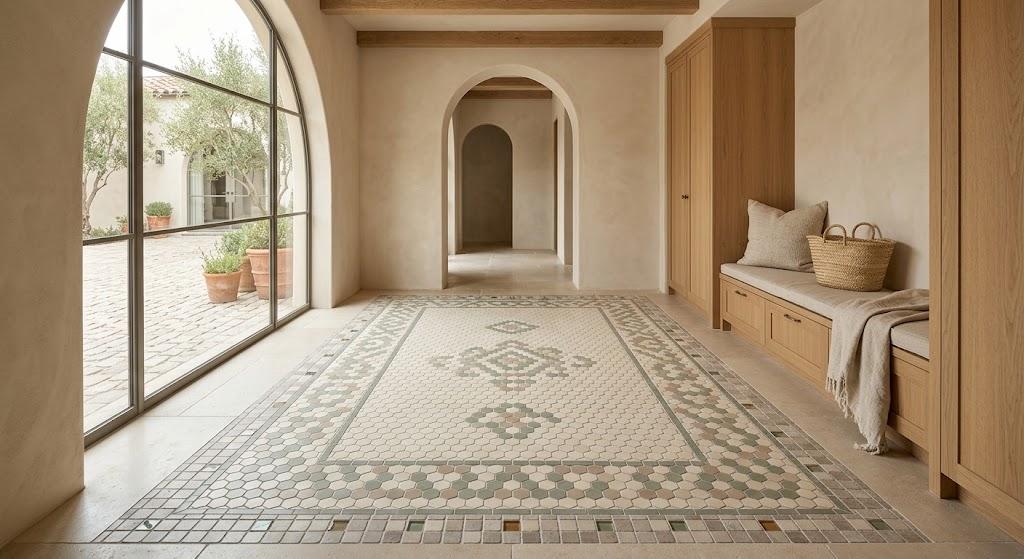
The floor occupies more visual territory than any other surface in a room. When it's assembled from a deliberate blend of shapes, materials, and textures, that expanse transforms from a backdrop into a statement. Eclectic mosaic work carries this potential uniquely well—and it's exactly why more people are drawn to it.
For much of modern design history, the recommendation was singular: pick one tile and commit fully. There's elegance in that approach, and it still has its place. But the range of available materials has expanded dramatically, and the design conversation has shifted. Homeowners and designers now pursue surfaces with more character—floors that feel layered and considered rather than uniform and expected.
Here's the reality, though. Mixing shapes and materials without a framework produces confusion rather than character. A floor demands coherence because it's the room's most visible surface. The rules that follow provide that coherence.
The Argument for Introducing Variety
Picture an entire floor rendered in one tile format, one color, one texture. The effect is orderly. It's also visually flat—nothing invites the eye to travel or discover.
Change one element—a second format introduced beside the first—and the floor gains momentum. The surface starts to vibrate with subtle energy. Designers refer to this effect as visual rhythm, and it's the quality that separates a static room from a dynamic one.
This isn't purely an aesthetic benefit. In open-plan homes, shifting from one tile format to another creates invisible boundaries. A patterned zone near the kitchen naturally suggests a different use than a plain area extending toward the living room. The floor communicates spatial organization without the need for walls.
Rule 1: Lock in the Color Story First
All cohesive mixed-tile compositions begin the same way: with a disciplined color palette. Two or three tones are enough for even the most ambitious designs.
Warm neutrals—ivory, sand, soft taupe—offer the broadest foundation. They accommodate variation in shape and texture without introducing visual friction. Richer accent pieces layered on top of this base gain definition and clarity.
What this rule actually demands is that color play the supporting role while shape and material take the lead. Muted earth tones and warm grays accommodate tiles with more personality—those with visible texture, bolder color, or intricate detail—far better than a saturated palette would.
Cool palettes operate on the same principle. Pale blue-gray paired with white and charcoal can be equally effective. The constant is restraint: the narrower the color range, the more freedom each element has to express its own identity.
Rule 2: Assign Every Tile a Job
A floor where every format carries equal visual importance doesn't feel balanced—it feels busy. Clear hierarchy is what makes mixed compositions legible.
Designate one tile as the foundation. It covers the most area, stays neutral in character, and performs the essential work of holding the scheme together. A second tile introduces more personality—perhaps through pattern, a different finish, or a smaller format. The accent tile, occupying the smallest area, delivers a concentrated moment of visual interest.
The 60-30-10 guideline translates seamlessly to flooring. Sixty percent of the surface receives the base tile, thirty percent goes to the secondary, and ten percent belongs to the accent. This allocation prevents any single element from dominating.
A well-stocked ceramic tile shop often groups products by tone and finish, making it easier to identify tiles that naturally fulfill each role. Chalky whites, muted clays, and soft earth tones make ideal base layers—their restraint gives every layered element room to register clearly.
Rule 3: Mix Shapes That Complement Each Other
Geometric variety is the engine of eclectic floor design. Hexagons, squares, rectangles, diamonds, triangles—each shape carries a distinct visual signature.
One combination that has proven itself across countless installations: hexagons as the primary field with a square-tile border framing the perimeter. The geometric contrast establishes a natural boundary, comparable to the way a rug defines a seating area within an open room.
Keeping color consistent while varying the shape produces a different but equally effective result. Two tiles in the same tone but different geometries let the grout lines form the pattern organically. The effect is refined and works across a wide range of styles.
The junction where two shapes meet deserves attention. That seam—where a hexagon kisses a rectangle, where a diamond transitions into a square—becomes a design moment in itself. Mosaic floor tiles arranged with awareness of these contact points create compositions that reward close inspection.
Even modest contrasts in form—stepping from a circle to a square, transitioning from an octagon to a rectangle—can shift the entire feel of a space. You don't need dramatic gestures; you need thoughtful placement.
Rule 4: Balance Different Scales
Proportion works beneath the surface of conscious attention, yet it shapes perception powerfully. Large formats feel expansive and calm. Small formats feel detailed and intimate. Combining both gives you precise control over a room's atmosphere.
Use large tiles to establish the dominant field—a serene canvas that anchors the composition. Introduce smaller elements—mosaics, compact hexagons, penny rounds—as focal points that draw the eye to specific areas.
Two practical guidelines prevent scale mixing from producing discord. Change one variable at a time: if the sizes differ, keep the surface finish consistent. If the finishes differ, keep the format the same. Additionally, consider the interplay between floor and wall surfaces—a detailed floor pairs well with larger-format walls, and the reverse works too.
Walking through a ceramic tile shop with multiple format displays makes these scale relationships tangible. Seeing a large-format slab next to a compact mosaic in person tells you more than any specification sheet.
Rule 5: Combine Materials Around a Connecting Thread
Ceramic, stone, glass, porcelain—each material brings something different to the composition. Weight, warmth, reflectivity, grain—these qualities multiply when materials are combined thoughtfully.
Glass accents set within a porcelain field introduce luminosity and chromatic depth. Concrete-effect tiles paired with brick-look pieces produce understated industrial warmth. Natural stone laid beside wood-look porcelain merges organic texture with contemporary crispness.
The essential requirement is a linking element. Color, finish, sheen, undertone—something must bind these materials together so they feel related. Without that unifying thread, the mix reads as accidental.
When sourcing mosaic floor tiles from diverse material families, search for that connection deliberately. A terracotta wall element shares warmth with a limestone floor. A fishscale detail in a shower niche echoes undertones present in the broader palette. The bond can be as subtle as a shared matte surface or a parallel warm cast.
Browse a curated ceramic tile shop and notice how the strongest product displays connect unrelated pieces through invisible threads—undertone families, finish categories, textural kinships. Learning to identify those connections transforms the selection process.
Rule 6: Let Borders Structure the Composition
Borders serve a dual function: they organize the visual composition and they streamline installation.
A defined perimeter border around a complex field pattern creates a resting place for the eye. It contains the visual activity, establishes completeness, and frames the room's edges with clean definition.
Transitional strips between different-format zones perform the same function at a smaller scale. A single course of brick-format tile between two larger fields acts as a visual pause—a signal that one zone ends and another begins. In open-plan settings, these transitions accomplish spatially what walls accomplish structurally.
Beyond their aesthetic contribution, borders reduce the complexity of cutting tile along the room's perimeter. The practical benefit reinforces the visual one: cleaner edges, tighter joints, a more refined finish.
Rule 7: Concentrate Pattern and Protect It with Calm
Pattern thrives when surrounded by restraint. A room saturated with decoration becomes exhausting; a room without any becomes forgettable.
Reserve your most ornamental tiles for a defined area—a feature wall, a floor inset, a shower surround. Let that section carry the complexity while everything around it stays quiet.
A striking backsplash mosaic gains presence when the floor beneath uses large, monochromatic tiles. The plain ground elevates the pattern rather than competing with it. At floor level, the same dynamic applies: a detailed inset framed by broad, plain formats reads as a deliberate centerpiece.
When decorative elements are concentrated and bordered, they become focal landmarks. The surrounding simplicity ensures they command attention. Without that calm perimeter, even the most beautiful pattern dissolves into background noise.
Practical Considerations
Several practical decisions made before installation begins will define the floor's lasting impression.
Grout selection deserves careful attention. Joint color and width fundamentally alter the reading of a finished floor. Dark grout defines every edge crisply; tone-matched grout softens the grid and lets tile surfaces dominate the visual field.
Test physical samples in the actual space. Showroom lighting creates conditions that your home's environment rarely duplicates. Lay samples side by side, observe them in morning light and evening light, and give yourself several days before deciding.
Request that your installer plan the complete layout before any tile is cut. Grout-line alignment across different formats is among the most consequential details in any multi-format project. Consult a ceramic tile shop for installer recommendations—their experience with mixed layouts translates directly into a cleaner result.
Scale ambition to the room's dimensions. Generous spaces absorb bold, large-scale patterns without difficulty. Tighter spaces call for restraint—a single accent section or a carefully placed detail band delivers more impact than complexity spread indiscriminately.
Final Reflections
An eclectic mosaic floor emerges from a series of decisions that speak to each other. Color supports shape. Scale tempers texture. Borders impose structure. Calm surfaces protect patterned ones.
Restrict your palette. Define roles for each element. Combine geometries with care. Balance scale deliberately. Connect materials through shared qualities. Frame busy zones with borders. Allow quiet areas to support decorative ones.
When every choice reinforces the others, the floor merges with the architecture as though it were part of the original vision. It earns its place through coherence rather than spectacle. That quiet confidence—the sense that the floor simply belongs—is the ultimate mark of a space designed with real intention.

 English
 Arabic
 French
 Spanish
 Deutsch
 Turkish
 Dutch
Dutch
 Italiano
 Russian
 Romaian
 Portuguese (Brazil)
 Greek
Greek