In a digital-first business environment, protecting intellectual property has become increasingly important. Businesses, creators, technology companies, artists, software developers, and innovators create valuable digital assets every day. These assets can include software code, designs, documents, digital content, inventions, research, trademarks, and creative works.
Traditional intellectual property management systems can face challenges involving ownership records, document verification, licensing, version tracking, and proof of existence. Blockchain technology offers new possibilities for creating verifiable records and managing selected digital ownership processes.
A trusted Blockchain Development Company can help businesses explore blockchain-based intellectual property solutions. HyprForge provides customized blockchain development, smart contract development, Web3 solutions, decentralized applications, cryptocurrency development, and modern web development services.
What Is Blockchain-Based Intellectual Property Management?
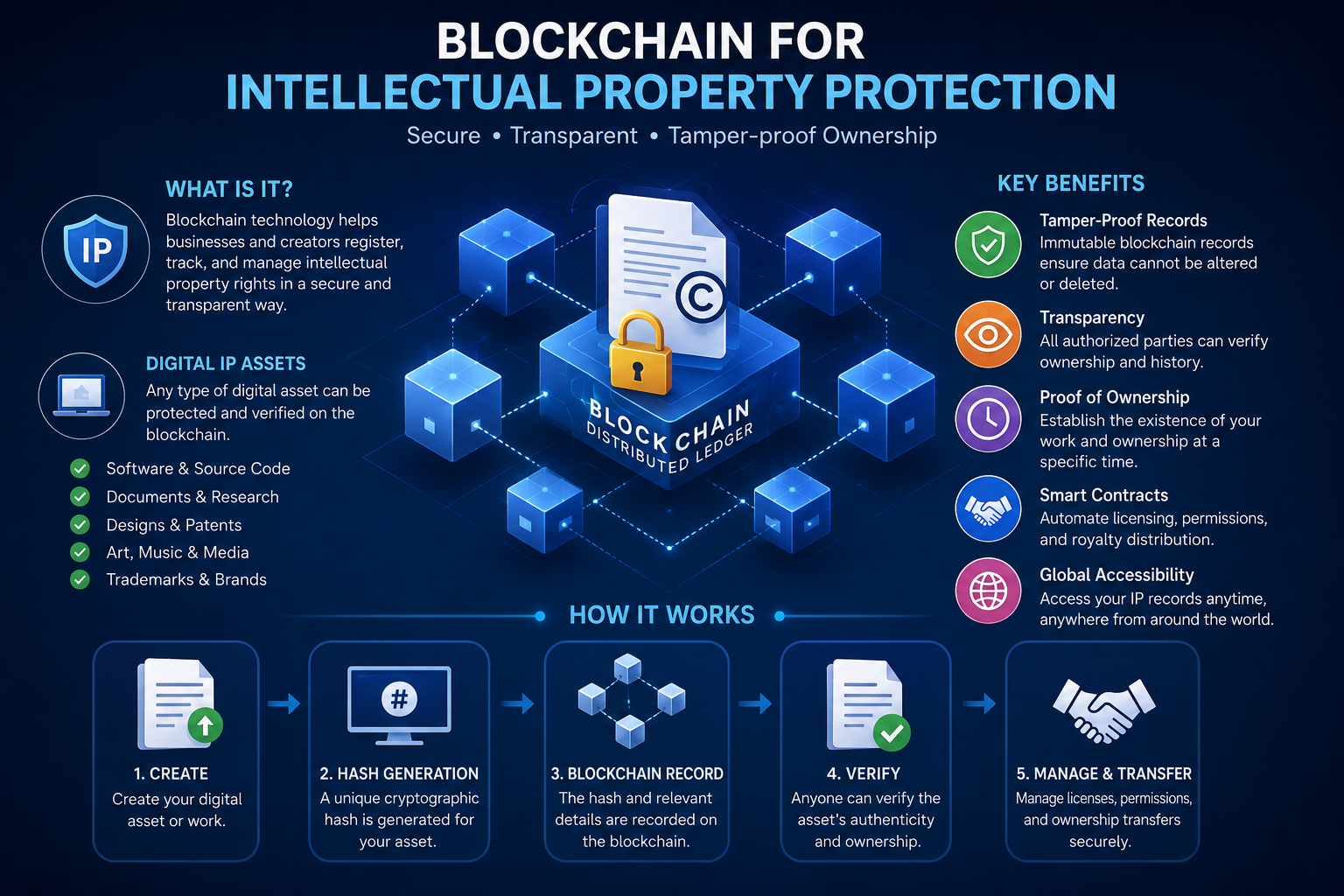
Blockchain-based intellectual property management uses distributed ledger technology to support selected processes related to digital assets, ownership records, timestamps, verification, and licensing.
A blockchain solution may create a tamper-evident record containing information such as:
- Asset identifiers
- Cryptographic hashes
- Timestamps
- Ownership-related events
- Version references
- License information
- Transfer records
The original intellectual property does not necessarily need to be stored directly on a blockchain. Sensitive files can remain in secure off-chain storage while the blockchain records a cryptographic reference or verification data.
This approach can help organizations establish verifiable records while protecting confidential information.
Why Intellectual Property Needs Better Digital Management
Digital assets can be copied, modified, distributed, and transferred quickly. As businesses operate across multiple platforms and international markets, tracking ownership and usage can become more complicated.
Common challenges include:
- Proving the existence of a digital file at a particular time
- Managing multiple versions of an asset
- Tracking licensing agreements
- Verifying digital documents
- Managing ownership transfers
- Recording usage permissions
Blockchain cannot automatically solve every intellectual property dispute or replace formal legal protections. However, it can provide technical infrastructure for recording and verifying selected events.
Start With a Clear Blockchain Strategy
Before developing an intellectual property platform, organizations should identify the exact problem they want to solve.
A Blockchain Consulting Company can help evaluate whether blockchain is appropriate for requirements such as:
- Digital asset verification
- Ownership record management
- Licensing workflows
- Document timestamping
- Version tracking
- Asset transfer records
- Multi-party collaboration
The consulting stage helps define which information should be recorded on-chain and which information should remain in traditional databases or secure storage systems.
Proof of Existence for Digital Assets
One potential blockchain use case is creating a verifiable timestamp for a digital asset.
A blockchain developer company can develop a system that performs the following process:
Digital File → Cryptographic Hash → Blockchain Record → Verification Process
The system can generate a cryptographic representation of a file and record relevant information associated with that representation.
Later, the same file can be processed again to determine whether its cryptographic characteristics correspond with the recorded information.
This can support technical verification processes, although businesses should understand the difference between a blockchain record and legal proof of ownership under applicable laws.
Smart Contracts for Licensing Management
Licensing is an important part of intellectual property management. Organizations may need to define who can use an asset, under what conditions, and for what period.
A blockchain smart contract development agency can create programmable systems for selected licensing workflows.
Smart contract functionality may include:
- License creation
- Permission management
- Usage conditions
- Expiration rules
- Approval workflows
- Ownership-related transfers
The legal agreement and smart contract should be carefully aligned. Businesses should obtain appropriate legal advice regarding contractual and regulatory requirements.
Managing Digital Content Rights
Blockchain technology can support selected processes for digital content ecosystems.
Potential applications include:
- Digital artwork
- Music assets
- Photography
- Video content
- Digital publications
- Software products
A Blockchain Development Agency can develop customized platforms that combine asset records, smart contracts, digital wallets, and web applications.
The platform architecture should focus on the actual business workflow rather than using blockchain merely as a marketing feature.
Blockchain for Software Intellectual Property
Software companies create valuable intellectual property through source code, algorithms, documentation, and proprietary systems.
A blockchain technology development company can help build systems for recording selected software-related events, such as version references or development milestones.
However, confidential source code should not be placed directly on a public blockchain. A secure architecture can use off-chain repositories and protected infrastructure while recording only appropriate verification information.
Security, confidentiality, access control, and intellectual property policies remain essential.
Web3 and Digital Ownership
Web3 technologies have introduced new concepts related to digital ownership and blockchain-based assets.
A Web3 Development Agency can help businesses explore applications involving:
- Digital collectibles
- Tokenized assets
- Creator platforms
- Digital memberships
- Verifiable records
- Decentralized marketplaces
A Web3 Development Company can create complete platforms that combine blockchain technology with wallets, smart contracts, APIs, databases, and user-friendly interfaces.
The value of a Web3 solution depends on the rights, functionality, and business processes associated with the digital asset—not simply the existence of a token.
Building an Intellectual Property Platform
A professional Web Development Agency can create accessible interfaces for businesses and users.
An intellectual property platform may include:
- Asset registration dashboards
- Verification tools
- Licensing portals
- User management
- Search systems
- Administrative controls
- Analytics dashboards
A Web Development Company can integrate these interfaces with blockchain networks, smart contracts, secure storage systems, APIs, and enterprise databases.
The user should not need advanced blockchain knowledge to verify an asset or manage a license.
Cryptocurrency Development and Digital Asset Ecosystems
Some digital ownership ecosystems may include blockchain-based tokens or digital payment functionality.
Cryptocurrency development can support selected technical features involving:
- Digital transactions
- Tokenized ecosystems
- Platform incentives
- Blockchain-based payments
Any public token or cryptocurrency product should be evaluated carefully for applicable legal, financial, tax, and regulatory obligations.
Intellectual Property and Decentralized Marketplaces
Blockchain-based marketplaces can support the exchange of compatible digital assets.
A Decentralized Exchange Development Company may provide specialized blockchain capabilities for digital asset transaction systems where appropriate.
A Decentralized Exchange Software Development Company can develop customized platforms involving smart contracts, wallet connectivity, and blockchain transactions.
Organizations searching for a dex development company should carefully evaluate whether decentralized exchange infrastructure is actually relevant to the intellectual property business model.
Security and Privacy Considerations
Intellectual property can be highly valuable and confidential. A blockchain solution must include a comprehensive security strategy.
Important considerations include:
- Encryption
- Access control
- Private key management
- Secure APIs
- Authentication
- Smart contract security
- Secure file storage
- Infrastructure monitoring
Blockchain records may be difficult to modify, so businesses should carefully validate information before permanently recording it.
Scalability and System Integration
A large intellectual property platform may process thousands or millions of assets.
The technology architecture may need to support:
- High-volume databases
- Blockchain transactions
- File storage
- Search infrastructure
- APIs
- Cloud services
- Analytics systems
A hybrid architecture can provide better performance by using blockchain for selected verification and record functions while storing large files in appropriate off-chain systems.
Why Choose HyprForge?
HyprForge helps businesses explore innovative blockchain solutions for digital products and modern technology ecosystems.
The company provides blockchain consulting, smart contract development, cryptocurrency development, decentralized applications, Web3 platforms, and customized web solutions.
Businesses looking for a bockchain app development company can work with HyprForge to develop customized blockchain applications based on their specific security, scalability, functionality, and business requirements.
Conclusion
Blockchain technology offers interesting possibilities for intellectual property management, particularly in areas involving verification, timestamps, digital records, licensing workflows, and asset tracking.
The technology should be implemented as part of a broader intellectual property strategy. Blockchain records do not automatically establish or replace legal rights, registrations, contracts, or regulatory requirements. Instead, blockchain can provide an additional technical layer for selected verification and record-management processes.
By partnering with an experienced Blockchain Development Company, businesses can explore customized solutions for managing digital assets and building modern intellectual property platforms.
As digital innovation continues to accelerate, blockchain may play an increasingly valuable role in creating more verifiable, transparent, and efficient systems for managing selected aspects of digital ownership and intellectual property.




 English
 Arabic
 French
 Spanish
 Portuguese
 Deutsch
 Turkish
 Dutch
Dutch
 Italiano
 Russian
 Romaian
 Portuguese (Brazil)