


From Beginner to Job-Ready Data Analyst: How Long Does It Take?
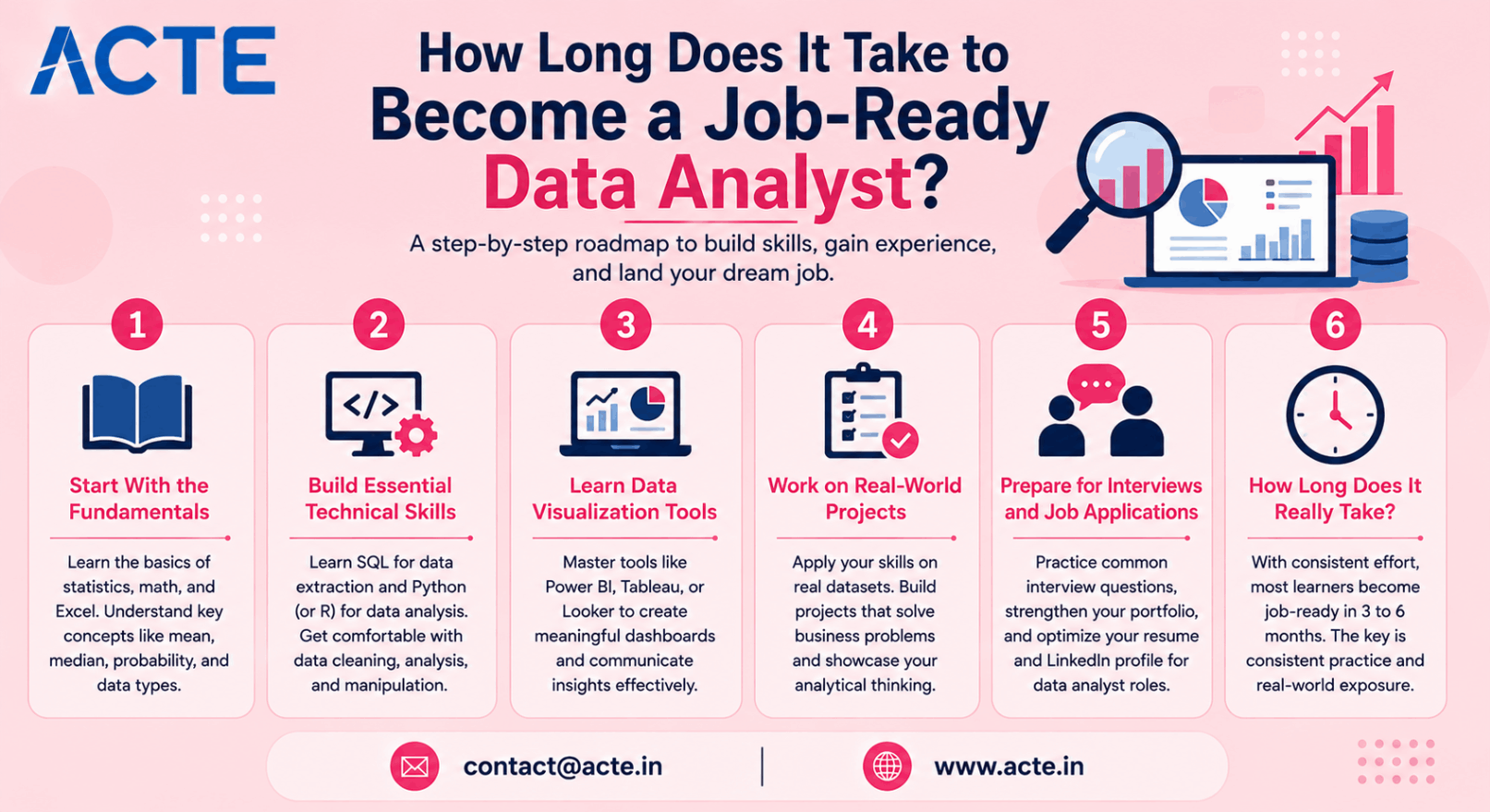
Becoming a job-ready data analyst can be a realistic goal within three to six months for someone who learns consistently and focuses on practical skills. The exact time required varies depending on Data Analytics Course in Hyderabad your previous experience, learning speed, and daily study schedule. Rather than trying to learn every available analytics technology, beginners should concentrate on the core abilities employers commonly expect, including data analysis, Excel, SQL, visualization, and problem-solving.

Start With Data Analysis Fundamentals
The first stage should involve understanding how data supports business decisions. Learn concepts such as data collection, data cleaning, basic statistics, trends, averages, percentages, and data interpretation. You should also develop the ability to identify useful questions and determine what information is needed to answer them. Spending a few weeks building these fundamentals can create a strong base for learning analytical tools.
Build Confidence With Excel
Excel is an excellent tool for beginners because it introduces many important concepts used in data analysis. Learn formulas, functions, lookup techniques, pivot tables, charts, filtering, sorting, and data-cleaning methods. Try working with sales reports, customer records, or financial datasets to understand how these features are used in practical situations. Consistent practice can help you become comfortable with Excel within three to four weeks.
Learn SQL Step by Step
SQL is essential for working with structured data stored in databases. Begin with simple queries and gradually progress to filtering, sorting, grouping, aggregate functions, joins, subqueries, common table expressions, and window functions. Focus on understanding why and when each query is used instead of memorizing commands. Solving different SQL problems regularly can help you develop the confidence needed for real projects and technical interviews.
Develop Data Visualization Abilities
Once you understand data preparation and analysis, learn how to communicate your findings through visualizations. Power BI and Tableau are popular choices for creating dashboards and business reports. Practice connecting data sources, transforming information, creating calculations, selecting suitable charts, and designing easy-to-understand dashboards. This Data Analytics Course in Chennai stage can take several weeks, particularly if you are learning business intelligence tools for the first time.
Complete Realistic Analytics Projects
Projects are one of the best ways to measure your progress. Choose datasets that represent real business situations and create projects around specific questions. You could examine product sales, customer retention, marketing performance, employee trends, or financial results. A Data Analytics Course in Bangalore complete project should demonstrate data cleaning, analysis, visualization, and interpretation. These projects can also become valuable additions to your professional portfolio.
Get Ready for the Hiring Process
Before applying for jobs, spend time improving your interview skills. Practice SQL challenges, Excel exercises, analytical reasoning questions, and case-based problems. Review your projects carefully so you can explain your methods and findings clearly. Create a resume that highlights practical skills and project achievements, and organize your best work into a portfolio that recruiters can easily understand.
How Many Months Should You Plan For?
If you can dedicate approximately two to three hours each day, three to six months can be a reasonable learning target. The early weeks can focus on fundamentals and Excel, followed by SQL and visualization. The final portion of the plan can emphasize projects, portfolio building, and Data Analytics Online Course interview preparation. However, job readiness should be measured by capability rather than a specific calendar deadline.
Conclusion
The time needed to become a job-ready data analyst depends on how effectively you combine learning with practice. A focused three-to-six-month roadmap can help beginners develop knowledge of data fundamentals, Excel, SQL, visualization, and practical analytics. By working on realistic projects and preparing for interviews, aspiring analysts can build the confidence and evidence of skills needed to pursue entry-level opportunities.

 English
 Arabic
 French
 Spanish
 Portuguese
 Deutsch
 Turkish
 Dutch
 Italiano
 Russian
 Romaian
 Greek