


The Complete Google Business Profile Audit Process for SEO Professionals
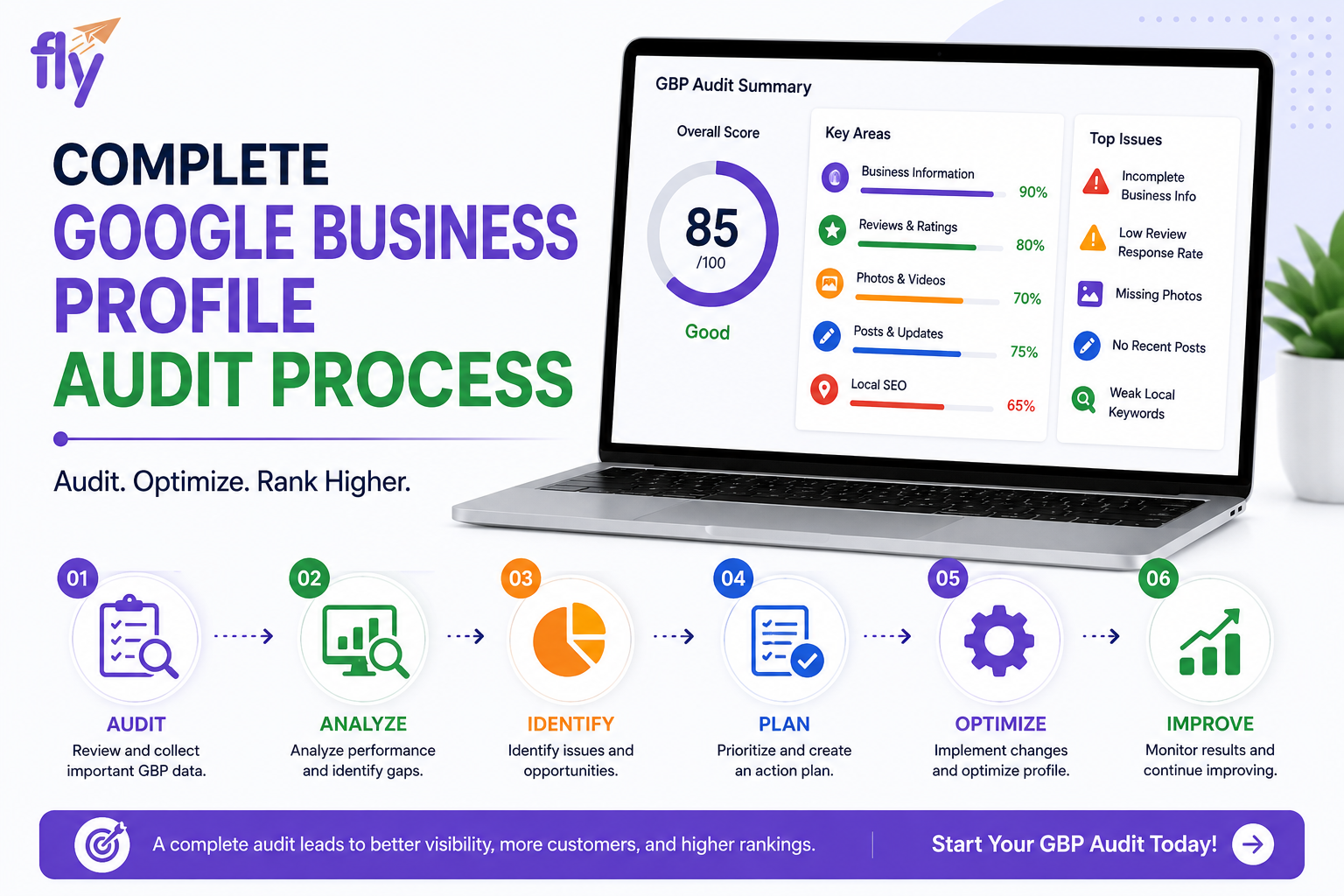
A Google Business Profile audit should tell an SEO professional more than whether a profile is complete. It should explain where the business currently stands, what may be limiting its local presence, how it compares with competitors, and where the next Local SEO opportunities exist.
That requires looking beyond individual GBP fields.
A useful audit connects profile accuracy, search relevance, reputation, customer experience, geographic visibility, website quality, and actual customer actions. Instead of treating every finding as an immediate optimization task, SEO professionals can use the audit to determine what deserves attention first.
Here is a practical way to approach the complete process.
Begin With One Question: Is the Profile Accurate?
Before looking at rankings or competitors, examine the profile as a potential customer would.
Search for the business on Google and open its profile. Check the business name, phone number, address, website, operating hours, service area, and other important information.
Then test them.
Call the phone number. Click the website. Check whether the map pin points to the correct location. Compare the opening hours with the client's current schedule.
This simple exercise often uncovers problems that dashboards miss.
For example, the website may work but direct visitors to an outdated page. The phone number may look correct but no longer connect to the appropriate location.
These are customer-experience problems, so they should generally be resolved before less important optimization tasks.
Understand What Google Thinks the Business Is
Once accuracy is confirmed, shift the audit toward relevance.
Start with the primary category.
Does it clearly represent the client's main business activity?
Then review additional categories and compare them with what the business actually provides.
The purpose is not to find every category that could loosely apply. A profile filled with unnecessary categories is not automatically better optimized.
Instead, ask whether Google and a potential customer can clearly understand the nature of the business from the information provided.
This relevance check should naturally lead into services.
Compare GBP Services With the Real Business
Create a simple comparison between what the business currently sells and what appears on GBP.
You may discover services that are missing entirely. You might also find outdated offerings that the company stopped providing months ago.
Now take the analysis one step further.
Search the client's website for those important services.
Suppose a high-value service is missing from GBP and barely mentioned on the website. That is no longer just a profile issue—it may be a broader content opportunity.
The GBP audit has now helped identify potential work for both profile optimization and website SEO.
Get a Quick View Before Going Deeper
When working with multiple clients, manually investigating every element from the beginning can be inefficient.
An initial audit can help identify which areas deserve closer examination.
Check the Google Business Profile:
https://www.fly-social.com/tools/gmb-audit
Treat the results as a diagnostic starting point.
Do not tell clients that a third-party score such as 65/100 is Google's measurement of their profile or that improving it to 100 guarantees rankings.
The professional value comes from interpreting the findings and deciding whether each detected gap is actually important.
Move From Profile Analysis to Reputation Analysis
Next, stop looking at GBP as a collection of fields and start looking at it as a customer decision page.
Reviews become particularly important here.
A simple audit might record:
Rating: 4.8 stars
Reviews: 75
A professional audit goes further.
When was the most recent review? How frequently does the business receive feedback? Does the owner respond? What do customers repeatedly mention?
Now add competitor context.
Imagine the client's 75 reviews look strong until you discover that nearby competitors have 280, 390, and 600 reviews.
That difference does not prove why one business ranks above another, but it highlights a reputation gap worth investigating.
The recommendation might therefore involve creating a sustainable process for requesting genuine customer feedback and improving how reviews are managed.
Read Reviews for More Than SEO
Customer reviews can also reveal opportunities that have little to do with rankings.
Suppose customers repeatedly praise quick appointments, knowledgeable staff, easy parking, or excellent after-sales support.
Those are real customer experiences that could potentially inform website content and marketing messages.
Now imagine multiple negative reviews mention unanswered calls or slow inquiry responses.
Optimizing GBP will not fix that.
The agency has uncovered a customer journey problem.
This is why professional audits should not reduce reviews to a number.
Look at the profile visually.
Next, examine photos.
Ask whether the images currently displayed help a new customer understand the business.
A profile may contain 50 photos but still provide a weak visual experience if most are outdated, irrelevant, or repetitive.
Consider what a customer actually wants to see.
For a restaurant, that could include the dining environment and food. For a clinic, it could include facilities and the reception area. For a retailer, it could include the storefront and products.
The recommendation should therefore be specific.
"Add more photos" is weak.
"Update the profile with current storefront, interior, team, and service-related images" gives the client something actionable.
Search for Profiles That Shouldn't Be There
Now search beyond the main profile.
Try combinations of the business name, phone number, and address on Google Maps.
Look for old locations, outdated business names, or potential duplicate listings.
For multi-location companies, this becomes especially important because locations may have moved, closed, or changed management.
Do not automatically report every similar listing as a duplicate. Verify whether it represents a legitimate separate business, practitioner, department, or location before recommending action.
Build a Competitor Snapshot
Instead of comparing the client only with the business ranking first, select several competitors appearing consistently for commercially relevant searches.
Create a mental snapshot of each competitor.
What category do they use? How strong are their reviews? What services are represented? How useful are their photos? What does their website look like?
Now search for patterns.
Perhaps the client's GBP looks equally strong, but competitors have substantially better websites.
That changes the strategy.
The opportunity may not be another GBP edit. It may be stronger service pages, improved organic SEO, better content, or greater online authority.
Competitor analysis helps determine where the real gap exists.
Map Visibility Instead of Checking One Ranking
One of the biggest mistakes in GBP auditing is recording a single Maps position as if it represents the entire market.
Local rankings can change according to where someone searches.
A business may perform strongly within one kilometre of its location and become much less visible farther away.
This happens partly because distance is an important local search factor.
For SEO professionals, the question should therefore change from:
"What position does the business rank?"
to:
"Where does the business have strong and weak visibility?"
That provides a much more useful understanding of local performance.
Follow the Customer Beyond Google Maps
Now imagine a customer finds the client's profile.
They click the website.
What happens?
Audit that journey.
Does the landing page match what they were searching for? Can they understand the service quickly? Is the website usable on mobile? Is there a clear phone number, booking option, quote request, or enquiry form?
A profile can successfully create visibility while the website fails to convert the visitor.
This is why a complete GBP audit should never stop at Google Business Profile.
Compare Visibility With Customer Actions
The next stage is performance analysis.
Do not rely exclusively on profile views.
Where available, examine meaningful customer interactions such as calls, website clicks, directions, and bookings.
Consider two hypothetical profiles.
Business A: 8,000 views and 70 customer actions.
Business B: 4,000 views and 250 customer actions.
Business A has twice the visibility, but Business B appears to generate substantially more interaction relative to those views.
This should lead to a different discussion.
The question becomes the following:
Why are people seeing the profile but not taking the next step?
The answer could involve reviews, service clarity, photos, pricing, availability, website experience, or the business's actual offer.
Sort Findings Into Three Groups
At this point, the audit may contain many observations. Do not send them to the client as one long checklist.
Organize them into three groups.
Fix Now: Incorrect phone numbers, broken website links, inaccurate hours, wrong addresses, or other factual problems affecting customers.
Improve Next: Category relevance, missing services, weak review activity, outdated photos, or profile experience.
Investigate Further: Website SEO, competitor strength, geographic limitations, online authority, or conversion problems.
This format makes the audit much easier to act on.
It also prevents minor issues from receiving the same priority as serious problems.
Know When GBP Is Not the Problem
A professional audit should be willing to conclude the following:
"Your Google Business Profile is already in good condition."
That is a useful finding.
If the profile is accurate, relevant, active, and customer-friendly, continuously editing it may not be the right strategy.
Shift the investigation toward the wider digital presence.
Explore additional SEO and digital marketing tools:
https://www.fly-social.com/tools
Website SEO, organic rankings, competitor strength, reputation, backlinks, and conversion experience may reveal the next opportunity.
The purpose of an audit is to find the real problem—not to manufacture GBP work.
Turn the Audit Into a 90-Day Direction
The final audit should tell the SEO professional what to do next.
During the first phase, correct accuracy and profile-management issues.
The next phase can address services, reviews, photos, and customer experience.
Longer-term work can focus on website content, competitive gaps, local authority, reputation, and geographic visibility.
This creates a strategy rather than an optimization checklist.
It also makes future reporting easier because performance can be compared against the baseline established before work began.
What a Complete GBP Audit Should Ultimately Answer
After completing the process, an SEO professional should be able to answer four questions clearly:
Is the profile accurate?
Is the business represented clearly for relevant services?
Where are competitors stronger?
What should we improve first?
If the audit cannot answer those questions, collecting more profile data will not necessarily make it more useful.
Conclusion
The complete Google Business Profile audit process for SEO professionals is not about ticking every available GBP field.
It is about understanding the business from three perspectives: Google, competitors, and customers.
Start with profile accuracy and relevance. Then investigate services, reviews, photos, duplicate listings, competitors, geographic visibility, website experience, and customer actions.
Finally, turn those findings into priorities.
Some businesses will need GBP improvements. Others will need a stronger review strategy, website SEO, content, reputation management, or broader local SEO work.
That is what separates a basic profile check from a professional GBP audit.
The objective is not to produce the longest report or the highest optimization score. It is to give the SEO professional enough evidence to decide what needs fixing, what represents an opportunity, and what should happen next.
FAQs
What is the first step in a professional GBP audit?
Start by verifying that the business's core information is accurate and that important customer touchpoints, including the phone number and website, work correctly.
Should competitor research be part of a GBP audit?
Yes. Competitor analysis provides context and can reveal whether the larger opportunity involves reviews, services, website SEO, or broader local presence.
Should a GBP audit focus only on Google Maps rankings?
No. Customer interactions, website experience, reviews, reputation, and conversion opportunities should also be considered.
What if the audit finds no major GBP problems?
Investigate the website and wider Local SEO presence rather than making unnecessary profile changes.

 English
 Arabic
 French
 Spanish
 Portuguese
 Deutsch
 Dutch
Dutch
 Italiano
 Russian
 Romaian
 Portuguese (Brazil)
 Greek
Greek