


How to Become a Pilot: Complete Guide to Pilot Training, DGCA Pariksha and Costs in India
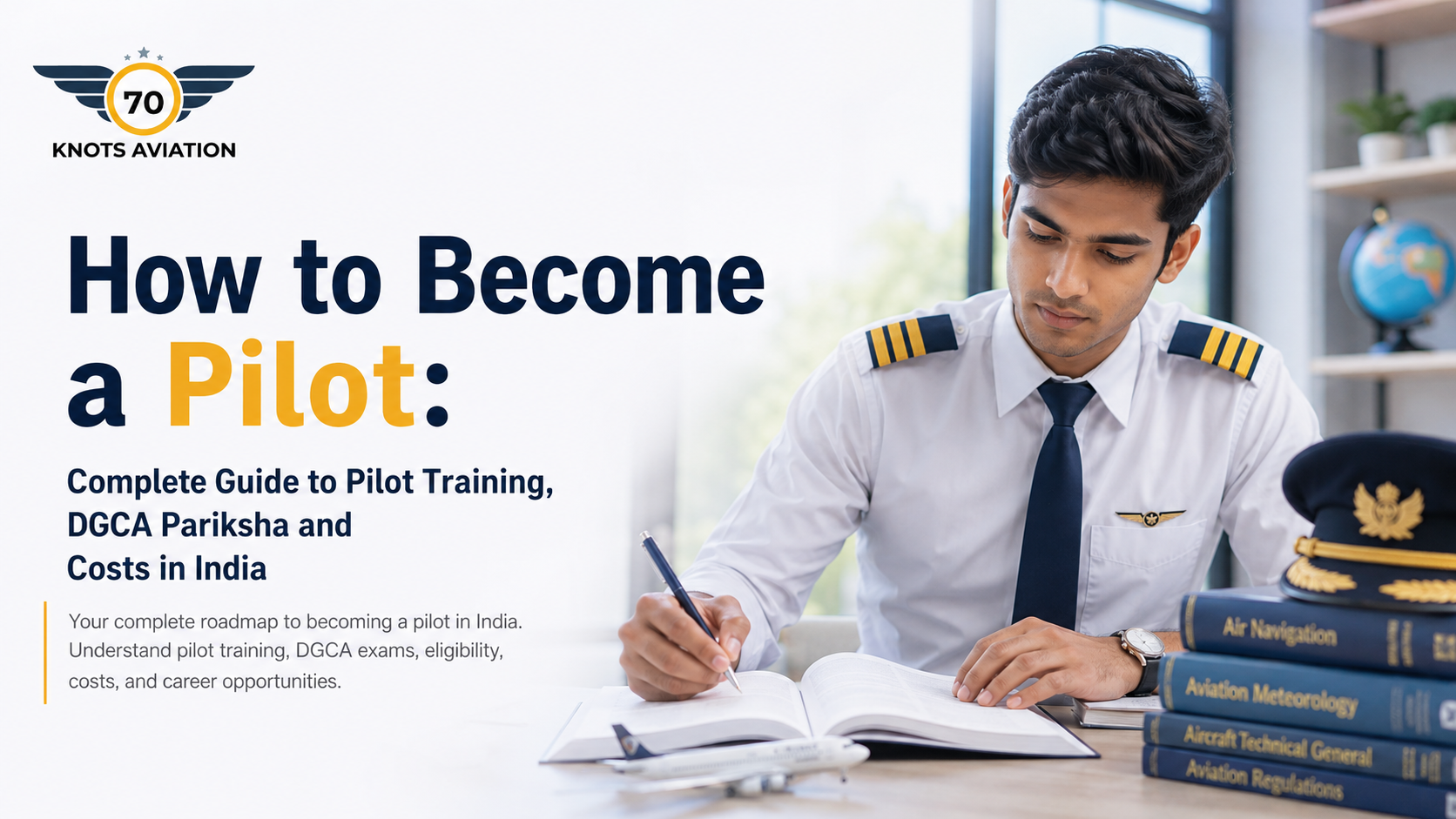
Becoming a pilot is a dream for many students who are fascinated by aviation, aircraft, travel, and the responsibility of flying people safely. However, becoming a professional pilot requires more than simply learning how to operate an aircraft. Students need to understand the eligibility requirements, medical standards, theoretical examinations, flight training, licensing process, and financial investment involved in pilot training.
For students planning an aviation career, understanding How to become a pilot is an important first step. A clear understanding of the process can help students choose the right training pathway, prepare for examinations, and make informed decisions about their education.
70Knots Aviation focuses on helping aspiring aviation students understand the different stages involved in pilot training and develop the academic foundation required for their future careers.
How to Become a Pilot in India
The journey toward becoming a professional pilot generally involves several stages. Students should approach the process systematically rather than treating flight training as the only requirement.
A typical pathway includes:
- Completing the required educational qualifications.
- Meeting the applicable age requirements.
- Obtaining the required aviation medical certification.
- Registering and preparing for DGCA examinations.
- Completing theoretical training.
- Undertaking flight training through an approved flight training organisation.
- Completing the required flying hours and skill tests.
- Meeting the licensing requirements for the desired pilot licence.
- Applying for the appropriate licence and completing the necessary regulatory procedures.
Students should always verify the latest requirements with the Directorate General of Civil Aviation (DGCA), because aviation regulations and procedures can change.
Educational Eligibility for Aspiring Pilots
Students interested in commercial pilot training in India generally need to pay attention to their academic background, particularly subjects such as Physics and Mathematics.
For students who have not studied the required subjects during school, alternative academic pathways may be available depending on the applicable regulations. Before enrolling in a pilot training programme, students should confirm their eligibility rather than assuming that every institute or course has the same requirements.
Academic preparation is particularly important because pilot training involves subjects that require logical reasoning, numerical understanding, and the ability to interpret technical information.
Medical Fitness and Pilot Training
Medical fitness is another important part of a pilot's career.
Before investing heavily in flight training, students should understand the applicable aviation medical requirements. Medical assessment helps determine whether an individual is fit to undertake the responsibilities associated with flying.
Students should therefore consider completing the appropriate medical assessment early in their planning process. Doing this before making major financial commitments can help prevent unexpected difficulties later.
Understanding DGCA Pariksha
The theoretical examination stage is an important part of pilot training in India. Students preparing for a professional pilot career need to become familiar with the DGCA Pariksha system and the subjects relevant to their licence and training pathway.
Aviation examinations can cover technical and theoretical areas such as:
- Air Regulations
- Air Navigation
- Aviation Meteorology
- Aircraft and technical subjects
- Radio communication and related aviation procedures
The exact examination requirements depend on the licence and applicable DGCA regulations.
Students should not treat theoretical examinations as something separate from flying. A pilot needs strong theoretical knowledge to understand weather conditions, navigation, regulations, aircraft systems, and operational decision-making.
How Should Students Prepare for DGCA Examinations?
Effective preparation usually requires consistency rather than last-minute studying.
Students can improve their preparation by:
- Creating a realistic study schedule.
- Understanding concepts instead of relying entirely on memorisation.
- Practising numerical and navigation-based questions.
- Reviewing aviation terminology regularly.
- Using reliable study material.
- Taking practice examinations.
- Identifying weak subjects and revising them repeatedly.
- Keeping track of the latest examination requirements.
A structured approach can make the transition from classroom learning to aviation training much easier.
Flight Training: From Theory to Practical Skills
After developing the required theoretical foundation, students progress toward practical flight training.
Flight training teaches students how to apply classroom knowledge in real aviation situations. Depending on the training stage, students gradually learn skills such as aircraft handling, take-offs, landings, navigation, communication, emergency procedures, and operational decision-making.
Flying requires concentration and discipline. Students must learn to follow procedures accurately while continuously monitoring the aircraft, environment, instruments, and instructions.
The objective is not simply to accumulate flying hours. Students need to develop safe and consistent flying habits under the supervision of qualified instructors.
Understanding Pilot Training Cost in India
One of the most important questions students and parents ask is about the pilot training cost in India.
There is no single fixed amount that applies to every student. The total expense can vary considerably depending on the training organisation, aircraft type, flying hours required, location, accommodation, examination expenses, medical requirements, licence-related fees, and other associated costs.
Students should therefore avoid selecting a training programme based solely on an advertised package price.
Before making a financial decision, ask the institute for a detailed breakdown covering:
- Ground school fees
- Flight training charges
- Aircraft-related charges
- Instructor fees
- Examination expenses
- Medical expenses
- Study materials
- Uniform and equipment
- Accommodation and living expenses
- Licence and administrative charges
- Additional flying hours, if required
The final cost can also change if a student requires additional flight training to reach the required standard.
Why the Cheapest Pilot Training Option May Not Always Be the Best
Cost is an important consideration, but aviation training should be evaluated from a broader perspective.
A lower advertised fee may not necessarily represent the lowest final expenditure if students later encounter additional charges, delays, limited aircraft availability, or the need for extra flying hours.
Instead, students should compare the overall training environment.
Important factors include:
- Aircraft availability
- Instructor experience
- Training infrastructure
- Student-to-instructor ratio
- Flying opportunities
- Maintenance standards
- Training schedule
- Academic support
- Transparency of fees
- Student feedback
- Regulatory compliance
The goal should be to find a training pathway that provides quality education, safety, transparency, and appropriate practical exposure.
How to Choose the Best Pilot Training Institute in India
Students often search for the Best pilot training institute in India, but there is no single institute that will automatically be the right choice for every student.
The best choice depends on the student's requirements, budget, location, learning style, career goals, and eligibility.
Before selecting an institute, students should research several important areas.
1. Check Regulatory Approval
Always verify whether the relevant training organisation is authorised and meets the applicable regulatory requirements.
Students should rely on official information rather than advertisements or social media claims.
2. Understand the Complete Fee Structure
Ask for a written breakdown of all expected expenses. This makes it easier to compare different options and identify additional charges.
3. Examine Aircraft Availability
Flight training depends heavily on aircraft availability. If aircraft are frequently unavailable, students may experience delays in completing their training.
4. Ask About Instructor Support
Good instructors can make a major difference to a student's learning experience. Students should understand how instructors provide feedback, monitor progress, and help trainees improve.
5. Investigate Training Infrastructure
Students should evaluate classrooms, briefing facilities, simulators where applicable, aircraft resources, operational facilities, and other learning infrastructure.
6. Speak to Current or Former Students
Student experiences can provide useful insights into scheduling, training quality, communication, administration, and other practical aspects that may not appear in advertisements.
Skills Students Need to Develop
Successful pilots need much more than technical flying skills.
Students should gradually develop:
- Situational awareness
- Communication skills
- Decision-making ability
- Discipline
- Time management
- Technical understanding
- Attention to detail
- Teamwork
- Stress management
- Problem-solving ability
These qualities become increasingly important as students progress toward professional aviation careers.
Is Pilot Training Suitable for Every Student?
Pilot training can be rewarding, but it also demands commitment.
Students should understand that aviation education involves theoretical examinations, practical training, medical requirements, financial planning, and continuous learning.
Someone interested in aviation should ask themselves whether they are comfortable with responsibility, structured procedures, technical subjects, regular assessment, and disciplined training.
A genuine interest in flying is a good starting point, but professional pilot training requires consistent effort.
How 70Knots Aviation Can Help Students
For students beginning their aviation journey, having access to structured academic guidance can make the learning process easier.
70Knots Aviation aims to provide aspiring aviation students with educational guidance related to pilot training, aviation subjects, examination preparation, and career planning.
Students can use such guidance to understand the overall pathway before making important decisions about their training.
Rather than rushing into an expensive programme, students should first understand the eligibility requirements, examination structure, training stages, expected expenses, and career opportunities.
Common Mistakes Students Should Avoid
Many aspiring pilots make avoidable mistakes because they begin their training without researching the process properly.
Some common mistakes include:
- Choosing an institute only because of its low fees.
- Not checking current regulatory requirements.
- Ignoring medical requirements until late in the process.
- Underestimating theoretical examinations.
- Depending entirely on one source of study material.
- Failing to understand the complete fee structure.
- Assuming that advertised training timelines are guaranteed.
- Not researching aircraft availability.
- Making career decisions based only on social media.
Good preparation begins with accurate information.
Frequently Asked Questions
1. How to become a pilot after Class 12?
Students generally need to meet the required educational, medical, examination, and training requirements. The exact pathway depends on the type of pilot licence they intend to pursue. Students should check the latest DGCA requirements before beginning training.
2. What is the pilot training cost in India?
The total cost varies depending on the training organisation, flying requirements, location, aircraft, accommodation, examinations, and additional expenses. Students should obtain a detailed fee structure before enrolling.
3. What is DGCA Pariksha?
DGCA Pariksha refers to the examination system used for relevant aviation examinations conducted under DGCA's regulatory framework. Students pursuing professional pilot licences may need to pass applicable theoretical examinations.
4. How should I prepare for DGCA examinations?
Start early, understand the syllabus, study concepts thoroughly, practise questions, revise regularly, and use reliable aviation study material. Consistent preparation is generally more effective than last-minute revision.
5. How do I choose the best pilot training institute in India?
Compare regulatory status, aircraft availability, instructor support, infrastructure, fees, training schedules, student feedback, and overall transparency. The right institute should fit your individual training and career requirements.
6. Is Physics and Mathematics required for pilot training?
Educational requirements depend on the specific licence and applicable DGCA rules. Students should verify the current requirements before enrolling in a training programme.
7. Is a medical examination required to become a pilot?
Yes. Aviation medical fitness is an important part of professional pilot training. Students should understand the applicable medical requirements before committing to a training programme.
8. Can students start pilot training immediately after Class 12?
Eligible students can begin the required stages of pilot training after completing the necessary educational and other requirements. The exact process depends on the licence and current regulations.
9. Does completing pilot training guarantee an airline job?
No. Completing training and obtaining a licence does not automatically guarantee airline employment. Employment depends on factors such as qualifications, experience, hiring conditions, airline requirements, performance, and other eligibility criteria.
10. Why is theoretical knowledge important for pilots?
Pilots need to understand navigation, weather, regulations, aircraft systems, communication, and operational procedures. Strong theoretical knowledge supports safer and more informed decision-making during flight operations.
Final Thoughts for Aspiring Pilots
A career in aviation requires careful planning, discipline, financial preparation, and a willingness to learn continuously. Students should not make decisions based only on advertisements or promises about training duration and employment.
Understanding the complete pathway—from eligibility and medical requirements to theoretical examinations and practical flight training—can help students make better decisions.
If you are researching How to become a pilot, start by understanding the official requirements, build a strong academic foundation, prepare seriously for DGCA Pariksha, research training organisations carefully, and create a realistic financial plan for the pilot training cost in India.
Most importantly, remember that choosing a Best pilot training institute in India should be based on training quality, safety, transparency, infrastructure, and suitability for your individual goals—not simply on popularity or price.

 English
 Arabic
 French
 Portuguese
 Deutsch
 Turkish
 Dutch
Dutch
 Italiano
 Russian
 Romaian
 Portuguese (Brazil)
 Greek
Greek