


How Better Cable Management Changed Safety at a High-Traffic Venue
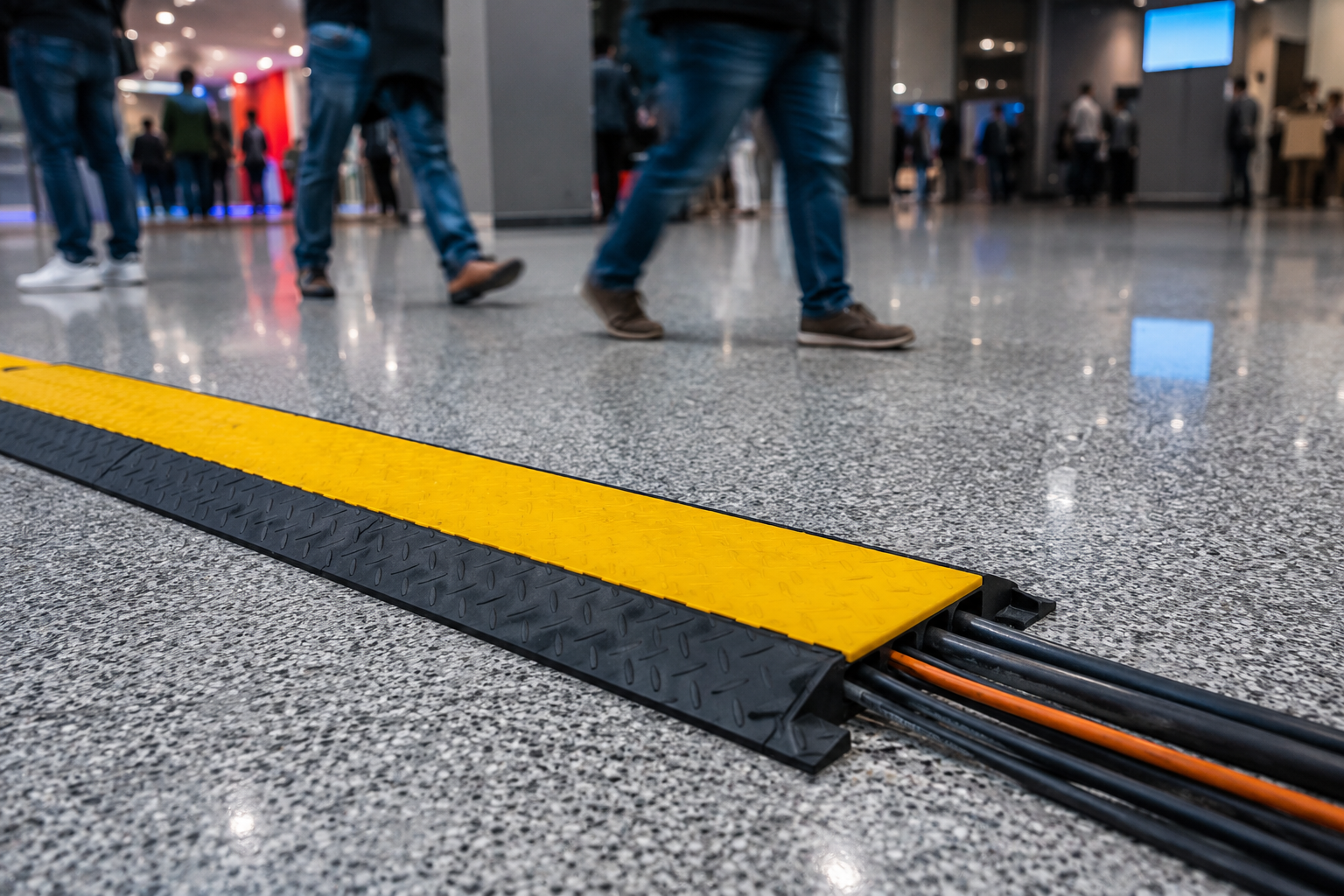
When thousands of people walk through the same venue, small hazards can become serious problems. A cable stretched across a busy walkway might seem harmless during setup, but add crowds, luggage, cleaning equipment and rushed staff, and the risk changes quickly.
That was the situation at a busy UK events venue. Temporary power and data cables were needed for exhibitions, presentations and live equipment, but some routes crossed areas used heavily by visitors and contractors. The cables weren't necessarily poorly installed; the problem was that the venue had to manage changing layouts without creating unnecessary obstacles.
The operations team decided to rethink its approach. Instead of treating cable protection as something to sort out during setup, it became part of the event planning process. Where cables had to cross pedestrian routes, an ADA cable protection ramp was introduced as part of a more structured cable management system.
The results weren't dramatic in appearance. That was precisely the point.
The Problem Behind the Cables
Event venues are constantly changing.
One week, a hall may host a trade exhibition. The next, it could be used for a conference, concert or corporate function. Each event brings different lighting, audio, display and power requirements.
Temporary cables often have to follow routes that weren't designed into the building's permanent electrical infrastructure.
The venue's team noticed that cable crossings were becoming a recurring concern. Staff had to place warning signs, redirect foot traffic and check cable routes repeatedly during busy periods.
There was no single major failure. Instead, there were lots of small warning signs.
Experienced venue managers know that those small issues are worth addressing before an incident forces the conversation.
Planning Cable Routes Before the Event
The first change was simple: cable routes were reviewed before equipment arrived.
The team identified entrances, corridors, service areas and other locations where pedestrian traffic would be highest. Where possible, cables were routed around walkways instead of directly across them.
But rerouting isn't always realistic.
Some equipment needs to sit in a particular location, and temporary power or data connections may have limited options. Where a cable crossing couldn't be avoided, the team introduced suitable protection.
An ADA cable protection ramp helped create a defined crossing point while covering the cables underneath.
Rather than leaving cables exposed or relying solely on tape, the venue could use a consistent protection method in areas where people and equipment needed to pass.
Protecting People and Equipment
The obvious benefit of cable protection is reducing the risk of trips, but that's only part of the story.
Event venues also have trolleys, flight cases, cleaning machines and other wheeled equipment moving around. A cable lying directly on a floor can be exposed to repeated pressure and movement.
A suitable cable ramp can provide physical protection against much of that everyday traffic, helping reduce the chance of cables being crushed or damaged.
That matters during live events. A damaged cable isn't simply a maintenance issue if it supplies power or connectivity to equipment that an audience is relying on.
Making Safety Easier for Staff
The venue also discovered that consistency made inspections easier.
Previously, different contractors had used different methods to secure temporary cables. One might tape a cable down, while another might position it against a wall or use a basic cover.
The new approach created a clearer expectation.
If a cable had to cross a pedestrian route, it needed to be properly protected and positioned. Staff could identify unsuitable installations during their pre-event checks without having to debate whether a particular arrangement was acceptable.
Good procedures often work this way. They make the right decision easier to recognise.
What UK Venues Should Consider
Cable management isn't just relevant to large arenas. Conference centres, hotels, schools, theatres, exhibition halls and temporary event spaces can all face similar challenges.
Before an event begins, teams should consider:
-
Where the busiest pedestrian routes will be
-
Which cables need to cross those routes
-
Whether cables can be rerouted
-
The expected pedestrian and wheeled traffic
-
Cable size and configuration
-
Indoor or outdoor conditions
-
Whether the protection system provides suitable visibility
-
How cable routes will be inspected during the event
The choice of protection should always match the application. A product suitable for light pedestrian traffic may not be appropriate where heavy equipment or vehicles are expected.
Conclusion
The UK venue's experience shows that effective cable management doesn't always require major infrastructure changes. Sometimes the biggest improvement comes from changing how temporary installations are planned.
By identifying cable crossings early, rerouting where possible and using appropriate protection such as an ADA cable protection ramp where crossings were unavoidable, the venue created a more consistent and controlled environment.
The practical takeaway is straightforward: don't wait until visitors arrive to discover where cables might become a problem. Walk the venue during setup, look at the routes from a visitor's perspective, and protect every unavoidable crossing properly.
Good cable management should be almost invisible when it works well. People should notice the event—not the hazards underneath it.
FAQs
What is an ADA cable protection ramp used for?
It is used to cover and protect cables where they need to cross areas used by pedestrians or other traffic. The specific ramp should be selected according to the application, cable dimensions and expected loading.
Can cable ramps completely eliminate trip hazards?
No product should be treated as a substitute for proper planning. Ramps can help create safer, more controlled crossings, but cable routing, installation and inspection remain important.
Are cable protection ramps useful for temporary events?
Yes. They can be particularly useful for exhibitions, conferences, concerts and other events where temporary electrical and data cables are required across busy areas.

 English
 Arabic
 French
 Spanish
 Portuguese
 Turkish
 Dutch
Dutch
 Italiano
 Russian
 Romaian
 Portuguese (Brazil)
 Greek
Greek